
Wednesday, June 18, 2025
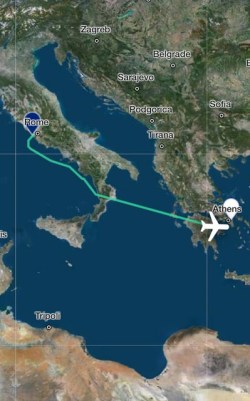
Our morning started extremely early because we had a 9:30 flight to Athens, and it would take a little while to get to the airport. Tauck provided a transfer to the airport as part of our tour, and we assumed that we would eat breakfast at the airport or on the flight to Athens. However, when we checked out, bags with breakfast items were waiting for us at the hotel desk. This was very generous to the point where we weren’t sure what to do with all the food!
A car came to pick us up as planned. Since it is a weekday, we had to deal with the expected commute traffic, although it was somewhat anti-commute from the city center to the airport.
With arrival at the airport, the Tauck “A Week in…Venice, Florence, and Rome” tour was complete, and the second part of our trip, the cruise, was about to begin. The Tauck tour was a great introduction to Italy for Kenna and a re-introduction for me, and was as close to perfect as one can imagine. Our tour director, Alexa, played a significant role in that.
After checking in at the Aegean Airlines desk in Rome, we proceeded through security. As frequent fliers, we have become accustomed to using airport lounges. We did get the use of an airport lounge, but it was somewhat crowded and small, though we didn’t have a long wait for our flight.
The flight itself was uneventful except for the scenery visible through the window. I had checked the options for getting to the city from the airport upon arrival in Athens, and my experience has been that trains are faster and more convenient than buses, so we decided to take the train (Athens subway extension) even though it is somewhat more expensive. This was not a great decision. Even at the airport, we had to lug our bags up flights of stairs to the train platform and figure out the protocol to get a ticket. Once inside the paid area, there were more stairs. We got on a train quickly, but as we rode into Athens, we picked up more and more passengers until the train was overcrowded toward the end of our trip. We made it off, but faced many more stairs getting to street level. Our friends Dave and Jan, who are joining us on this portion of the tour, arrived a couple of hours after us, so I quickly texted Dave to tell him to take the bus instead.
We checked into our hotel, the Athens Capital Hotel, again a 5-star luxury hotel. We had some free time, so we wandered around the area a bit. Our hotel is exactly in the center of Athens, and across the street from the parliament building, where we were able to see the hourly changing of the guards.
Mid-trip is the optimal time to do laundry, and Kenna had done some research into laundries in Athens that we might take our dirty clothes to. She found Athens Laundry about a 15-minute walk from our hotel. Our walk there gave us exposure to some different parts of Athens. Close to the laundry, the storefronts were heavily graffiti-decorated, but artistically so. The clerk at the laundry spoke perfect English and promised our laundry would be ready in the early evening, but we agreed to pick it up the next morning instead.
During the afternoon, we visited the hotel lobby to find the representative from Lindblad/National Geographic setting up a table to greet guests. We had booked an optional pre-cruise tour of Athens and checked in for that. Our first meeting as a group would be for lunch the next day.
Dave and Jan had made reservations for the four of us at Soil, a two-Michelin-star restaurant, a moderate walk from our hotel. They had made arrangements to meet someone else just before our dinner reservation, so we met them at the restaurant. As expected, our dinner at Soil consisted of a tasting menu featuring many small courses, laboriously prepared and beautifully presented. This was a “very special occasion” sort of dinner. We walked back to the hotel with Dave and Jan well-satisfied from our delicious meal.
This article is part of a series about our recent trip to Italy, Greece, Albania, and Croatia. To see the introductory article in the series, click here.
Tuesday, June 17, 2025
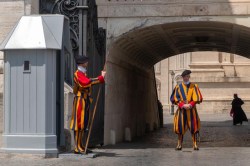
We had an early start today as we set out for one of the highlights of our Italy tour, the Vatican. Of course, this isn’t Italy; Vatican City is a separate nation, located within Rome, with the Pope as its head of state.
Our first stop was the Vatican Museum. We had a wait to enter, but the wait for our tour was nothing like that for those without reservations. As expected, it was pretty crowded.
Our tour began outside, where we viewed exhibits of art from the Sistine Chapel, which were explained to us by our local guide. Michelangelo didn’t consider himself a painter, but one doesn’t say no to the Pope, and he accepted the commission to create the artwork for the ceiling and the wall over the altar of the Chapel. Our guide went through the various pictures on the ceiling, because, as we would find out later, there was no way we could have had it explained to us while actually in the Chapel.
The Vatican Museum displayed additional artwork that is part of its collection. As elsewhere, every possible surface was an artistic masterpiece. Particularly notable were some of the paintings on the ceiling that appeared to be three-dimensional, but were instead expertly shaded flat paintings.
We then entered the Sistine Chapel, which was “wall to wall” people. We had several minutes to admire the artwork, and then met our tour guide at the exit to continue the guided tour.
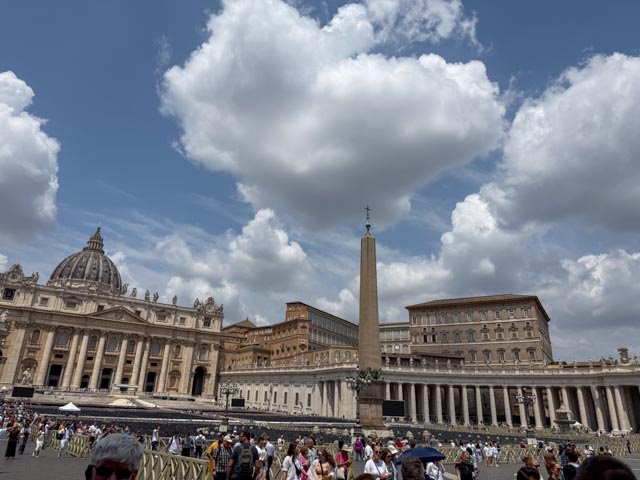
Our next stop was St. Peter’s Basilica. We entered twice: once through the center door and then through the Holy Door that is open only because it is a jubilee year. Jubilee years occur only every 25 years and hold special significance for Catholics, especially when they make a pilgrimage to the Vatican and walk through the Holy Door that is only open during the Jubilee. This also accounts for some additional crowding throughout.
After a few minutes for souvenir shopping, we re-boarded our bus and returned to the hotel. We had the afternoon to do as we wished, so we grabbed a quick lunch and then walked to a few of Rome’s classic tourist attractions: the Spanish Steps, Trevi Fountain, and the Pantheon. All were a quite reasonable walk from our hotel.
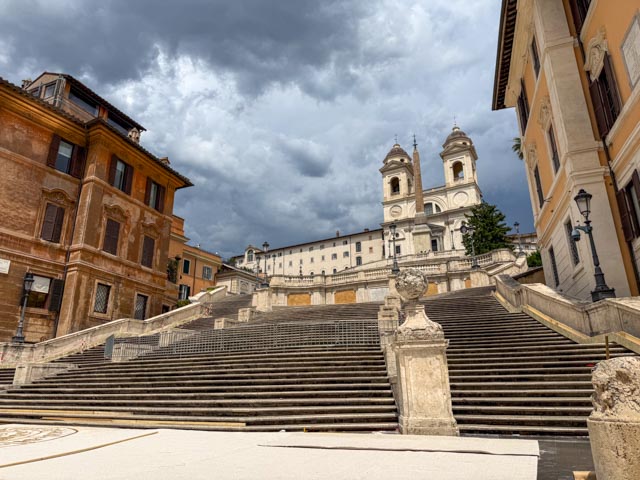
When we got to the Steps, we saw a rare sight: they were empty. It turned out they were closed with police tape keeping people out. We found out later that someone had attempted to drive their car down the Steps and got stuck. The car wasn’t evident, but they were still cleaning up the area. There was also a lot of lighting equipment at the bottom of the steps, as though perhaps a movie was about to be filmed, but we never found out about that.
We continued to the Trevi Fountain and took a look at it, but the crowds afforded no opportunity to throw coins in the fountain unless we were willing to wait in a long line. We didn’t feel a strong need to throw coins, so we continued to the Pantheon. Again, there were long lines at the Pantheon, so we decided to admire it from the outside and then return to our hotel via the bank of the Tiber River.
Our farewell dinner was this evening, and we had a last opportunity to chat with our new acquaintances from the tour. Our tour director, Alexa, polled everyone to see who was willing to share contact information; nearly everyone was. Alexa will also follow up with movie recommendations and other interesting information after the tour.
This article is part of a series about our recent trip to Italy, Greece, Albania, and Croatia. To see the introductory article in the series, click here.

Monday, June 16, 2025
This morning we again boarded a train for our final destination of our Italian tour, Rome. The trains again proved to be very popular in Italy.
A bus picked up our tour group at the train station and took us on a driving tour of Rome. At one point, we got off the bus and walked a couple of blocks to a restaurant for a delicious lasagne lunch. Then we got back on the bus and drove to the Coliseum, where we disembarked. Our local guide then led us on a walking tour around the Coliseum. She discussed the structure of the Coliseum, the types of events held there (not just the persecution of Christians), and its underground facilities for quick scene changes. It was a very technologically advanced area for its time.
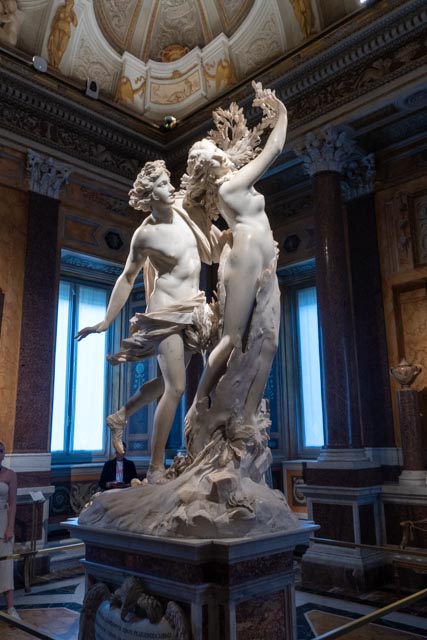
Following our walking tour, our rooms were ready, so we drove to our hotel, the Palazzo Ripetta. Like the other hotels on this trip, it is a luxury hotel located in a very convenient and safe part of the city. After checking into the hotel and getting settled, we boarded our bus for a private tour of the Galleria Borghese, an art museum renowned for its sculptures by Bernini. Both Kenna and I were amazed by the detail and realism of the sculptures, especially considering that they were carved out of marble.
After the tour, we went to a nearby pizza restaurant recommended by Alexa, met up with another couple from our tour, and had a delightful dinner to close our first day in Rome.
This article is part of a series about our recent trip to Italy, Greece, Albania, and Croatia. To see the introductory article in the series, click here.
Sunday, June 15, 2025
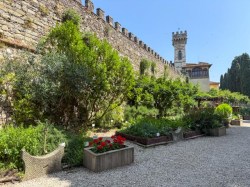
Today we took a bus ride to the Tuscan countryside to visit a Chianti winery. This was a lovely change of pace because of the crowds in Venice and Florence and the very warm weather. We began by driving south into the hills surrounding Florence, which provided a nice overview of the city.

After driving for a bit, our tour director, Alexa, announced that we would be making an extra stop at the Florence American Cemetery. While this wasn’t on our itinerary, she had cleared it with Tauck, and everyone on the bus was interested in stopping there. The cemetery is the resting place for 4,392 American soldiers in World War II whose families chose to have them buried in Italy rather than repatriated to the US. As with other military cemeteries we have seen, it was a very moving tribute, and immaculately maintained.

We continued to a winery in the little village of Passignano. The winery is attached to an abbey called the Badia di Passignano. The tour itself was typical of winery tours, at least for those of us from California. The primary wine they produce is Chianti Classico, a specific local appellation.
Following the tour, we were treated to a wine tasting and gourmet lunch in the adjacent restaurant. The wine was quite different from the typical, inexpensive Chianti often found in Italian restaurants in the US. It has a very smooth taste, and like good wines, the alcohol wasn’t the primary flavor. A trademarked black rooster logo designates Chianti Classico. I will probably be looking for it at the wine store since it was too heavy for us to carry around.

We had a little free time following our return to Florence, and decided to go looking for a campanile to get some views of the city. We got a little lost and ended up at the Cappelle Medici, which houses the tombs of the Medici rulers. We were impressed by the building and artwork.
While walking back to our hotel, we heard the distant music of the calico storico parade. We followed the sound to the parade street and saw more of the teams’ supporters and festivities.
As part of the tour, we had the option to have a “fancy dinner” on one of our days in Florence. We opted for the third day because it seemed to have the most time available, although we were a little concerned about being too full after our gourmet lunch. The dinner was indeed very nice. We were at an outdoor seating area on a square facing the Palazzo Vecchio, and were told we could order anything on the menu. My pasta course included lobster, which was a real treat.
This article is part of a series about our recent trip to Italy, Greece, Albania, and Croatia. To see the introductory article in the series, click here.

Saturday, June 14, 2025
Following breakfast at our hotel, we met up with our local guide and were taken on a tour of the Uffizi Gallery, a large museum with an enormous collection of art, including some well-known classics such as Botticelli’s The Birth of Venus.
Following our tour, we walked the Ponte Vecchio bridge across the Arno River. A walking bridge, Ponte Vecchio also supports the enclosed walkway used by the Medici rulers to travel between their palaces safely. Today, it is a bustling and touristy commercial district, lined with stores selling jewelry and souvenirs.

Once across the bridge, we made our way to Palazzo Pitti, the newer of the Medici palaces. The palazzo is now a museum, and we were hoping to see the extensive formal gardens behind it. But unfortunately, the gardens were accessible only with admission to the museum, which we weren’t inclined to do.
After a bit of wandering around on that side of the Arno, we crossed back on the Ponte Vecchio and had a late lunch near the Uffizi. We then went to the Galileo Museum, which highlighted the many Italian contributions to a wide range of scientific fields.
We returned to our hotel to relax for a bit, and started to hear thumping noises suggesting perhaps a band playing outside. So we went out and followed the sound, only to encounter a parade of musicians and others in medieval dress marching in the direction of the calcio storico field. Apparently, the games are accompanied by a good deal of pageantry as well, with each of the teams and their supporters identified by their team colors. The prize for winning the tournament is a cow, and we also got to see the cow as it walked past us down the street. The parade was a lot of fun, and the costumes were gorgeous.


Our evening activity was a private tour of the Duomo museum led by our local guide. The Duomo is the cathedral in the center of Florence, and the museum displays and protects significant artifacts such as the doors to the baptistry (the ones on the actual baptistry are replicas). One thing that struck me was the intentional distortion of the proportions of some statues that are intended to be viewed from a much lower perspective. Their features are exaggerated vertically so that they look normal when viewed as intended. Michelangelo also exaggerated the features of David, which was originally meant to be placed atop the Duomo.
After the museum tour, we grabbed a very informal late dinner by stopping by one of the many All’Antico Vinaio sandwich shops. They feature a large variety of enormous sandwiches on focaccia bread. Kenna and I ordered one cut in half to share. It was delicious and about the right amount of food.
This article is part of a series about our recent trip to Italy, Greece, Albania, and Croatia. To see the introductory article in the series, click here.

Friday, June 13, 2025
Today was the first of the intercity train journeys of the Italy tour. Our Tauck tour arranged for us to ride one of Italy’s high-speed trains from Venice to Florence. But getting to the train was much of the fun: first we boarded a water taxi to take us to our bus, then the bus to the train station.
The train station was quite busy. Alexa explained that train travel is very popular in Italy, partly due to the country’s size and shape. The train was clean, modern, and indeed fast, traveling at about 150 miles per hour. Our route featured a diverse range of scenery, from the coastal plain through farmland, followed by a mountainous stretch that included several tunnels.
On arrival in Florence, we boarded another small bus and rode to our hotel, the Hotel Bernini Palace. We arrived in the late morning, so we began with a short introduction to art history in Florence from a local guide, followed by lunch. We then set out on a walking tour of Florence, which is a very compact and walkable city. Our tour took us to one of the highlights of Florence, the Galleria dell’Accademia, where we had the opportunity to see Michelangelo’s David, a true highlight of our tour. Even from the far end of the room in which it is displayed, David has an amazing presence and detail that shows him sizing up Goliath before taking him down.
In the evening, we walked around a bit more, hoping to visit the Basilica of Santa Croce, where Michelangelo and Galileo are buried. However, the area was closed off for the annual Calcio Storico Fiorentino tournament. Our guide explained that this is a soccer- or rugby-like game with very few rules other than “no weapons”. The tournament is a competition between different Florence neighborhoods.
This article is part of a series about our recent trip to Italy, Greece, Albania, and Croatia. To see the introductory article in the series, click here.
Thursday, June 12, 2025
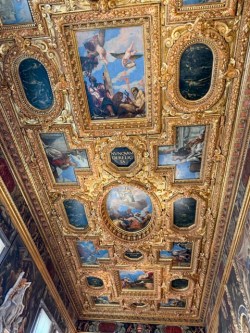
We began the day with another excellent breakfast and then set out to explore some of Venice’s highlights. Alexa had arranged for a private boat to St. Mark’s Square, where we met with the first of our local tour guide. The guide first took us to the Doge’s Palace, once the seat of power for the very influential Venetian Republic. There were various elaborately decorated rooms, many of which were used for meetings and negotiations with official foreign visitors. We also got to cross the famous Bridge of Sighs to the former prison across a small canal.
We then went next door to St. Mark’s Basilica for a tour. This famous church was originally the Doge’s private chapel. Its interior features a great deal of mosaic artwork, with some of the materials stripped from Constantinople in the Crusades.

We finished the morning with a ride on a traditional Venetian gondola. Each party in the group was given its own gondola, so Kenna and I had one to ourselves (plus the gondolier, of course). The gondoliers don’t sing anymore, so Tauck arranged for a few musicians to join a couple of the gondolas in our group to serenade us as we circulated through several of the nearby canals.

An optional visit to a demonstration of the famous Murano glass blowing followed the gondola ride. It was optional because it was a commercial operation, and they didn’t want anyone to feel obligated to make a purchase. However, we opted in and gained an understanding of how the Venetian glass artisans work. There was little pressure to buy anything, but we decided to buy a Christmas tree ornament anyway.
The afternoon was set aside for us to do as we pleased. We got some pizza at a nearby cafe, and then browsed some of the shops before the “obligatory” (for me) afternoon gelato, especially since it was a rather warm day. After stopping by the hotel for a bit to relax and clean up, we went to one of the small restaurants on the edge of Giudecca Island for dinner, followed by a stroll across Giudecca’s canals into some residential parts of the island. Since transportation in Venice is primarily by boat (cars and even bicycles are prohibited), we walked past many parked boats belonging to the residents.
This article is part of a series about our recent trip to Italy, Greece, Albania, and Croatia. To see the introductory article in the series, click here.
Wednesday, June 11, 2025
We treated ourselves to a bit of extra sleep this morning, but not too much so that we could adjust to the nine-hour time change. The hotel buffet breakfast was terrific — many familiar choices and some local items as well.
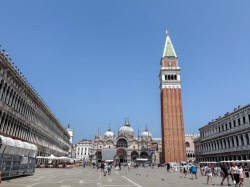
Since we arrived a day early for our tour, we were on our own until late in the afternoon. We took the shuttle boat from the hotel to St. Mark’s Square and noticed that there was only a short line for the campanile tower. The view from the tower was a great introduction to Venice. We got our bearings by looking out in all directions from the tower, and also noticed a plaque stating that Galileo had conducted some of his experiments from the tower. So many things in Europe are far older than anything we have at home.

After the campanile, we decided to walk to the famous Rialto Bridge across the Grand Canal. The bridge was, as usual, jammed with tourists like ourselves, as well as with the shops that line either side of the bridge. It was good to see, but too crowded to really enjoy, so we continued to the Basilica of the Frari, one of the many churches with notable Renaissance artwork. We then retraced our steps to St. Mark’s Square, stopping to share a quick pizza for lunch at one of the many small squares along the way.
After resolving a bit of confusion about shuttle schedules and where to board the return shuttle, we returned to the Hilton on Giudecca Island. We spent a little while relaxing and getting cleaned up, and then set out for the initial meeting with our Tauck tour group. In the hotel lobby, we found another member of the tour who appeared to be lost, and together we found the tour leader, Alexa, who checked us in for the tour. Additional members of our 17-member tour appeared, ranging in age from a young couple to several retirees, mostly in their 60s and 70s. One of the retirees brought his grandson and granddaughter, who had just graduated from high school, and another brought her granddaughter, who had just graduated from college.
Alexa introduced herself to the group. She is a native of Rome who has lived in Venice for about 10 years. She has excellent English, which we later learned was partly due to her experience working as a cast member at Disney World (she is a “friend of” Snow White) for a couple of years. She also distributed “whisper devices,” which are wireless receivers used by groups to hear their leaders when out on a tour without bothering others nearby.
After a while, we went to the hotel’s rooftop bar for drinks and hors d’oeuvres to get to know each other, followed by dinner.
This article is part of a series about our recent trip to Italy, Greece, Albania, and Croatia. To see the introductory article in the series, click here.

Monday-Tuesday, June 9-10, 2025
As I have done in the past, I am blogging a summary of our recent vacation trip. I will post daily installments offset by five weeks to allow time for editing and review after we return home.
Our “Adriatic trip” is actually shorthand for two trips stitched together. We had planned a cruise from Athens to Split, Croatia, with our friends Dave and Jan from the Kimberley trip last year. But since the cruise is only a little longer than a week, we looked for something either before or after. Dave and Jan found a NatHab trip to Croatia and Slovenia, but that trip was full, so we weren’t able to join them. Instead, we found a week-long tour visiting Venice, Florence, and Rome through Tauck Tours. The Italian trip was a good fit for us since Kenna hadn’t been to Italy previously, and I had only visited a small part of northern Italy in 1986 and on an earlier European tour when he was in high school.
Our travel agent gifted us an additional day at the hotel in Venice, allowing us to arrive a day early to acclimate to the time change and minimize the chances of disruption in case of any flight delays. We opted for a long layover in Frankfurt (7 hours) to further reduce the risk of missing a connecting flight. Access to the Lufthansa airline lounges made the layover quite bearable.
Upon arrival at the Venice airport, we were met by a representative of Tauck, who helped us with our luggage. One of the unique features of the Venice Airport, located on the mainland, is that it has a water taxi station to transport people to the islands of Venice. The Tauck representative walked us there and then rode the water taxi with us to our hotel, the Hilton Molino Stucky, and ensured we were checked in properly.

It was early evening at that point, and we had been well fed on the plane, so we took a walk. The hotel is across a channel from the central part of Venice on Giudecca Island. We walked down the north shore of the island almost to the end and back, passing many cafes and small restaurants along the water, getting glimpses of the main part of Venice across the water. Having gotten that exercise, we returned to the hotel, stopped at the hotel lobby bar for a drink and a snack, and crashed for the night.

In October 2023, my wife emerged from the bathroom one morning to report that we had no hot water. I found that our gas-fired, on-demand water heater had failed and was leaking a small amount. I called our plumber, who confirmed we needed a new water heater.
We immediately faced the following decision: Should we replace our water heater with a similar gas-fired on-demand unit or change to an electric heat pump water heater? We have been hearing a great deal about the efficiency and ecological benefits of heat pump water heaters, and on-demand gas units like the one we had are said to emit considerably more carbon than even gas-fired tank units.
Placement for a heat pump water heater would be a challenge. The water heater had been located in the attic, and the heat pump water heater was somewhat taller than even the gas-fired tank unit that was installed at the time we bought the house. That meant it could not fit in the attic and would need to be installed in the garage. We found a reasonable location, although we would lose storage space in the garage. It also meant that the loop for our hot water recirculating system needed to be extended down to the garage, making the loop longer.
The plumber said that he could replace the on-demand gas unit with a similar one in a couple of days, but it would take a week or so to obtain a heat pump unit, which would also cost considerably more. We had to make a snap decision because we didn’t want to be without hot water any longer than necessary. Wanting to be good ecological citizens, we opted for the heat pump unit despite the cost, complexity, and delay in installation.
As promised, the plumber obtained the heat pump water heater, an American Standard 50-gallon unit (model ASHPWH-50). Installation took about two days and involved running a considerable amount of pipe from the old location in the attic to the new location in the garage, installing a new 30-ampere 220-volt electrical circuit at the heater, and bracing against earthquakes. The installation went well, except a defective water leak sensor had to be bypassed.
First Impressions
The first thing I noticed about the new water heater was its significant noise. The specification sheet listed it as emitting 40.1 dBA, which is about the same as a refrigerator’s (and also an implausibly specific value). However, the water heater was much louder than this.
The on-demand water heater spoiled us: we never ran out of hot water. We soon found that not to be the case with the new water heater, and I turned the water volume for my showers much lower than before. Perhaps scarcity is a good thing.
The new water heater is a “hybrid” unit with a heat pump and also a conventional heating element. It has several modes:
- Green (heat pump only)
- Comfort (“rational use of the heat pump and, if necessary, the heating element”)
- Fast (heat pump + heating element)
- i-Memory (“learns your habits and replicates them autonomously”)
- Electric (heating element only)
There’s also a Boost mode, which is like Fast, but reverts to the previous mode when it gets up to temperature. Initially, it was set for Comfort, but I couldn’t understand when it was and wasn’t running the heating element. I asked product support and the installer, but I still couldn’t make sense of Comfort mode, so we changed to Green. I manually turn on the Boost feature when we need extra hot water.
The noise issue
The noise generated by the water heater was bothersome, especially since it was noticeable in my office adjacent to the garage. I downloaded a sound level measurement app on my phone. I sent a video to American Standard (actually Ariston) product support. They told me I had not measured it under the right conditions. Of course, my garage is not an anechoic chamber.
I consulted “the internet” and found conflicting answers about the noise generated by heat pump water heaters. Some comments described them as very noisy, and others found them quite acceptable. I tried to find others locally with similar water heaters for comparison and failed. In late 2024, the behavior of the water heater changed: sometimes it had a loud “whirr,” and sometimes it didn’t. This prompted me to make several recordings of the sound (and analyze it with a spectrum analyzer app) and determine that much of the excess noise was coming from the fan in the heat pump. I again contacted product support, and they agreed to ship me a replacement fan. My plumber replaced it, and the noise is much better now.
The app
Like many new devices, the water heater connects to the internet through my WiFi and, through a cloud service, allows an app on my phone to control and monitor it. The app, called Comfort Link, is acceptable but less than excellent.
Good:
- Allows me to remotely control the water heater, including turning on Boost mode when needed and turning off the water heater when we’re on vacation
- Displays the water heater temperature so I can judge whether to take a shower
- Shows the history of power usage by the water heater by month, day, and hour
Not so good:
- The water heater has an icon that appears when it judges when it’s OK to shower. This isn’t on the app, but it would be very useful.
- The water heater temperature shown on the app doesn’t agree with that shown on the water heater. The support people explained that the water heater has several temperature sensors, and the app displays (I think) the average between the tank top and tank bottom temperature. But that doesn’t explain why the front panel displays something different.
- Limited history of power usage data (e.g., daily data for only the current and previous month)
- Poor resolution of power usage data. Measurements seem only to be taken only once per hour, so the heating element usage is reported in 4.5 kWh increments and the heat pump in 0.5 kWh increments.
- There seems to be no API to download data other than through the app.
Efficiency
The heat pump is indeed more efficient than the electric heating element. This is suggested by the usage graph, where the orange bars represent energy usage from the heating element:

But of course, the days we used the heating element are also days where I turned on Boost mode because we were using more hot water, which exaggerates the difference. I measured the tank temperature over time as it heated up:
- Heating element (4.5 kW): temperature rise 68.9°F/hr = 15.3°F/kWh
- Heat pump (0.45 kW): temperature rise 17.3°F/hr = 38.7°F/kWh (77°F ambient)
- Heat pump (0.45 kW): temperature rise 11.9°F/hr = 26.5°F/kWh (61°F ambient)
- Heat pump (0.45 kW): temperature rise 11.4°F/hr = 25.3°F/kWh (57°F ambient)
As expected, the heat pump’s efficiency depends on the ambient temperature, which determines the amount of heat the heat pump can “harvest” from the air. Compared with the heating element, the heat pump’s overall efficiency ranges from a factor of 1.65 to 2.53.
Operating cost
The heat pump water heater is efficient, but is it more cost-effective than our previous gas water heater? As noted above, it isn’t possible to make an exact comparison because we don’t know how our usage may have changed. If we make the worst-case assumption that our usage hasn’t changed, we are now using an average of about 5.3 kWh per day (153 kWh/month divided by 29 days). At an off-peak rate of $0.44/kWh, that works out to $2.33/day. Counting only those days where we used only the heat pump, that’s about 4 kWh/day or $1.76/day. Before getting the new water heater, our gas usage was about 8 therms/month, virtually all of which was for hot water. At our current rate of about $2.50/therm, that works out to $20/month or $0.67/day.
As our plumber had hinted when we installed the new water heater, gas is relatively inexpensive compared to electricity at current prices (unless you’re generating your own electricity). While an electric heat pump water heater is efficient and ecologically responsible, don’t expect it to save you money at current rates.
 Altmode