
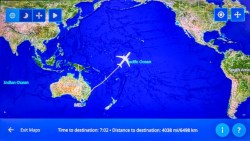
Wednesday, June 12, 2024
This being our last day in Perth, we had a leisurely start, although that was limited by the need to check out of our hotel room on time. We had breakfast in the hotel, finished packing, and checked our bags for the day at the front desk.

We began with a visit to the WA Museum Boola Bardip (Boola Bardip means Many Stories in the local indigenous language), which is located in an area designated as Perth’s cultural center, with theaters and performance venues as well as the Western Australia library and archives. The extensive museum has exhibit halls dedicated to wildlife, cultural, and historical themes. The exhibits, many of them interactive, were well-designed and informative.
It was lunchtime after that, and Kenna remembered a “healthy burgers” chain, Grill’d, that we tried and liked during last spring’s trip to Brisbane. We split a lamb burger, which was a nice change of pace.
We stopped by the Perth Town Hall but couldn’t see much because of an event. The Town Hall is the second-oldest building in Perth, so the receptionist suggested we check out the oldest building, the Old Court House Law Museum. The main room of the building was a small courtroom set up as it would have been in Perth’s early days. The museum also had several exhibits about the evolution of laws applied to Aboriginal people and women, which showed how much things have changed since the beginning of the 20th century and how far we still need to go.

We continued on to the Perth Mint, where we took a short self-guided tour that explained the Mint’s history and how it related to the Australian gold mining industry. It was fun talking with one of the “coin geeks” there. Today, I learned that successive British monarchs face opposite directions when depicted on coins. Queen Elizabeth II faces right, but King Charles faces to the left when he appears on Australian coins.
We then went to Elizabeth Quay for a break and a small snack and watched our final Perth sunset of the trip from there. We walked back to the hotel, collected our bags, and took a taxi to the airport. Unfortunately, we arrived about an hour before check-in opened, but we waited that out, passed through security, and caught our 11:45 flight to Melbourne. After a short layover we caught a nonstop to San Francisco, a 13-hour flight but a comfortable one. It was good to get home, early on June 13. Now for the challenge of staying awake, to get onto California time!
This article is the final installment in a series about our recent trip to Indonesia and Australia. To see the introductory article in the series, click here.
Tuesday, June 11, 2024
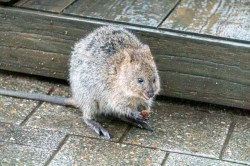
We have heard a lot about Rottnest Island, which is just off the coast of Perth. Rottnest (“Rotto” to the locals) is a recreational island with cabins for rent, several beaches with snorkeling (in the summer), restaurants, a golf course, skydiving, and more. It is also the home of about 10,000 quokkas. Quokkas are small marsupials billed as “the happiest animals on earth.”
We booked a round trip on the Rottnest Express last night, so we got an early start this morning and grabbed coffee and a breakfast wrap on the way to the pier. We got seats upstairs for both the view and the airflow. The trip started slow (about 10 knots) as we left the pier, increased to about twice that once we reached a broad section of the Swan River, and slowed again as we approached Fremantle. We stopped, picked up more passengers there, and then proceeded to Rottnest Island at a higher speed.
Although we had been equipped with a map, we weren’t sure where to go when we got to Rottnest. We stumbled on the main village and were heading out when we noticed some rain starting to fall. We returned to the village to get some snacks, and the sky opened up: it poured! We were thankful to be in the village as there weren’t a lot of other places to get out of the rain. While there, we noticed our first quokka and gates on the grocery entrance and other businesses designed to keep quokkas out.
Despite a lot of public education not to feed the quokkas, many of them hang out in the village to eat up the crumbs and other droppage from human diners. They are indeed cute, but the “always smiling” thing seemed a little overstated. They can be a little aggressive, too: when Kenna and I shared a chicken sandwich for lunch, a quokka climbed on the bench between us and tried to get to the sandwich. We moved rather quickly.

The rain continued off and on, limiting our ability to venture beyond the village until we boarded a bus for a “discovery” tour we had booked for the afternoon. The tour took us around the perimeter of the island, with excellent descriptive commentary from a guide on the bus. We stopped at several points to take pictures, most notably at the far west end facing the vast Indian Ocean, where there was also a large osprey nest.
Following our tour, we stopped briefly to pick up souvenirs (a t-shirt for me), and it was time for our return trip to Perth. Along the way, in one of the slower-speed segments, a couple of hydrofoil surfers managed to “draft” off our ship, keeping up for quite a long time. We were also tailed briefly by a few dolphins.
Returning to our hotel, we were exhausted but managed to venture out for a quick pizza dinner.
This article is part of a series about our recent trip to Indonesia and Australia. To see the introductory article in the series, click here.
Monday, June 10, 2024
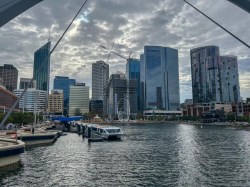
Kenna and I slept in a bit today, then set out into downtown Perth. We grabbed breakfast at one of the many coffee shops. Perth seems to be quite a coffee city, but there are no Starbucks here.
We walked to Elizabeth Quay and the Barrack Street jetty, from which many tour boats originate. We picked up some information on Rottnest Island tours and were surprised when Lee and Colleen, two of our fellow passengers on the Orion, also showed up. We may see them again.
From there, we walked to Kings Park and its botanical garden. We made some wrong turns but eventually found it and discovered it is up quite a hill from downtown and has a great view. The botanical garden is nicely labeled and includes specific sections for areas like the Kimberley. From a distance, we saw Lee and Colleen here too. We could have spent a lot more time here, but we wanted to make it out to Fremantle, so we caught a bus to the train station and a train to Fremantle.

One of our first goals in Fremantle (“Freo” to the locals) was to visit the Indian Ocean for the first time. We went out to a nearby beach and touched the water, which, of course, felt like…water. Soon after that, we ran into a couple of other fellow passengers from the Orion, who had just returned from the Maritime Museum. They told us it was excellent, so we headed over there.
After a quick late lunch in their snack bar, we toured the exhibits. One memorable exhibit for me was Australia II, the Australian winner of the America’s Cup sailing race in 1983. It was a big deal at the time and continues to be a source of pride for Australians.
Fremantle hadn’t initially seemed much like other beach towns (Santa Cruz, Brighton UK, etc.) I have visited. But as we headed more into the city center, we began to see the makings of a beach town: some brewpubs, a game arcade, souvenir shops, etc. It was still somewhat more restrained than many.
Exhausted from several miles of walking, we returned to the train station and rode back to Perth, where we had more walking to do to get to the hotel. We opted to have dinner in the hotel’s pub, which was mediocre and surprisingly closed at 8 p.m. — earlier than most any pub I have seen.
This article is part of a series about our recent trip to Indonesia and Australia. To see the introductory article in the series, click here.
Sunday, June 9, 2024
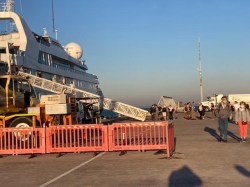
Today started quite early because they needed to get us off the Orion early and prepare it in eight hours for the next cruise. We had our suitcases out for pickup at 7 a.m., ate breakfast, and exited the ship about 7:30. We had to go through Australian customs, which went smoothly for us but resulted in delays for some others, primarily some MDs who had medical supplies with them and one passenger who had bought a wooden oar somewhere along the way.
There were two busloads of passengers going to the airport. Our bus driver polled the passengers about our departure times and then took us on an impromptu bus tour of Darwin. Darwin is a surprisingly modern and clean city, and the driver was rightfully proud of his home town.

We arrived at the airport about three hours before our flight. Unfortunately, we couldn’t check our luggage until 90 minutes before flight time, so we had to wait outside security. There were enough of us there that we were able to use the time to reminisce about the cruise.
When the time came, we obtained our luggage tags and sent our bags down the conveyor. Unlike in the US, we just entered our names and destinations to check our luggage; no ID was required. Similarly, we went through security without showing an ID or our boarding passes, and there was no ID check getting onto the plane. This was very surprising to us!
The flight to Perth was uneventful. When we arrived in Perth, we found the climate to be very different. While it is the dry season in Darwin and the Kimberley coast, it is the wet season in Perth, which has a climate quite similar to the San Francisco Bay Area but shifted by six months. It was rainy and cloudy when we arrived.
When we got off the plane, we were surprised to see Dave’s friend Bruce and his wife waiting for us at the gate! That’s a consequence of not requiring a boarding pass to go through security and was a nice throwback to pre-9/11 practices.
We checked into our hotel, The Melbourne Hotel (yes, located in Perth), and found that we had booked a nicely outfitted but unusual guest room. For example, there was no door to any of the bathroom area; it was open to the bedroom. This is fine, but it takes a little getting used to.
Dave’s friend Bruce had made reservations for a lovely restaurant in North Fremantle,
Bib and Tucker. I had kangaroo for dinner, which had a nice flavor and is a very lean meat (accordingly cooked somewhat rare). Our hosts pointed out that the kangaroo they serve is farmed explicitly for that purpose.
After a very busy day, we said goodbye to Jan and Dave who left for the US that evening and to our hosts. We took the train from North Fremantle back to Perth, where we crashed.
This article is part of a series about our recent trip to Indonesia and Australia. To see the introductory article in the series, click here.
Saturday, June 8, 2024
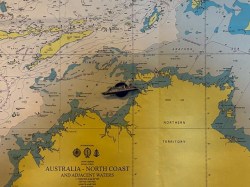
Today is an at-sea day as we cross back over the Joseph Bonaparte Gulf to Darwin, where we will disembark from the Orion tomorrow morning. Again, the seas were rough, but not as much as the outgoing crossing. As with other at-sea days, there were lectures from the naturalists and an information session on future cruises. The day ended with the Captain’s cocktail reception and dinner. The cocktail reception featured a slideshow of photos that passengers had submitted (unfortunately, I misunderstood how to submit mine). There was also an auction of a specially-decorated flag from the ship to benefit the crew welfare fund and of a didgeridoo from Goyma’s family, the proceeds from which went back to his family. Happily, both auctions produced high bids for the beneficiaries.
For dinner, Dave and Jan were kind enough to join us in the COVID dining area for our final dinner on the Orion. It was a particularly good dinner, and we witnessed a beautiful sunset and moonset.

This article is part of a series about our recent trip to Indonesia and Australia. To see the introductory article in the series, click here.

Friday, June 7, 2024
I checked in with Dr. Bob early this morning to remind him that I needed to be checked and cleared to take today’s helicopter flight to Mitchell Falls. He told me that I had been diagnosed too recently and had to be removed from the flight list. I was disappointed. I pointed out that I had been diagnosed at 7:45 a.m. the previous day, and the cutoff time was given as 8:00. But after further consultation, he called back and said I was good to go because the helicopter ride was somewhat after 8:00.

We made a Zodiac boat transfer to a nearby beach. A few minutes later, three helicopters landed on the beach. We met our pilot and were given a safety briefing (tl;dr: STAY AWAY FROM THE SPINNING ROTORS). Dave and Jan were the other passengers on the helicopter with us. I had the left front seat next to the pilot (who sat on the right, as if we were flying on the left side of the sky).
With an open window next to me, the view was, as expected, gorgeous (both in the sense of attractiveness and the presence of gorges). We rode the 30 miles up the Mitchell River to the falls, mostly admiring the terrain as no particular animals were visible.
On arrival, we hiked up a short trail to get several good views of Mitchell Falls. We had enough time to explore the rocky terrain in the area before returning to the helicopter landing area for our trip back to the beach. The return trip was equally awesome.

For lunch, I joined in with others who had also tested COVID-positive and ate separately from others on the observation deck. This precaution was taken because, even though we were eating outside, eating is one of the times when it is easiest to spread the virus. The upper deck was enjoyable and quiet, although we noticed that several people who we knew had tested positive weren’t there.
After lunch, we had an informative lecture and a trip to another native art site. This schedule was coordinated with another (somewhat larger) ship in the area, Le Jacques Cartier, that we had also seen this morning when visiting Mitchell Falls. Unfortunately, the art site wasn’t big enough to accommodate both ships simultaneously, and we went second. The tide was very low when we went, so we had a very long (and delayed) zodiac boat ride to shore. We had to climb shore rocks to get to where the art was, which was slow for some visitors.
There was quite a bit of Indigenous art to look at, but before we could see it all, an urgent call was put out to return to the zodiac boats because the tide had fallen further. We climbed back down the rocks and waded out farther to reach the zodiac boats. We were disappointed not to have enough time to admire the rest of the art.


Today’s delicious dinner was an “Aussie BBQ” with all the trimmings, which I ate with my fellow COVID patients. After dinner, there was a talent show featuring many of the cooks, waiters, and porters from the hotel staff. It was a nice way to introduce them more personally.
This article is part of a series about our recent trip to Indonesia and Australia. To see the introductory article in the series, click here.

Thursday, June 6, 2024
I felt a little stuffy this morning, and given the ship’s COVID outbreak, I decided to get tested. I called Dr. Bob, the ship’s doctor, who came by with a couple of swabs, one for me and one for Kenna. A few minutes later, he called back with the result: I had tested positive, but Kenna was negative. He returned a little while later to check my vitals, listen to my lungs, and deliver Paxlovid, which I had taken on both of my previous COVID cases.
The ship’s protocol for handling this was straightforward: I needed to isolate myself in our room for 24 hours, and Kenna should stay away as much as possible. Breakfast, lunch, and dinner menus appeared on my cabin door. I selected meals, which were delivered to me in the room. Since the cruise ends on Sunday, I will need to wear a mask on the ship for a few days for the rest of the cruise.

Kenna went out to eat with the rest of the ship (specifically with Jan and Dave, whom we had spent time with) and then went on the day’s activities. The morning activity was a ride to see Thor’s Hammer, a tall sandstone rock formation. Kenna’s Zodiac was piloted by Karla, the expedition leader, and paired with Kurt, the geologist, in another Zodiac. Between the two, the group got a good geology lesson with specimens of quartz crystals that Karla borrowed from a rocky outcrop where they stopped.
The afternoon excursion was their best opportunity to see crocodiles as the tide was going out on Porosus Creek. They were still a little early, but after a while finally got a few sightings including a chance to watch a crocodile devour a crab, before having to return to the ship.
There was also a briefing for tomorrow’s helicopter trip. The helicopter company was consulted to see if they would permit masked Covid-positive people on the helicopters, and they said it was OK, provided they were diagnosed before 8 am today (I was diagnosed about 7:45). Whew. I will still need to be checked to see if I’m running a fever (I wasn’t today), so my fingers are crossed that I can go.
My day was mostly spent reading and doing consulting work since I had to stay in the cabin anyway.
In the evening, Kenna was told they had found another place for her to sleep to minimize her exposure. It is a cabin for harbor pilots to use when necessary. We appreciate the creativity of the hotel manager, Fran, in finding this for her. Fran has been amazing through this entire cruise, and this evening brought Kenna a night light to use in the temporary cabin.
This article is part of a series about our recent trip to Indonesia and Australia. To see the introductory article in the series, click here.
Wednesday, June 5, 2024
Today’s breakfast came with an announced request to allow the COVID-infected people to pick up breakfast first, after which they would clean the serving utensils and invite the rest of us for breakfast. We were asked to wash our hands at a sink on the back deck to limit any further spread.
Today’s activities consisted of two outings in Zodiac boats, which we just toured and didn’t land anywhere. The morning cruise was around a few nearby islands and into a mangrove-lined area where we hoped to see some crocodiles. We didn’t see any, but we did see some birds and the stunning local geology, and we were treated to some more stories from Goyma, our indigenous guide, who happened to be on our zodiac boat.
Around lunchtime, I ran into Dr. Bob, our ship physician. He said there was a “trickle” of additional COVID cases but that some had recovered, none of the existing cases were severe, and most patients were taking Paxlovid. This is probably appropriate considering most passengers’ ages (we estimate the median age at 73).
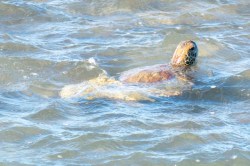
After another ship repositioning, we were off on zodiac boats to Montgomery Reef, a unique reef formation. The reef is just below sea level at high tide but emerges more than several feet above water level, to the delight of birds and other creatures. We saw several turtles in the water and many birds (mostly egrets) on the reef and in the air. During the approximately 90 minutes we were there, the reef went from just emerging from the water to over 10 feet above water level, with very substantial amounts of water draining from the edges of the reef.

As we were leaving, we noticed a zodiac boat flying the Lindblad/National Geographic flag. Sure enough, we pulled up alongside it and were treated to tropical drinks served from a punchbowl before our ride back to the Orion.

Dinner was again outside and comfortable; meals will probably be outside for the rest of the cruise. After dinner, they arranged to shut off the lights in one area of the ship and held a star party. We easily saw the Southern Cross, as expected, but also the Big Dipper, except it was pointing down to Polaris, which was below the horizon.
This article is part of a series about our recent trip to Indonesia and Australia. To see the introductory article in the series, click here.
Tuesday, June 4, 2024
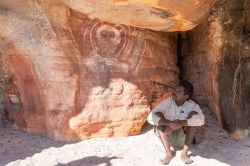
Bigge Island (pronounced “biggie”) is named for someone named Bigge although the island is big. It is the home for some more Gwion Gwion (ancient) and Wandjina (newer) rock art. Starting from the beach where we landed, we took a short hike to the art sites, with narration by our guides, particularly our indigenous guide, Goyma. I practiced some of the photography skills taught by our photo experts at some lectures earlier in the trip, with some success.

After lunch (and some repositioning of the Orion), we landed at a different beach with a few boab trees. This included a huge and notable tree called the Mermaid Tree, around which a low platform had been built to protect its roots, much as has been done around some giant sequoia trees in California.
We then walked further along the trail to where a couple of “parade grounds” built by bower birds were located. The bower bird is very plain-looking, so to impress a potential mate, it creates a straw tunnel and decorates its approach with local materials. These aren’t nests, just ways to attract a mate.

Returning to the ship, we found menus tucked into four doors across the hall, indicating additional COVID cases had been found. Dinner was moved outside to the aft deck, which was very comfortable and pleasant, but a lot of work for the staff since the galley is downstairs, necessitating a lot of shuttling back and forth.
This article is part of a series about our recent trip to Indonesia and Australia. To see the introductory article in the series, click here.
Monday, June 3, 2024
The Orion was repositioned overnight at our next destination on the Kimberley coast. Fortunately, the seas were relatively calm (as compared with the trip to and from Darwin), and we didn’t need to work as hard to walk around.
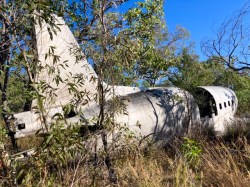
Our morning destination was the site of a World War II plane wreck, a C-53 that had gotten lost on a trip from Perth to Broome. They neglected to bring along a navigator. The plane ran out of fuel, tried to land on a mud flat, and skidded into the forest, losing one of its wings and an engine. Fortunately, they were rescued after several days, and everyone survived. The metal frame and skin of the plane are relatively intact, and we had an opportunity to walk around a bit and examine them.
While in the area, we walked through the woods and saw several things described in our preparatory lectures: a boab tree, a paperbark tree (essential to the Aboriginals for many uses), and a potentially quite old termite hill.
We walked back to the beach across the mud flat, examining large sandstone formations along the way.
The afternoon destination was Jar Island, a nearby island featuring ancient Gwion Gwion indigenous rock art. We were given three options for our short hike: “easy,” “moderate,” and “difficult,” with the more challenging routes giving us more to see. We chose the difficult route, which, other than requiring a little use of hands to ascend and descend some rocks, was not that challenging. The rock art was of uncertain (but very old) age and was painted on the sandstone at the three sites we visited.


Returning to the beach just as the sun was beginning to set, we were surprised by an impromptu beach party (cocktails and music) that the staff had set up. The party was a lot of fun, and we returned to the Orion just as it was getting dark.
Upon our return, our festive mood was quickly dispelled by an announcement from the ship’s doctor that three cases of COVID had been found on board the ship. Masks were distributed (but were voluntary), and arrangements were made to isolate the affected people in their cabins for a minimum of 24 hours and to bring their meals to them. I had noticed someone wearing a mask picking up breakfast early that morning and was suspicious that there was an outbreak on the ship. It soon became evident who the affected people were, as dinner menus appeared in the document holders on their cabin doors. Two of the cabins across the hall from ours were included.
This article is part of a series about our recent trip to Indonesia and Australia. To see the introductory article in the series, click here.
 Altmode