
Saturday, June 28, 2025
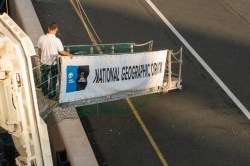
We had to be up early this morning, since our transfer to the airport left at 8 am. We set out our bags to be transferred, had a quick breakfast, and said our goodbyes and thanks to the crew. What little we saw of Split seemed to be a typical city. The bus ride to the airport was relatively slow due to construction on the route, but we had plenty of time before our flight. We flew Croatia Airlines to Rome, with a connection on United to San Francisco. We passed the time before our flight in a lounge at Split Airport, along with a few other cruise guests and two of the photographic experts who accompanied us.
The flight to Rome was short, about 50 minutes, and fairly basic. Once in Rome, we had a considerable amount of walking to do to pass from our arrival gate in the Schengen zone of the terminal through immigration to the international zone. At our departure gate, there was unfortunately little in the way of shops, lounges, or other services.
Unfortunately, Croatia Airlines was unable to issue our onward boarding passes for San Francisco when we were in Split. When our gate opened for the flight, we stood in a short but slow-moving line to receive our boarding passes from the United agent. After identifying ourselves once at the head of the line, the agent said, “We’ve been looking for you.” Nevertheless, it took a considerable time to receive our boarding passes as the agent took phone calls and tended to other duties before completing our transaction.
Once on the plane, we had a typical long-haul flight to SFO, and then home to sleep in our own bed and recover from jet lag.

This is the last article in a series about our recent trip to Italy, Greece, Albania, and Croatia. To see the introductory article in the series, click here.
Friday, June 27, 2025
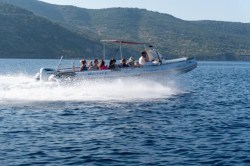
The last full day of our tour brought us to two islands off the coast of Croatia, Vis and Bisevo. The Orion anchored just off the coast of the town of Komiza on Vis. Although there were several activity options for the day, most of us took the option of a tour to Bisevo island. The tour began with an exciting speedboat ride to the island, complete with rock music soundtrack, which we enjoyed greatly but some on our tour felt was excessive. Upon arriving at Bisevo, we navigated into a small sea cave, then to the island’s harbor. From there, we took a ride into the hills to a local winery where we were treated to a wine tasting and accompanying snacks. There was also a small ancient church nearby that we were able to explore.

Returning to the Orion by speedboat and zodiac, we had lunch, followed by some free time allowing us to explore the village of Komiza. There were a few small beaches and a church referred to as Our Lady of the Pirates (which was not open, unfortunately). We took a short stroll around the town before returning to the Orion. The cocktail hour featured pictures contributed by many of the other travelers on the cruise, which we were able to obtain a souvenir copy of. This was followed by the Captain’s Farewell Dinner, the last dinner of the cruise, and then packing for tomorrow morning’s departure.
This article is part of a series about our recent trip to Italy, Greece, Albania, and Croatia. To see the introductory article in the series, click here.
Thursday, June 26, 2025
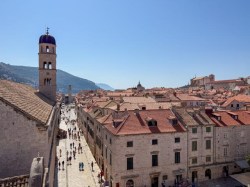
Today we arrived at Dubrovnik, our first stop in Croatia. Dubrovnik is an old and picturesque city that was heavily damaged in the Balkan wars of the early 1990s. Fortunately, Dubrovnik has been reconstructed, preserving much of the city’s previous character.
There were several activity options for today, including a cooking class, a hike into the hills above the city, and a coastal tour that included sampling oysters. We opted to take a walking tour of the Old Town and city walls. The tour introduced us to some of Dubrovnik’s history, and then we climbed up to the top of the city wall, one of the few intact city walls in Europe. It was a hot and sunny day, and we sought out shade in the few places it was available. Unfortunately, a few of the tour members had mobility difficulties, and it took some time to make it all the way around, especially since there were over 1000 steps on the route. Our local guide gave us quite a bit of information about the city on the way, and after we were finished, took us into a Franciscan monastery, which was one of the very early pharmacies in Europe.

We returned to the Orion for lunch, and then took advantage of some of our free time to head back into Dubrovnik for some exploration on our own and for dinner. We went to find the Jesuit Steps that were featured in “Game of Thrones,” but they weren’t all that significant to us since we haven’t watched that show. We found a small sidewalk cafe for dinner, which was reminiscent of dinners I had enjoyed when traveling to Belgrade a few decades ago.
This article is part of a series about our recent trip to Italy, Greece, Albania, and Croatia. To see the introductory article in the series, click here.
Wednesday, June 25, 2025
The Orion was repositioned to the port of Durrës overnight. We found ourselves in the middle of a container port, with cranes loading and unloading freight from adjacent ships and trucks, with containers frequently passing by.
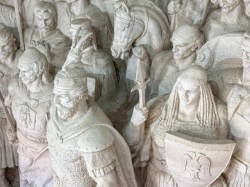
We opted for a trip to Krujë, a city an hour or so inland with a museum about Albanian history depicting an Albanian hero, Skanderbeg, who led a rebellion against the Ottoman Empire. Our local guide gave us more background on Albanian history and the areas we were passing through on our bus trip. Along the way, I noticed that we were passing the George W. Bush Bakery. Soon after, we passed a statue of President Bush and some other businesses named after him. It turned out that he had visited Albania in 2007 and is a bit of a local hero.
The museum did a good job of presenting Skanderbeg, and Albanian history generally. This was a bit of a surprise because it was built during the Communist era. Except for one room at the end of the tour, there was no Communist propaganda evident.

We then shopped our way through the small bazaar in the center of town on our way to lunch, which was held at a nearby restaurant . It was an opportunity to meet some people from our ship that we hadn’t crossed paths with before.
On the bus ride back, our local host handed out small cups and a sample of local raki (an alcohol spirit) that was made by the bus driver’s family. It is traditional for many families in Albania to make their own raki, which involves both a fermentation and a distillation process.
Our tour guide spoke excellent English (including colloquial terms), so I asked him how he had learned it. Had he lived in the US for a while? It turned out that he had learned it through the internet. He is apparently an avid gamer and learned by speaking live with other gamers. I am surprised at how well that worked.

After returning to the ship in Durrës, we noticed that the agenda said we had time to explore the downtown, but we hadn’t heard any more about that. We spoke with the expedition leader, who said that we were welcome to get off the ship and walk around the town. She pointed in a general direction, indicating the way to walk. So Kenna and I walked that direction, among the many trucks moving containers about, and after making a couple of wrong turns, found the gate that led us into town. Once again, no immigration or customs inspection was required; we just showed our ID cards from the Orion.
In the town, we first encountered a Venetian fortification tower, although it was unfortunately closed due to the afternoon siesta period. We walked along a bit further and found a Roman forum and amphitheater. The amphitheater was impressive in size, but had undergone a great deal of decay. Many of its steps and seats had crumbled and were impassable.
We stopped for a quick coffee at one of the outdoor cafes, walked around the business district a bit more, and returned to the ship, again dodging truck traffic at the port.
This article is part of a series about our recent trip to Italy, Greece, Albania, and Croatia. To see the introductory article in the series, click here.

Tuesday, June 24, 2025
Overnight, the Orion was repositioned off the coast of Corfu, an island near the northern part of Greece’s western coastline. With its strategic location, Corfu has considerable history, including a 6th-century fortress and a quaint Old Town. During our walking tour, we were treated to tastes of a local spirit, raki, at a shop in town. Many of us bought some, and we also bought some of their limoncello to compare with our home-made version. We also had a few minutes to roam around by ourselves, and Kenna and I did one of our favorite explorations, visiting a local grocery store.

At the pier in Corfu, we were docked across the pier from a Holland America Line cruise ship. The other cruise ship made the Orion seem very small, and indeed, the other cruise ship accommodates about 2000 guests while the Orion only accommodates about 100. Not having been on a ship that big, it was hard for us to imagine what that is like. There was also a sizable luxury yacht, the Launchpad, docked nearby. It is thought to belong to Mark Zuckerberg, and we speculated that he might have been in the vicinity to attend Jeff Bezos’s wedding in Venice.
During lunch, the Captain repositioned the Orion just off the coast of Sarandë, Albania. Albania’s time zone is one hour earlier than Greece’s, so we suddenly had an extra hour (which was not wasted: there was a photography lecture on the ship as we moved).

At Sarandë, we boarded buses for the short ride to Butrint National Park, a world heritage site featuring extensive Roman and post-Roman ruins. The ruins were generally well preserved, an effort that is continuing. Many of the floor mosaics were not visible to us because they have been covered to protect them until more permanent protection can be provided.
Our walking tour of Butrint was very warm and sunny, so after the tour we had an opportunity to stop and have a cold drink. I opted for a local beer, Korça, which proved to be a very respectable Pilsener.
On our bus ride back to Sarandë, the guide talked a bit about the Communist era in Albania, which was more severe than in many other Eastern European countries. The Albanian leader, Enver Hoxha, was very paranoid and had over 173,000 concrete bunkers constructed around the country to guard against invasions. As a result of Hoxha’s paranoia and isolationism, Albania became the third poorest country in the world. While still poor (apparently now the third poorest country in Europe) and rather corrupt, they have made substantial progress and seem to have a very optimistic attitude.
Albania is a separate country, and the only country on our trip that is not a member of the European Union or the Schengen Agreement (which eliminates internal customs borders between member states). Accordingly, I expected that there would be some customs or immigration formalities, but there were none. Albania aspires to EU membership, and perhaps they want to be as friendly to EU visitors as possible.
This article is part of a series about our recent trip to Italy, Greece, Albania, and Croatia. To see the introductory article in the series, click here.

Monday, June 23, 2025
During the night, the Orion traveled from Delphi to Kefalonia, one of the Ionian islands just west of the Greek mainland. After breakfast, we departed by Zodiac boat to visit two caves on the island. The first was a “wet cave,” which we visited using local rowboats. Portions of the cave were lit naturally by an overhead opening and other portions were closed from above but lit from below by a subsurface opening to the outside.
The second was a large, dry cave, reminiscent of various caverns we have visited in California, featuring large numbers of stalactites and stalagmites. There was a large cavern with excellent acoustics in which we were told famous singers have practiced and performed. One of our group members sang a short song to give us an idea of the sound.

After returning to the Orion for lunch, we took a Zodiac boat back to the island to explore Sami Town, a small village adjacent to where the Orion was anchored. We opted to join a photo walk, where two photography experts from the ship led us in exercises to improve our photographic skills. They gave us a few challenges, such as taking pictures of reflected images, and gave us feedback on the photos we took. It was a fun exercise, although it was early in the afternoon on a hot day.
The day finished with the usual cocktail hour and presentations, followed by dinner on the Orion.
This article is part of a series about our recent trip to Italy, Greece, Albania, and Croatia. To see the introductory article in the series, click here.
Sunday, June 22, 2025
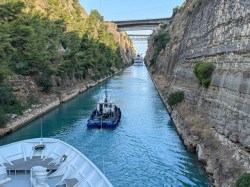
The early event for the day was the ship’s passage through the Corinth Canal, a narrow sea-level canal providing a shortcut from having to sail around the Peloponnese peninsula. The canal is very narrow, and the Orion was just small enough to make it through. Our entrance to the canal was delayed by a ship passing through in the opposite direction. Soon we were towed through the canal, an operation that required considerable precision and skill.

After passing through the canal, we made our way to Delphi, considered by the ancient Greeks to be the center of their world. After lunch, we visited the Temple of Apollo, where the Oracle of Delphi delivered prophecies. The Temple itself was constructed about 330 BCE, although two earlier temples on the site date to as early as the 7th century BCE. It was adjacent to a sizable theatre and by an athletic stadium. There was also a modern museum at the site, constructed to present and preserve many of the smaller and more fragile artifacts.
This article is part of a series about our recent trip to Italy, Greece, Albania, and Croatia. To see the introductory article in the series, click here.
Saturday, June 21, 2025
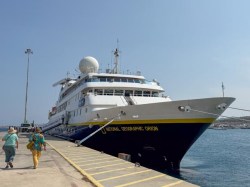
This morning, we checked out of our hotel and boarded a bus that would eventually take us to the National Geographic Orion, our ship for the rest of the trip. We had a bit of a drive to the ship, and things were timed so that we would arrive when the ship was ready for us (the previous guests disembarked this morning).

Our bus ride took us to the south of Athens, following the coastline to the Temple of Poseidon. The temple was another classical Greek structure, smaller but considerably less crowded than the Acropolis. Poseidon was, of course, the Greek god of the sea, so the temple’s location on a high outcropping overlooking the sea was particularly appropriate.
Continuing on the bus, we visited Papagiannakos Winery to the southeast of Athens. In contrast to the winery we visited in Italy, this winery was very modern and had LEED (energy efficiency) certification. The vineyards in this area look very different from what we are accustomed to seeing: the grapes were pruned to low bushes rather than trellises. Our lunch and a wine tasting were at the winery, and the wine was excellent and relatively inexpensive. We wish that we had room to take some home.
After lunch, we continued to the port of Lavrio to board the Orion. As we boarded the ship, we were greeted by several of the staff, including the Hotel Manager, Fran. We had met Fran on our Kimberley expedition last year. She took good care of Kenna when I had Covid on that trip, and we remember her (and much of her staff) well. We exchanged hugs as we boarded.
We met in the ship’s lounge for the opening briefing by our expedition leader, Karla Pound. Karla was also the expedition leader for the Kimberley trip, and when we raised our hands in response to her question, “Who has been on the Orion before?” she looked at us and said, “I remember you!” We felt very welcome.
The day closed with the requisite lifeboat drill, followed by a delicious dinner in the ship’s dining room.
This article is part of a series about our recent trip to Italy, Greece, Albania, and Croatia. To see the introductory article in the series, click here.

Friday, June 20, 2025
Our tour took us to the Acropolis today, so we got a relatively early start, both because it was going to be a hot day and to avoid the crowds. Our bus took us to the parking area at the base of the Acropolis, so we had to do some climbing. I’m not sure if we beat the crowds — it was quite crowded, particularly entering and leaving the site.
Unfortunately, there was quite a bit of scaffolding on the Parthenon, but restoration and preservation work at the site probably never stops. We had enough time to explore the area and take a few pictures, but it was getting hot quickly. We got the group together and headed back for our bus.

Our next stop was for lunch, which we would have to make ourselves. The tour included a short Greek cooking class, where we made (or at least participated in making) stuffed peppers, Greek salad, and tiropita (phyllo triangles with a cheese and egg filling). This was organized as a competition between two teams, and we took the competition seriously. Jan was our leader, and we won, so she got the prize: a chef’s hat signed by our instructor.
The afternoon took us to more Athens sights, including the Panathenian Olympic Stadium, where the modern Olympic Games were first held in 1896. The bus dropped us off at the Plaka, Athens’ historic old marketplace, where we were led on a walking tour before heading back to the hotel. It was a rather hot afternoon, and we were thankful for the many vendors selling cold drinks.
For the evening, we were picked up by the bus again for a drive to a beachside restaurant to the south of Athens. We sat outside at a long table on the stony beach. The dinner was unremarkable, but it provided a nice opportunity to chat with some of our fellow travelers.
This article is part of a series about our recent trip to Italy, Greece, Albania, and Croatia. To see the introductory article in the series, click here.
Thursday, June 19, 2025
After breakfast, Kenna and I made our return visit to the Athens Laundry. Our entire laundry load cost 18 euros, about the same as a single shirt would have cost at the hotel. We enjoyed the walk again as well.
We met up with Dave and Jan at the rooftop terrace of the hotel for lunch, and met the other participants in our pre-cruise tour of Athens. The view from the roof was, of course, excellent. Unfortunately, the service was slow, and we were a little rushed to meet the bus for our afternoon tour.

We met up with our local guide and toured the Acropolis Museum. Many of the original artifacts from the Acropolis are stored in the museum to protect them from the elements. In a few cases, replicas have been made that are on display at the actual Acropolis. Like much of Athens, the land on which the museum is built also has historic ruins, so the museum is built on piers that avoid destroying the artifacts below. The building is very modern and bright, and displays the artifacts clearly and comfortably. Our local guide provided context and historical details as we walked through the galleries.
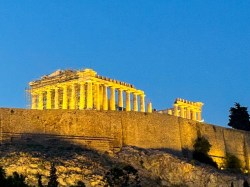
After returning to the hotel to relax a bit, we joined our group briefly for a cocktail reception, but I had made dinner reservations well in advance, so we couldn’t stay long. Our dinner tonight was at Strofi, a local restaurant that I had eaten at in 1983, 42 years ago (almost to the day). I was in Athens on a business trip, and the hotel had recommended Strofi. Everyone on that trip loved the restaurant and the food, not to mention the view of the Parthenon from their rooftop terrace. We ended up eating dinner there every night of our visit to Athens. I had since recommended Strofi to others and was anxious to try it again myself. Dave and Jan came with us, and we had a most enjoyable dinner, again on the rooftop terrace looking up at the Acropolis.
This article is part of a series about our recent trip to Italy, Greece, Albania, and Croatia. To see the introductory article in the series, click here.
 Altmode