
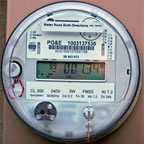
We were moving some furniture this past weekend, and I was moving the satellite receiver in the bedroom when I came upon this:
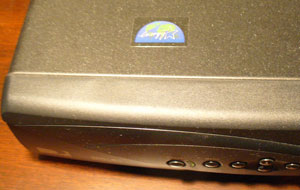
That’s right, it’s the satellite receiver I wrote about a couple of weeks ago, the one that takes 11 watts turned on and 10 watts turned “off”, and it has an Energy Star sticker on top. But I associate Energy Star with computer monitors (especially the older CRTs) that turn themselves almost completely off when not in use. How is this possible?
I went to the Energy Star website to research the criteria for set-top boxes to be listed as Energy Star compliant. According to the page on set-top boxes for consumers:
Set-top boxes that have earned the ENERGY STAR are at least 30 percent more efficient than conventional models.
I’m not at all sure what a “conventional model” is. Presumably there are satellite receivers that are even worse, but DirecTV offers a very limited choice sso I’m not sure you can actually get one. So I went on to the information for “partners” (equipment manufacturers). The program requirements list a number of different types of set-top boxes (such as cable, satellite, IP, terrestrial), along with optional capabilities (additional tuners, advanced video processing, DVR, and so forth). Limits are given in kWh/year for each type of set-top box, with additional allowances for each additional capability present. There are two tiers of limits: Tier 1, effective January 1, 2009, and Tier 2, effective January 1, 2011.
The Tier 1 limit for a satellite set-top box with no additional capabilities is 88 kWh/year. But what bothers me is how that’s calculated:
kWhBase = 0.365 * (14 * Ptv + 10 * Psleep)
In other words, the formula assumes that the receiver is on 14 hours a day. While some people must use their TVs that much, it’s hard to believe that this is typical, even in the US. The result is that Psleep (the power consumption when turned “off”, more accurately characterized as sleep mode) does not count for as much as it should.
Under this formula, my set-top box consumes 93 kWh/year. This doesn’t qualify under the current limits, but it’s very possible that they were different in 2004 when it was built. The criteria continue to tighten; the Tier 2 limit, effective 2011, is 55 kWh, a step in the right direction. But they need to rethink the duty cycle in the test criteria, as well as whether these are actually 30% more efficient than anything, as claimed on the consumer Energy Star website.

Really Simple Syndication (RSS, and a similar protocol, Atom) has been touted for several years as the way to keep track of many things: blog posts and comments, wiki edits, news headlines, even email messages and Twitter feeds. Nevertheless, email remains the de facto notification mechanism for most people and applications. I use RSS quite regularly to manage my blog reading, but I’m not very satisfied with it. Here’s why:
RSS is a pull medium
Any time I want to use an RSS reader, I need to ask my RSS reader to collect (pull) the RSS summary from each of the “feeds” (typically blogs) that I subscribe to. This works reasonably well for content that changes relatively slowly like many blogs, but works less well for headlines and especially Twitter. There is no mechanism for notifying me when something new shows up; I need to poll for it.
Lack of multi-device integration
I read blogs from at least three devices: my home machine, my work laptop, and my iPod Touch. I also read my home email from all of those places. The difference is that when I read an email message, all three places show the message as having been read. Not so with RSS. The devices don’t have a way of communicating with each other, so each time I change devices everything looks unread. Subscriptions are similarly disaggregated; I have to subscribe to each feed on each device. I’d rather, when I find a new blog (or something) worth reading, to be able to add it to all devices at once.
Poor reading organization
Rather than organizing the information by feed, I’d rather have a more flexible way of prioritizing the information. This is more of a client software problem than a protocol problem, but it’s still a reason I don’t like RSS as much as I might. I’d like it if my RSS reader organized the information it presents to me by subject (perhaps using keywords or tags to do so), or according to a more complex sorting algorithm that either I could specify or it would learn from my reading behavior.
Older information is lost
RSS feeds typically syndicate only relatively items, and are often limited to only the most recent N articles, where N is typically 20 or so. If N increases, the size of the feed increases proportionally, as does the overhead for the reader which has to match the current feed against its stored database to see what has already been read. However, lower values of N fail if the reader doesn’t regularly retrieve the feed. One currently has to expect that articles may be lost when you go on vacation, and that limits RSS to non-critical tasks.
Unless we want to continue to use email as a notification mechanism for everything, it would be useful to have a syndication mechanism that doesn’t suffer from the limitations of RSS (or Atom). A new mechanism could be designed that is more tailored to this purpose than email, and can be designed from the start to avoid the many ways that email is abused. For example, Mark Cuban recently talked about the use of WebHooks and PubSubHubbub to overcome the pull limitations of RSS and similar protocols. These and other (push) protocols have the potential to make the use of the Internet a much more responsive, event-driven experience.
I’m going to stick my neck out a bit and blog about something that I don’t think I know that much about: economics. Hopefully some astute reader will set me right through some insightful comments if I’m all wet.
I have been watching the Cash for Clunkers feeding frenzy with some concern. The government contributed first $1 billion, then another $2 billion, to incentivize consumers to trade older, less efficient vehicles for new, somewhat more efficient ones. This was billed as both an environmental and economic incentive.
On the environmental side, many commentators have observed that the benefits aren’t entirely clear: the program only required a modest improvement in fuel economy, which might be overshadowed by the environmental impact of manufacturing the new car and disposing of the old one. This is a concept known as life cycle assessment, which I find fascinating but which hasn’t yet, to my knowledge, analyzed something as big and complex as an automobile in detail. The disposal cost is aggravated by the requirement that the car being returned be rendered undriveable.
On the economic side, I’m all for stimuli that create jobs by building infrastructure. The most famous example of this was FDR‘s creation of agencies such as the Works Progress Administration and the Tennessee Valley Authority during the Great Depression. These projects created infrastructure, much of which we’re still using, that enabled future growth in addition to creating jobs in the short term.
But I see a fundamental difference with Cash for Clunkers. What’s happening generally is that people are accelerating their purchases of new vehicles using the program. With the exception of the remaining life on the “clunkers” being destroyed, the program isn’t creating new demand, it’s accelerating future demand. In other words, it’s mining demand that might occur during the recovery from the current recession and pulling it into the present. It’s making the current recession a bit shallower but wider, and not much different in total volume, at least as far as the automotive industry is concerned.
Are there benefits to a shallower recession? Sure. Not as many workers will be affected, and those that are might reasonably make career changes to other industries. This is much harder than it seems, though — these other industries may not exist where the workers live, and it’s very hard to sell a home in an area with a weak economy. I’m also concerned when I hear that automakers are ramping up capacity to meet the demand of Cash for Clunkers; it is such a short-term program that this is likely to be the wrong thing to do.
Many of the things in President Obama’s stimulus plan build infrastructure for the future, but I wish there was more emphasis there. I won’t be at all surprised if I hear that the automotive industry takes longer to recover than other parts of the economy. After all, we have already gotten the clunkers off the road.
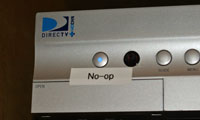 A few weeks ago, I noticed a colleague at work had a Kill-A-Watt power usage meter, which he allowed me to borrow. It’s a great device, and relatively inexpensive, so I quickly bought one for myself.
I went around the house measuring all sorts of devices, particularly things like my networking gear that is on all of the time, some of the computers, and entertainment equipment. As expected, many of these devices draw some power in their standby modes; this is necessary if they have a clock, or can be turned on via a wireless remote.
I was expecting the DVR (DirecTV HD model) to take a significant amount of power on standby, but I was shocked by the comparison between “off” and “on” power usage:
On: 40 watts
Off: 38 watts
That’s right, there is only a 2 watt difference between being turned on and turned off! It seems that all that the “power” button must do is to turn on the front-panel LEDs and turn on the video output circuitry. Of course, there are a lot of nice features you get by having the receiver effectively on all the time: the program guide is continuously up to date and the remote recording feature allows one to request a recording via the Web or an iPhone app.
So I checked our bedroom set, which is connected to an older-model, non-HD, DirecTV receiver:
On: 11 watts
Off: 10 watts
Only 1 watt different! The program guide still needs updating for this receiver, but of course one can’t remotely request a recording from it.
Does it have to be that way? I’d be happy with a program guide that’s a few hours old, and with remote recording that requires that I give it a little bit of advance notice. So why not have the receiver (and recording processor and disk in the DVR) switch to a “real” standby mode most of the time, with a timer that wakes it every so often to receive instructions and updates from the satellite? It would also wake when a remote-control or front-panel command is received.
How much power are we talking about? At the end of 2008, DirecTV had 17.6 million subscribers. Let’s assume (I think very conservatively) that there are 10 million DVRs and 10 million non-DVRs (since some subscribers have more than one TV). Suppose, through power cycle management, we can reduce power consumption 90% of the time to 2 watts for the non-DVRs (typical of home audio equipment) and to 10 watts tor the DVRs (typical of a sleeping home computer). That works out to a savings of 324 megawatts, just for DirecTV customers. Other satellite receivers, DVRs, and cable set-top boxes have this problem as well, although I don’t know to what extent.
Another way to look at this is that a more efficient DVR could save about 221 kWh per year, and a more efficient non-DVR receiver could save about 65 kWh/year.
The irony is that on both receivers, the button is labeled “Power”. It’s almost as if they felt they needed that button as a feel-good measure.
My family and I just returned from vacation in Hawaii, and experienced “code sharing” on United Airlines with rather unexpected results.
For anyone not familiar with the term, code sharing is the common practice of airlines to co-brand a partner airline’s flight with their own flight number. This is often seen on long-haul and international flights, where a United flight might be co-branded with flight numbers from partners like Air New Zealand or Lufthansa. In this case, we were travelling on Island Air flight 417 from Kona to Maui, sometimes known as United 4978.
The code sharing process is far from seamless:
Appearance on reservation systems: Some reservation systems and not others showed the existence of UA 4978. Although I used various third-party reservation systems to search for flights, I booked directly with United so that I could use a discount coupon from a previous delayed flight (more on that below). But United’s website didn’t show the inter-island flight; it tried to route me from Kona to Maui via Los Angeles. I had to call and speak to a reservation agent in order to book the itinerary with the codeshare flight. This has got to be a bug; I can’t imagine that United intends it this way.
Coupons don’t work: I explained to the agent that I intended to use a $200 discount coupon, and she helpfully split my reservation from that of my wife and daughter so that I could do that (although I wonder why that is necessary) and she told me I could purchase the ticket at a United ticket counter. I did so the next day, and was told that I couldn’t use the coupon on that itinerary, because of the Island Air flight. Apparently the intent is to make it as hard as possible to use those coupons (a fact we should all heed when being asked to give up our seats on overbooked flights), but United should consider the itinerary “all United” when their flight number is on all the flights. They did attempt to split the Island Air flight into a separate itinerary, which would have increased the fare by about $160, and I didn’t consider that to be good value for my $200 coupon.
Information system disconnect: When we arrived at the Island Air ticket counter at Kona, my daughter’s E-ticket was listed under the name “Change Name”. After much pressing of keys and a conversation with someone, and asking how we booked the reservation, the agent told us that she couldn’t change the name; United would have to do that. We walked with her over to the United counter where she was listed under the correct name and they issued a paper ticket for her, which worked around the problem. At this point I was very glad that I had booked directly with United; they would undoubtedly have tried to blame the booking agent had I not booked directly.
Airlines would better achieve their objectives with code sharing by working more closely with their code sharing partners to make the process more cooperative and seamless, and would provide better customer service as a byproduct. In addition, they should be required to treat flights on which they apply their flight numbers as their own to the greatest extent possible so that the “operating carrier” is truly that and that code sharing isn’t an excuse to shrug and say, “Well, it isn’t our flight.”
We have had the photovoltaic system in place for about 2 1/2 years now. What are the results? The simple answer: We haven’t paid more than a metering charge since. But there’s a lot more to it than that.
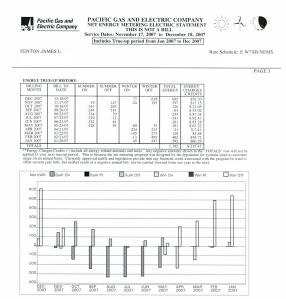
In the first year, the system generated 7380 kWh of energy, 3977 kWh from the south array and 3403 kWh from the west array. Our net energy usage for that period was 1182 kWh (we used 1182 kWh more than we generated), but our bill was zero because we generated more than we used during peak hours. Here in California, Pacific Gas & Electric averages the usage for “net energy metering” customers on an annual basis, which takes into account seasonal variations in usage. They send monthly statements summarizing this, such as this bill at the end of the first year:
As I mentioned in the last post, the inverters have serial interfaces that allow one to read, in real time, the status of the unit. Xantrex has free monitoring software (for Windows) available, so when the system was first installed I had it hooked up to my Windows PC in order to generate a year’s worth of baseline data. The Xantrex software generated a CSV file each day with the day’s measurements, plus another file that summarized the daily output of the system. I was able to generate graphs fairly laboriously by importing the data into Microsoft Excel. But it was great to see what the system was doing and to verify that both arrays were producing power as expected.
For the most part I stopped collecting data after the first year, in part because it seemed like a contradiction to keep a PC running mostly to collect data from the photovoltaic system. But I do have a Linux system that runs all of the time (it is my mail server), so earlier this year I made a programming project out of importing the old data into MySQL and writing an application that would query the inverters periodically and insert the results into the database. The result now is that it’s fairly easy to generate graphs like the following:
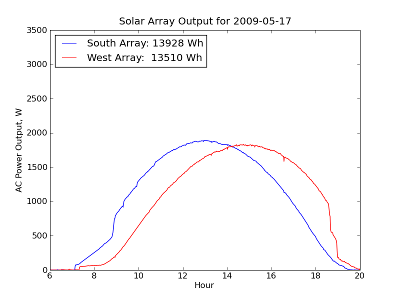
Graph for May 17, 2009
I had been noticing this year that the output from the system seemed a bit lower; I had remembered having several 30 kWh by this time in 2007, but none this year. I compared the graph above against the baseline two years earlier and found the earlier graph to look almost exactly the same, but higher. The output of the system had decreased about 8.5% over the two years. What happened? It appears that, even though the panels didn’t look excessively dirty, they’re quite sensitive to dirt. On June 1, I cleaned the panels with a long-handled mop and squeegee, and it appears that things are back to 2007 levels (we have had an unusual cloudy spell so it’s difficult to be more definite). I expect to be cleaning the panels more often in the future.
You’ll also see that the output from the west array isn’t that much lower than the south array. The difference is more pronounced in the winter (due to sun angles and shorter days) but I suspect that the west array is actually contributing more financially due to time-of-day metering. Morning fog can also cause the west array to be more productive than the south array.
A similar graph taken during the winter months tells a very different story:

In addition to the shorter day and lower sun angle, this graph shows the impact of shading on array output. This is probably most visible on the west array about 2 PM. As the sun angle goes down, objects further away can shade the array from the sun. Even relatively small partial shading of the array has a major impact.
Here’s a summary of the output of the system over the course of a year (2007):

System output for 2007
As you can see, the output of the system varies widely between winter and summer. In addition, you can see more consistent results during the summer, due to the relatively dry and sunny summers here in California.
One of our neighbors to whom I showed our data collection and analysis setup described it as having significant “toy value”. He’s right; I have had a good time collecting, analyzing, and showing off the data. But it has also taught me a lot about the sensitivities of the system to things like shading, solar panel dirt, and alternative panel placements which I hope is useful to others as well.
In an earlier post, I described the process leading up to the installation of our house’s photovoltaic system. This post describes the system itself and its installation.
As described previously, the design of our system was done by the contractor, based on the electric bills we provided and input such as the fact that we wanted the system to be somewhat sensitive to aesthetics, not wanting to cover the front of our house (which faces south) with solar panels. Instead, we opted to have half of the panels on the front, in an area that isn’t as visible from the street, and half on the back, facing west.

South-facing array (front)

West-facing array (rear)
The system consists of:
- 24 each Sanyo HIP-200BA3 panels (12 panels each facing south and west)
- 2 each Xantrex 3.8 GT series inverters (1 each for the south and west arrays)
- 1 lot mounting hardware, AC disconnect, etc.
The Sanyo HIP-200BA3 panels are rated at 200 W (180 W guaranteed) and are about 52 x 35 inches in size (132 x 89 cm), with a total area of 12.7 square feet per panel. One of the things I like about these panels compared with others I have seen is that the frame is anodized black, which is much less conspicuous than ones that are their natural aluminum color. The total area covered by the panels is about 305 square feet.

Xantrex inverters and line connection
The Xantrex inverters operate independently in order to better optimize their efficiency for the different time of day that the two arrays peak. The use of two inverters did increase the cost of the system somewhat, but provided good efficiency while maintaining the aesthetics of the house. Each inverter has a serial output that can be used to monitor the inverter output from a remote PC using software available from Xantrex. More on that in a future posting describing the results from the system. The inverters also have a display on the front of each unit and a very unusual but practical user interface: knock on the front of the inverter to change the display.
The system cost (in mid 2006) was about $36,000 for the hardware and $5,500 for installation. We got substantial incentives and rebates at the time, but these vary with time and locality.
The installation of our system took place in Fall, 2006, with the installation being performed by Renewable Alternative Technologies of Gilroy, California. They did an excellent job; with all of the support posts I was concerned about possible roof leaks, but there haven’t been any at all. You can see some more pictures of our system on their website under “Los Altos – 4.2 KW Grid-tied System.”
No, I haven’t suddenly Gone Legal and created a Terms of Use to you must agree in order to read this blog!
A few minutes ago, I went to rate a recent movie return on Netflix and was greeted with the all-too-familiar message that I must read and accept their revised Terms of Use before proceeding. I’m one of those people that pays a smidgen of attention to those things, partly because I’m curious to see what they want to do and what they don’t want me to do.
I looked at the ToU. It’s long — 11,531 words according to Microsoft Word, and that doesn’t include the separate Privacy Policy. There was no date, version number, or similar identifier that I could use if I wanted to refer to this version. And, importantly, no information at all about what had been changed.
I’m certainly not a lawyer. But it only makes sense that informed agreement to a document like this should be preferred to “closing your eyes and clicking Agree”. Netflix knows what version of the Terms of Use I had agreed to before, so it’s possible for them to either tell me in English what areas had changed or allow me to display the textual diffs from the version I had previously accepted. And there is no reason not to identify the version number or date on the document.
I don’t mean to single out Netflix; they’re definitely not the only offenders in this area. It seems like every time I update iTunes and every other time I access the iTunes Music Store, I need to accept a ToU update. But not every ToU update is this opaque; I got one the other day that clearly said at the top what areas had changed. I wish I could remember whose that was, so I could thank them here.
I briefly considered whether there was some way that it is possible to “crowdsource” the changes to various products’ Terms of Use, perhaps by putting up a wiki that allows one to see the different versions and compare them. But I suspect that many Terms of Use are probably copyrighted, and copying them over to a wiki might not be considered Fair Use. Can anyone think of a workable way to do this?
 This is the first in a series of blog posts about the photovoltaic system (solar panels) we have on our house. We installed our system in Fall, 2006 and are enthusiastic about it. This first posting talks about the planning of the system; future posts will get into more of the details and the results we have gotten from it.
Motivations
First you need to think about why you want a photovoltaic system. Some people are motivated economically, and are looking for a reasonably short payback on the cost of the system. Others are doing this because it seems like the right thing to do, and want the satisfaction of doing something good for the environment, as well as some economic benefit from reducing or eliminating their electric bill and from increasing the value of their homes. We fit into the latter category.
When we started looking into this in 2006, the home solar installation and contracting industry was just emerging. There are now many options that didn’t exist then, especially for those whose motivation is economic. For example, some firms are leasing solar panels to homeowners to eliminate the capital outlay obstacle.
If you want to achieve a relatively short payback time for your system, you probably won’t be driving your electricity bill all the way to zero. That’s because electricity is often sold in a tiered pricing system: there’s usually a baseline number of kilowatt-hours (kWh) per month that are fairly cheap, and electricity beyond that is more expensive. With a smaller solar system, you can offset the more expensive power cost.
At least in California, it isn’t possible to get the utility company to pay you for extra electricity you generate; homes are considered “incidental” generators of power. Therefore, it probably doesn’t make sense to put up more solar panels than needed. However, they do average the bill for those with photovoltaic systems over an entire year, because it is expected that customers will be net consumers of power in the winter and net producers in the summer. This lets you take advantage of the extra power you produce in the summer when you need it in the winter.
Time of Use Metering
Depending on the power tariffs where you live, there may be a time of use metering plan available. This is a really good deal for people with photovoltaic. Why? The times when power is most expensive (typically weekday afternoons in the summer) are the times when photovoltaic systems generate the most power.
The time-of-use plan we are on is known as E-7, which designates a peak period between 12 noon and 6 pm on weekdays. This rate schedule has been replaced with E-6, which has three tiers in the summer and two tiers in the winter. E-7, which is no longer available to new customers, is generally considered to be more favorable to solar installations, although I haven’t done an analysis to see if that is actually the case.
Aesthetics
Since our house faces south, we were concerned about the visual impact of a photovoltaic installation.
There are several different types of photovoltaic collectors, including slate tiles, flexible shingles, and solar panels. While we looked to some extent at all three, it was clear that because of our wooden shake roof, we’d need to basically replace the roof in order to consider the first two. It also appeared that the solar panels were more efficient per unit area; so the fact that they’re more visible is somewhat mitigated by the fact that there is less area for a given power output.
We identified an area over the garage that is relatively less visible from the street than other areas of the house. We also came upon the idea of putting half of the panels on a west-sloping roof in the rear of the house. The contractor warned us that this would be about 15% less efficient than a front-facing panel, and this is confirmed by our data. However, since the time-of-use plan favors the afternoon hours, a west-facing array is more favorable than that from a financial standpoint.
Finding a contractor
Most of what we learned about finding a contractor is probably obsolete now. We talked with a few companies who had the right intentions, but didn’t follow through and left us questioning their ability to manage the project. A friend recommended Palo Alto Solar, whom we ultimately contracted with. During the project, Palo Alto Solar was acquired by SolarCity, which has since been actively marketing photovoltaic installation in the local market. A lot has changed in three years.
Determining what you need
We provided our contractor with copies of a year’s worth of electric bills, and they figured out what we needed to achieve our objective of driving the bill to zero. We then worked with them to plan the placement of the panels on the roof. You also need inverters to change the DC output of the panels to AC, synchronized with the power line. Having two arrays in different directions, we have two inverters to get the most efficiency out of the installation. The contractor’s estimate was very good; we generate only slightly more (in terms of cost) than we consume, and part of that is probably due to subsequent power conservation.
Power outages aren’t a significant problem where we are, so we didn’t consider any form of energy storage such as batteries. The cost of batteries would have been high for limited benefit, and also environmentally unfriendly in situations where they aren’t really needed.

Canada Day fireworks
Last summer, we spent the last part of June and the very beginning of July at my cousin’s cottage in Ontario. We enjoyed the Canada Day fireworks (pictured) from his boat, a new experience for me. After that, we returned to California in time to celebrate Independence Day three days later.
This experience and my enjoyment of travel caused me to wonder what it would be like to carry this to the extreme: How many National Holiday celebrations can one attend in a year? I’m calling this the Traveling Reveler Problem: it bears some relationship to the Traveling Salesman Problem, but is much easier to solve because the choices are very constrained.
To start with, we need a set of (somewhat arbitrary) rules. So let’s suppose that the goal is to observe a fireworks show in each country:
- Traveler must arrive in the capital city 1 hour prior to local sunset
- Traveler must stay in the capital a minimum of 3 hours prior to departing
- Visa and political travel restrictions are not considered
- Preference is given to countries with the largest population, in the event of a “tie”
- It is assumed that the traveler has a long-range jet aircraft at his/her disposal to get from place to place. A more ambitious effort would be to plan an itinerary on commercial airline flights, which I will leave as an exercise to the reader.
I have arbitrarily chosen the list of countries in the CIA World Factbook list of National Holidays.
So without further ado, here is a first crack at a solution to the Traveling Reveler Problem. Places written in strikethrough are ones that would be missed due to conflicts. This would make a great travel series. Michael Palin, are you out there?
Country National Day Comments
Cuba 1-Jan
Haiti 1-Jan
Sudan 1-Jan Chosen based on population
Burma 4-Jan
Northern Mariana Islands 8-Jan
Australia 26-Jan Conflicts with India, which is of course bigger
Christmas Island 26-Jan
Cocos (Keeling) Islands 26-Jan
India 26-Jan
Nauru 31-Jan
Sri Lanka 4-Feb
New Zealand 6-Feb
Niue 6-Feb
Tokelau 6-Feb
Grenada 7-Feb Looks challenging, but we’re crossing the International Date Line
Serbia 15-Feb
Lithuania 16-Feb
Kosovo 17-Feb
Gambia, The 18-Feb
Saint Lucia 22-Feb
Brunei 23-Feb Both smaller than Guyana and harder to get to from Saint Lucia
Guyana 23-Feb
Estonia 24-Feb
Kuwait 25-Feb
Dominican Republic 27-Feb
Bulgaria 3-Mar
Ghana 6-Mar
Mauritius 12-Mar
Ireland 17-Mar
Aruba 18-Mar
Tunisia 20-Mar
Namibia 21-Mar
Pakistan 23-Mar
Greece 25-Mar
Bangladesh 26-Mar
Virgin Islands 31-Mar
Iran 1-Apr
Senegal 4-Apr
American Samoa 17-Apr
Syria 17-Apr
Zimbabwe 18-Apr
Holy See 19-Apr
Tanzania 26-Apr
Sierra Leone 27-Apr
South Africa 27-Apr
Togo 27-Apr
Netherlands 30-Apr
Netherlands Antilles 30-Apr
Marshall Islands 1-May Probably not possible due to distance and time change
Poland 3-May
European Union 9-May
Guernsey 9-May
Jersey 9-May
Micronesia 10-May Probably not possible due to distance and time change
Israel 14-May
Paraguay 14-May Slightly smaller than Israel and further away
Norway 17-May
Cameroon 20-May
Yemen 22-May
Bermuda 24-May
Eritrea 24-May
Argentina 25-May Difficult to fit between Eritrea and Georgia
Jordan 25-May
Georgia 26-May
Azerbaijan 28-May
Ethiopia 28-May
Nepal 29-May
Anguilla 30-May Very difficult location (Caribbean) between Nepal and Samoa
Samoa 1-Jun
Italy 2-Jun Doubtful we can get from Samoa to Rome in time
Tonga 4-Jun
Denmark 5-Jun Might be possible due to favorable time change
Sweden 6-Jun
Norfolk Island 8-Jun A very long trip from Sweden and to Portugal!
Portugal 10-Jun
Philippines 12-Jun
Russia 12-Jun
Falkland Islands 14-Jun Probably very cold as well.
Iceland 17-Jun
Seychelles 18-Jun Doubtful that it’s possible to make it from Iceland
Greenland 21-Jun
Luxembourg 23-Jun
Mozambique 25-Jun
Slovenia 25-Jun
Madagascar 26-Jun
Djibouti 27-Jun
Congo, Democratic Republic of 30-Jun
British Virgin Islands 1-Jul
Burundi 1-Jul
Canada 1-Jul Biggest but very far away
Rwanda 1-Jul
Somalia 1-Jul
Belarus 3-Jul
Puerto Rico 4-Jul
United States 4-Jul
Cape Verde 5-Jul
Isle of Man 5-Jul
Venezuela 5-Jul
Comoros 6-Jul
Malawi 6-Jul
Solomon Islands 7-Jul Probably can’t get there in time
Palau 9-Jul
Bahamas 10-Jul Probably can’t get there in time
Mongolia 11-Jul
Kiribati 12-Jul Unfavorable time change
Sao Tome and Principe 12-Jul
Montenegro 13-Jul
France 14-Jul
French Polynesia 14-Jul
Iraq 14-Jul
Mayotte 14-Jul
New Caledonia 14-Jul
Saint Barthelemy 14-Jul
Saint Martin 14-Jul
Saint Pierre and Miquelon 14-Jul
Wallis and Futuna 14-Jul
Colombia 20-Jul
Belgium 21-Jul
Egypt 23-Jul
Liberia 26-Jul
Maldives 26-Jul
Peru 28-Jul
Faroe Islands 29-Jul Could be challenging
Morocco 30-Jul
Vanuatu 30-Jul
Benin 1-Aug
Switzerland 1-Aug
Macedonia 2-Aug
Bolivia 6-Aug
Jamaica 6-Aug
Cote D’Ivoire 7-Aug
Singapore 9-Aug
Ecuador 10-Aug
Chad 11-Aug
Congo, Republic of 15-Aug
Korea, South 15-Aug Too far from Africa
Liechtenstein 15-Aug
Gabon 17-Aug
Indonesia 17-Aug
Afghanistan 19-Aug
Hungary 20-Aug
Ukraine 24-Aug
Uruguay 25-Aug Unlikely between Ukraine and Moldova
Moldova 27-Aug
Turks and Caicos Islands 30-Aug
Kyrgyzstan 31-Aug
Malaysia 31-Aug
Trinidad and Tobago 31-Aug
Libya 1-Sep
Slovakia 1-Sep
Uzbekistan 1-Sep
Vietnam 2-Sep
Qatar 3-Sep
San Marino 3-Sep
Swaziland 6-Sep
Brazil 7-Sep
Andorra 8-Sep
Korea, North 9-Sep Doubtful due to time change
Tajikistan 9-Sep
Gibraltar 10-Sep
Costa Rica 15-Sep
El Salvador 15-Sep
Guatemala 15-Sep
Honduras 15-Sep
Nicaragua 15-Sep
Mexico 16-Sep
Papua New Guinea 16-Sep
Chile 18-Sep
Saint Kitts and Nevis 19-Sep
Armenia 21-Sep
Belize 21-Sep
Malta 21-Sep
Mali 22-Sep
Saudi Arabia 23-Sep
Guinea-Bissau 24-Sep
Botswana 30-Sep
China 1-Oct
Cyprus 1-Oct
Hong Kong 1-Oct
Macau 1-Oct
Nigeria 1-Oct
Tuvalu 1-Oct
Guinea 2-Oct
Germany 3-Oct
Lesotho 4-Oct
Croatia 8-Oct
Uganda 9-Oct
Taiwan 10-Oct
Equatorial Guinea 12-Oct
Spain 12-Oct
Zambia 24-Oct
Austria 26-Oct
Saint Vincent and the Grenadines 27-Oct
Turkmenistan 27-Oct
Czech Republic 28-Oct
Turkey 29-Oct
Algeria 1-Nov
Antigua and Barbuda 1-Nov
Dominica 3-Nov
Panama 3-Nov
Cambodia 9-Nov
Angola 11-Nov
Latvia 18-Nov
Oman 18-Nov
Monaco 19-Nov
Lebanon 22-Nov
Bosnia and Herzegovina 25-Nov
Suriname 25-Nov
Albania 28-Nov
Mauritania 28-Nov
Timor-Leste 28-Nov
Barbados 30-Nov
Central African Republic 1-Dec
Romania 1-Dec
Laos 2-Dec
United Arab Emirates 2-Dec
Thailand 5-Dec
Finland 6-Dec
Burkina Faso 11-Dec
Kenya 12-Dec
Bahrain 16-Dec
Kazakhstan 16-Dec
Bhutan 17-Dec
Niger 18-Dec
Japan 23-Dec
I count 143 celebrations to attend. I cringe to think of all the carbon this trip would release!
 Altmode