
Thursday, May 23, 2024
We arrived in Singapore at about 6:40 a.m. As we have seen before, Singapore is a gorgeous airport, with flowers, fish, and the like throughout. We went to the Singapore Airlines lounge, marveled at the exotic food offerings, and got some morning coffee for our short stopover.
Our flight to Denpasar was also right on time and comfortable. We both had window seats for this flight, which was worthwhile because there was a fair amount of scenery below. At one point, one of the flight attendants came by to point out a couple of volcanoes (but not the ones that have been erupting recently) poking through the clouds.
Arrival in Denpasar was more straightforward than expected. We had done the advance Visa on Arrival (sort of a confusing name since we got the approval in advance) and advance customs declaration, so we flew through immigration and customs. We emerged to hundreds of people holding signs looking for specific passengers. We had hired a driver for tomorrow’s excursion to Ubud, and at his recommendation we went to the taxi desk at the airport, paid for our taxi to the hotel, and the driver came and led us to his taxi. It could not have been easier.
The taxi ride to the hotel was a study in contrasts. Once we left the airport grounds, we encountered a typical scene of buildings in various stages of repair, many motor scooters, and other vehicles. Our driver was very skilled at navigating the chaos.
Soon, we came to Nusa Dua, a resort enclave in southern Bali. After passing through a security checkpoint (having two older white people in the taxi probably made us look legit), we were suddenly among large hotels, palm trees, manicured lawns, and signs announcing an international conference being held in the area. We went through an additional security checkpoint and came to our hotel, the Grand Hyatt Bali, which had yet another checkpoint. The taxi dropped us off, and we walked through still another checkpoint, where our bags were x-rayed. It was about 1 p.m., but fortunately, our room was ready.
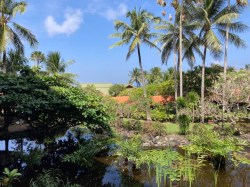
The hotel’s grounds are gorgeous, and a small army of groundskeepers maintains everything well. We spent most of the afternoon walking around the hotel grounds, discovering (and getting lost among) the many restaurants, swimming pools, and large beach areas. There were fewer choices for dinner than we initially thought because several of them (like the sports bar) are primarily places to drink and get light snacks rather than a full meal.
We chose the Garden Cafe, a restaurant near our room for dinner. It served a variety of Asian and Western dishes.
While we were doing this, our daughter Celeste was driving from Denver to her summer work assignment in upstate New York. She is currently on Central Time, so at about 8:30 p.m. (7:30 a.m. for her), we had a “phone” conversation with her, about 9000 miles away. It’s striking to me how easy this is now; not long ago, this would have been very difficult to arrange.
The jet lag caught up with us quickly, so we headed for bed early, at about 9:30 p.m.
This article is part of a series about our recent trip to Indonesia and Australia. To see the introductory article in the series, click here.
Tuesday-Wednesday, May 21-22, 2024
As I have done several times in the past (although it has been a while), I am again blogging a summary of our vacation trip. I will post daily installments offset by six weeks to allow time for editing and review after we return home.
This is one of our most extensive trips. We begin in Bali, Indonesia, cruise via Lindblad Expeditions on the National Geographic Orion, ending up in Darwin, Northern Territory, Australia, and then fly to Perth, Western Australia, for a few days. The overall trip is just over three weeks. We’re referring to this as the “Kimberley Trip” because much of it will be exploring the northwest coast of Australia, which is referred to as the Kimberley Coast. The main characters here are myself (Jim), my wife Kenna, and our friends Dave and Jan, who are taking the same cruise with us.
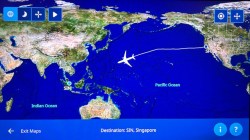
Today (I’m calling it two days because we’re crossing the Date Line), Kenna and I are flying from San Francisco via Singapore to Denpasar, Indonesia, the main airport for Bali. Dave and Jan left a day or so earlier.
Our departure from San Francisco was late in the evening (10:40 p.m.), so we had the day to finish a little work, complete packing, and clean up the house before the Lyft driver picked us up at 7 pm. The airport was uncrowded, and we had a relaxing time in an airport lounge. The departure was delayed a bit because the winds were favorable, and we aren’t allowed to land in Singapore too early in the morning.
Just before Thanksgiving, NPR‘s All Things Considered radio program had a short item on DMARC, a protocol that attempts to control fraudulent use of internet domains by email spammers by asserting that messages coming from those domains are authenticated using DKIM or SPF. Since I have been working in that area, a colleague alerted me to the coverage and I listened to it online.
A couple of people asked me about my opinion of the article, which I thought might be of interest to others as well.
From the introduction:
JENNA MCLAUGHLIN, BYLINE: Cybercriminals love the holiday season. The internet is flooded with ads clamoring for shoppers’ attention, and that makes it easier to slip in a scam. At this point, you probably know to watch out for phishing emails, but it might surprise you to know that there’s a tool that’s been around a long time that could help solve this problem. It’s called DMARC – or the Domain Message Authentication, Reporting and Conformance Protocol – whew. It’s actually pretty simple. It basically helps prove the sender is who they say they are.
Of course it doesn’t help prove the sender is who they say they are at all, it expresses a request for what to do when the sender doesn’t. But I’ll forgive this one since it’s the interviewer’s misunderstanding.
ROBERT HOLMES: DMARC seeks to bring trust and confidence to the visible from address of an email so that when you receive an email from an address at wellsfargo.com or bestbuy.com, you can say with absolute certainty it definitely came from them.
(1) There is no “visible from address”. Most mail user agents (webmail, and programs like Apple Mail) these days leave out the actual email address and only display the “friendly name”, which isn’t verified at all. I get lots of junk email with addresses like:
From: Delta Airlines <win-Eyiuum8@Eyiuum8-DeltaAirlines.com>
This of course isn’t going to be affected by Delta’s DMARC policy (which only applies to email with a From address of @delta.com), but a lot of recipients are going to only see “Delta Airlines.” Even if the domain was visible, it’s not clear how much attention the public pays to the domain, compounded by the fact that this one is deceptively constructed.
(2) There is no absolute certainty. Even with a DKIM signature in many cases a bogus Authentication-Results header field could be added, or the selector record in DNS could be spoofed by cache poisoning.
HOLMES: So the thing about good security – it should be invisible to Joe Public.
This seems to imply that the public doesn’t need to be vigilant as long as the companies implement DMARC. Not a good message to send. And of course p=none, which for many domains is the only safe policy to use, isn’t going to change things at all, other than to improve deliverability to Yahoo and Gmail.
HOLMES: I think the consequences of getting this wrong are severe. Legitimate email gets blocked.
Inappropriate DMARC policies cause a lot of legitimate email blockage as well.
When we embarked on this authentication policy thing (back when we were doing ADSP), I hoped that it would cause domains to separate their transactional and advertising mail, use different domains or subdomains for those, and publish appropriate policies for those domains. It’s still not perfect, since some receive-side forwarders (e.g., alumni addresses) break DKIM signatures. But what has happened instead is a lot of blanket requirements to publish restrictive DMARC policies regardless of the usage of the domain, such as the CISA requirement on federal agencies. And of course there has been a big marketing push from DMARC proponents that, in my opinion, encourages domains to publish policies that are in conflict with how their domains are used.
Going back to my earlier comment, I really wonder if domain-based policy mechanisms like DMARC provide significant benefit when the domain isn’t visible. On the other hand, DMARC does cause definite breakage, notably to mailing lists.

Thursday, October 27, 2022
With the other members of our group having already departed, we joined our friends Liz and Peter to explore a few more places in Montgomery. We started our day at the Civil Rights Memorial Center, part of the Southern Poverty Law Center headquarters. The Memorial Center wasn’t large, but had some excellent multimedia presentations on the civil rights struggle, both historical and ongoing.
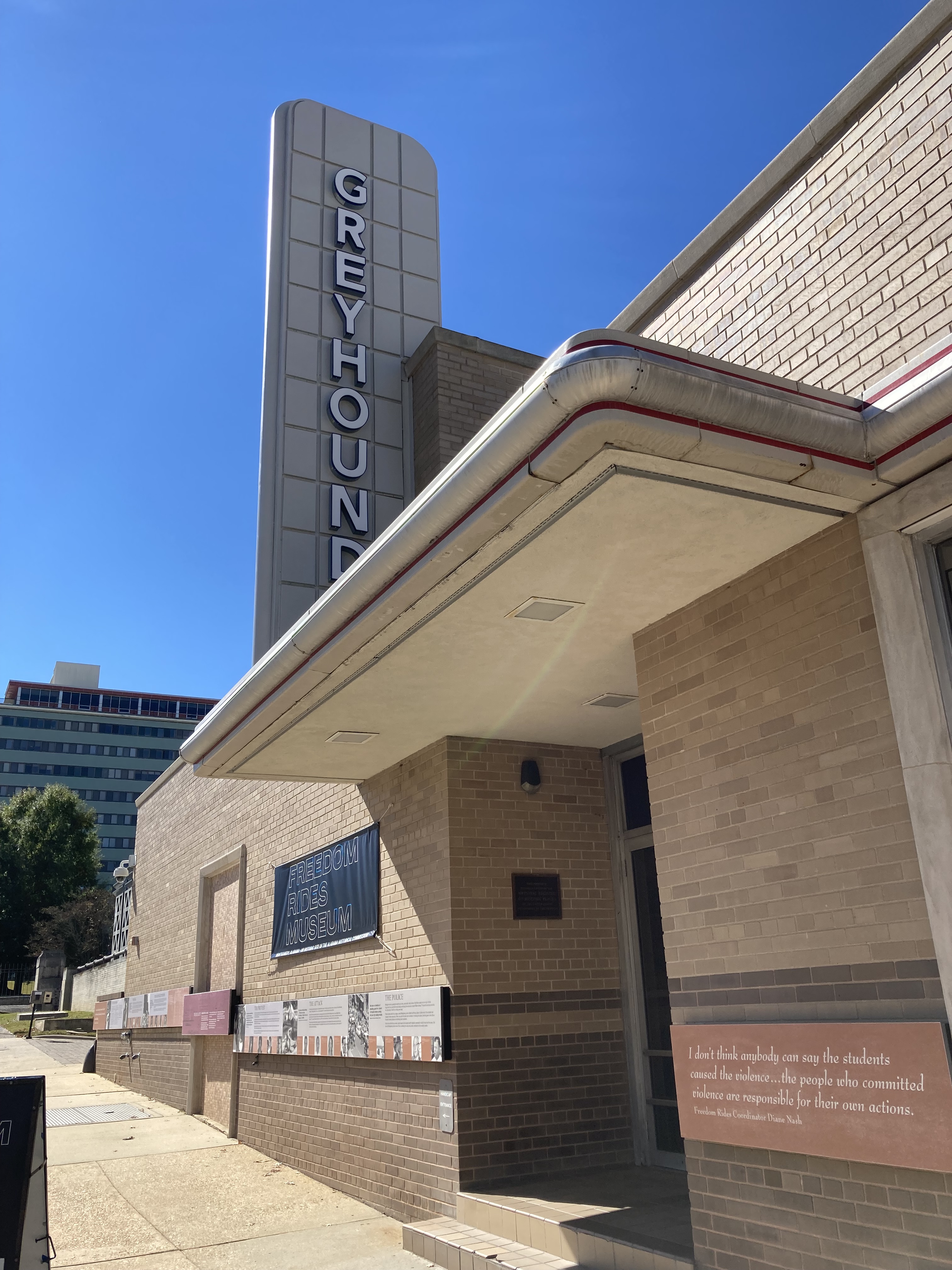
From there we walked over to the former Greyhound bus station associated with the Freedom Riders. The station is now a small museum, the Freedom Rides Museum, and has signs on the outside with a detailed history. While there, a Black woman drove up to take some video of the bus station and we had a somewhat surprising conversation with her. She was not entirely pleased with the placement of all of the civil rights museums and displays in Montgomery — she thought that the Black community needed to strengthen themselves and didn’t need to be constantly reminded of their struggles.
From there we walked to the Rosa Parks Museum a few blocks away. The museum tour consisted of a couple of multimedia presentations describing the background and events of the day she refused to give up her seat on a city bus, which gave us a much more detailed understanding of the events of that day and the questionable legality of her arrest. This was followed by a short self-guided tour of artifacts relating to the tension between the Black community and the police.
It was then about time to make our way to the airport for our flights home. We returned to our hotel to retrieve our bags and got a Lyft ride to the airport. The Montgomery Regional Airport is a fairly small airport consisting of about five gates located only about 15 minutes from downtown. TSA inspection was quick and we had a small lunch in the airport’s one restaurant. Co-located with the airport is an Alabama Air National Guard base, which surprised us as several pairs of fighter planes — F-16s I think — took off with considerable noise and speed.
This article is the final installment in a series about our recent travels to the US South. To see the introductory article in the series, click here.

Wednesday, October 26, 2022
Today was the last day of the official tour (we are staying a day longer) and a very powerful day. After breakfast at the hotel, we went to the Legacy Museum, a large and modern museum established by the Equal Justice Initiative to tell the story of Black experience from enslavement to mass incarceration (the current situation). The museum proceeded roughly chronologically from the slave trade, slavery, the Civil War, reconstruction, Jim Crow segregation, and lynchings, to the current disproportionate sentencing and incarceration of Black people. The images and words used in the museum were very strong and intentionally uncomfortable for many. We were somewhat prepared by our recent experience, but the story was very uncomfortable nonetheless.
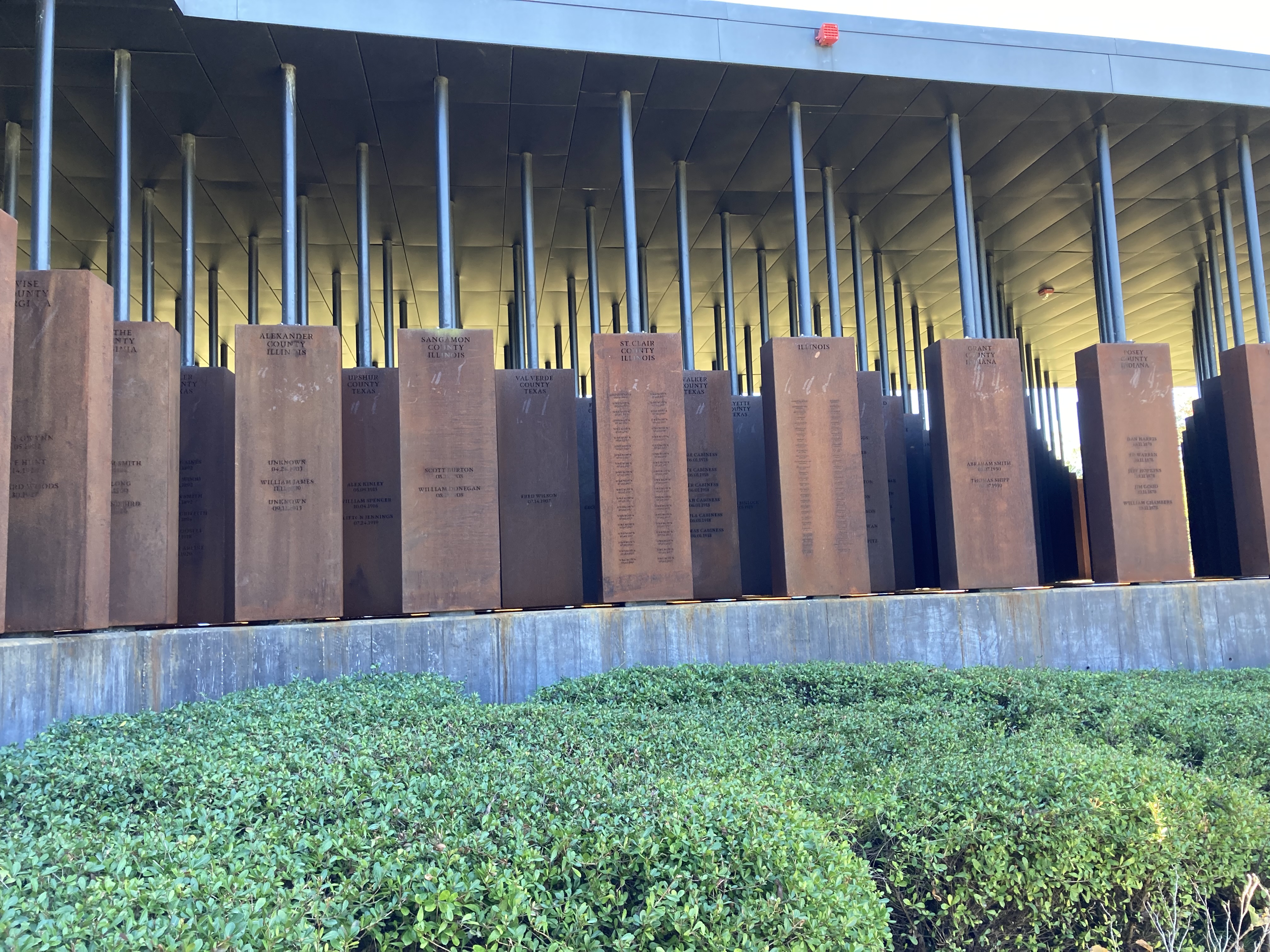
Following the museum, we traveled to another of Equal Justice Initiative’s projects, the National Memorial for Peace and Justice. The memorial, which is outdoors, includes hundreds of large corroded iron rectangular blocks that, by county, list the names and dates of lynching victims up to 1950. There was also a section to recognize counties and states that had put up markers recognizing the deaths of these victims. I was struck by the number of markers and names of people who had been lynched; this presentation of the names helps one appreciate the magnitude of the lynching problem.
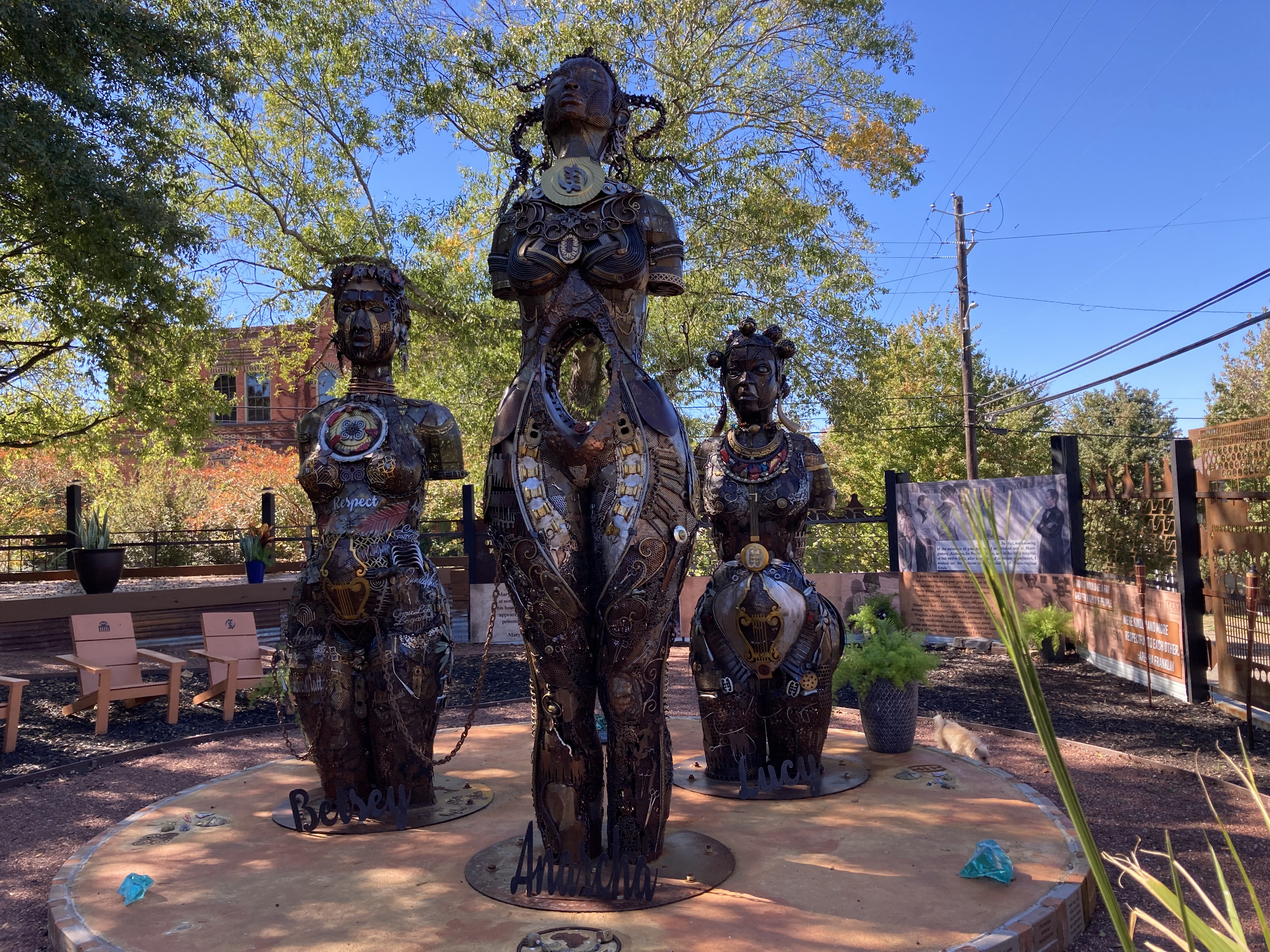
We then traveled to the studio (for lack of a better name) of Michelle Browder, who led us on our tour yesterday, for lunch and discussion. After lunch, Michelle showed us her artwork, which included large sculptures and an old car that had been intricately decorated by use of a plasma cutter on its body. Her artwork and advocacy were recently highlighted in People Magazine.
We then sat down for a final debrief on our memories of the week before the first of our co-travelers had to leave for the airport.
Afterward, our friends Peter and Liz joined us in visiting the Museum of Alabama, located in the state archives building near the capitol. The museum was well presented, but we were now better equipped to read between the lines of many of the descriptions. For example, commerce often meant slave trade.
After returning to the hotel to clean up, we went to a nearby brewpub, the Tower Taproom. It had quite good pub food, and an interesting array of self-service taps that were enabled using a card they issued at the cash register. The taps measured beer (a good selection, plus a few wines and ciders) by the ounce, and you were charged for the amount you poured.
This article is part of a series about our recent travels to the US South. To see the introductory article in the series, click here.

Tuesday, October 25, 2022
After getting up and packing for today’s trip to Montgomery, we loaded up the bus and made the very short trip to the Selma Center for Nonviolence, Truth, and Reconciliation (SCNTR). We had breakfast at the Center, followed by training, focusing on the meaning and application of nonviolence, from the Center’s director, Ainka Jackson. One of the major themes was the difference between nonviolence, which is an active role, from the passive role of non-violence (or avoidance of violence).
Lunch was also at SCNTR and featured a powerful presentation from Callie Greer on nonviolence and forgiveness. Many years ago, her son was shot and killed in an argument with one of his peers. When the perpetrator was put on trial, she asked in her victim statement that he not be sentenced to death or to life in prison, but rather be given a minimum sentence. The judge, stunned, complied. She met the perpetrator after he had served his prison time and asked for his mother to contact her. Callie and the perpetrator’s mother continue talking to this day.
Another situation that Callie related was that her daughter found a breast lump. Due to the lack of appropriate healthcare, her cancer was not diagnosed until it had progressed too far and the daughter died. She is finding it difficult to forgive the healthcare system (specifically, the lack of Medicaid in Alabama) for this.
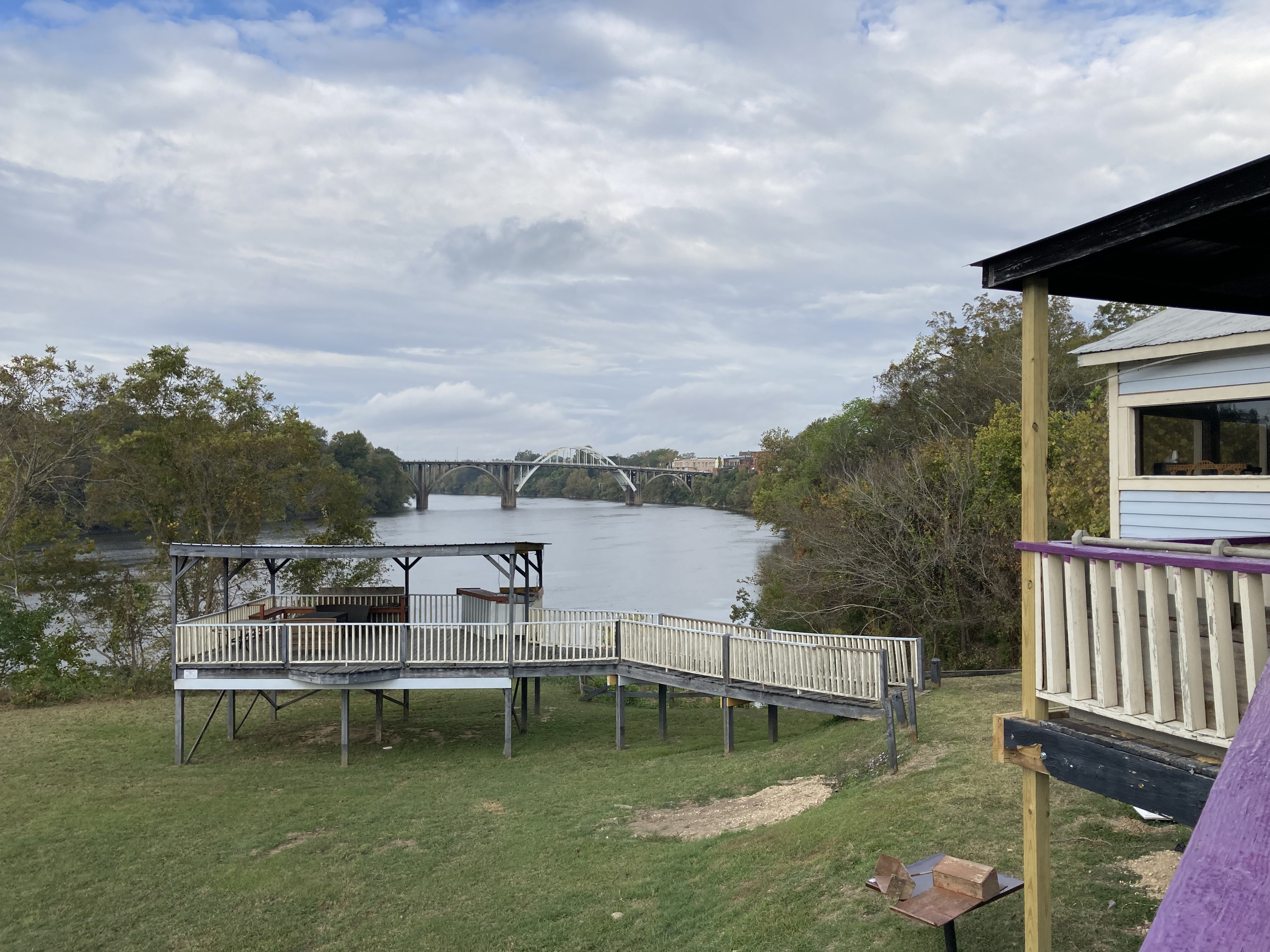
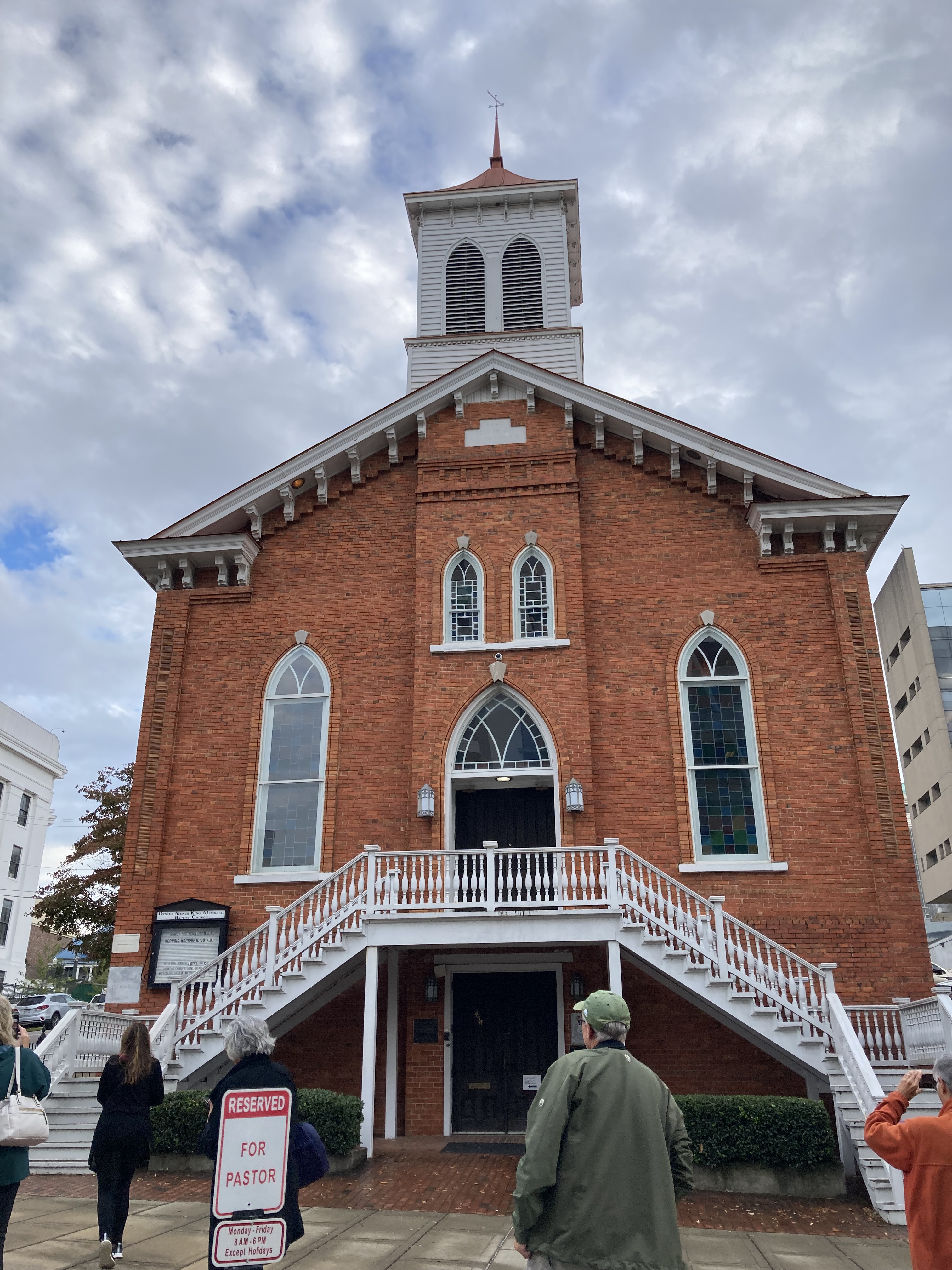
After the lunch discussion, we rode the bus across the Pettus bridge and on to Montgomery, Alabama. Downtown Montgomery is a considerably more attractive capital than downtown Jackson, probably due to their focus on attracting conventions and other travelers. When we arrived, we met Michelle Browder, who in addition to being our tour guide is an entrepreneur. She is focused on telling a more complete story about the role of Black women as test subjects in the development of gynecological treatment, and how they were victimized in undergoing this experimentation.
Michelle led us on a tour that began at the waterfront of the Alabama River, and gave us a lesson on reading between the lines of the historical markers in town. She pointed out in particular three markers that highlighted the slave trade and Montgomery’s role in it. There were to be more of these markers, but of course the city stopped the project.
After the tour, we returned to check into the hotel (the Renaissance, probably the nicest hotel in town), and gathered at Central, a nearby restaurant that is also among the best. This was the final group dinner of the trip, because most of the group will be leaving tomorrow afternoon.
This article is part of a series about our recent travels to the US South. To see the introductory article in the series, click here.
Monday, October 24, 2022
After a buffet breakfast at our hotel, we had an hour or so with Mike Espy, former Secretary of Agriculture, Congressman, and Senate candidate. Secretary Espy discussed the political climate in Mississippi in quite some detail, and made it yet more clear that Mississippi politics are more complicated than one might think, and civil rights is not a lost cause.
We then boarded our bus for the three-hour bus ride to Selma, Alabama. Selma today is a somewhat depressed town of about 18,000 having one of the highest murder rates in the state. In the 1960s, Selma was an important site for the civil rights movement. In 1965, attempts were made to march from here to the state capitol in Montgomery to demand voting rights. Initially this Freedom March was blocked by police and resulted in considerable injury to the protesters. Eventually a successful march was held following issuance of a court order.
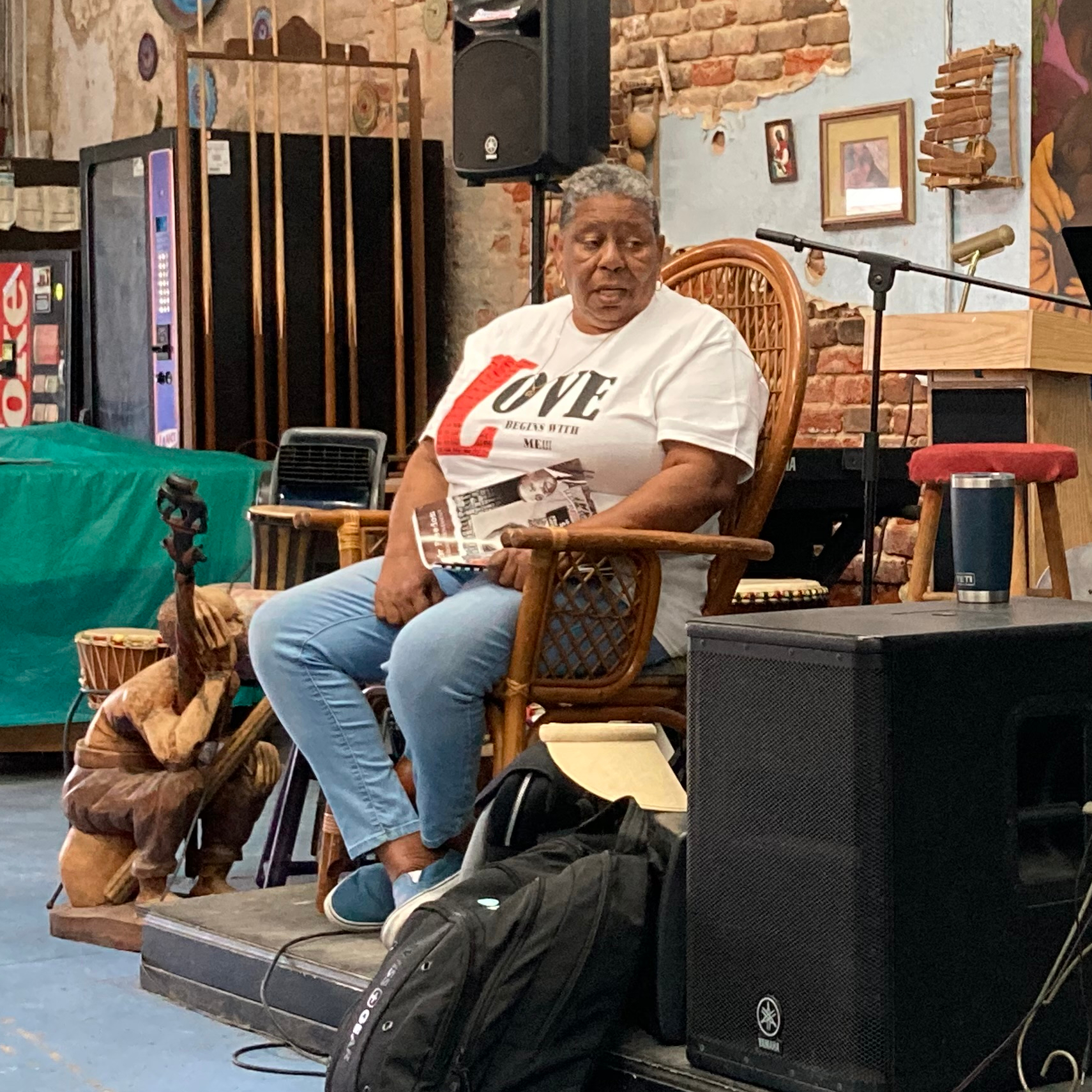
Upon arrival, we visited the By the River Center for Humanity, a mixed-use community facility. They served us a delicious lunch which was followed by a talk by JoAnne Bland, one of the participants in the Freedom March. She shared with us some of her vision for Selma, and led us in a bit of singing and dancing as well.
We then walked across the famous Edmund Pettus Bridge, and visited the National Voting Rights Museum just across the river from Selma. The museum had artifacts and pictures from the Freedom March, as well as considerable material on subsequent visits to Selma by presidents, particularly Bill Clinton and Barack Obama.
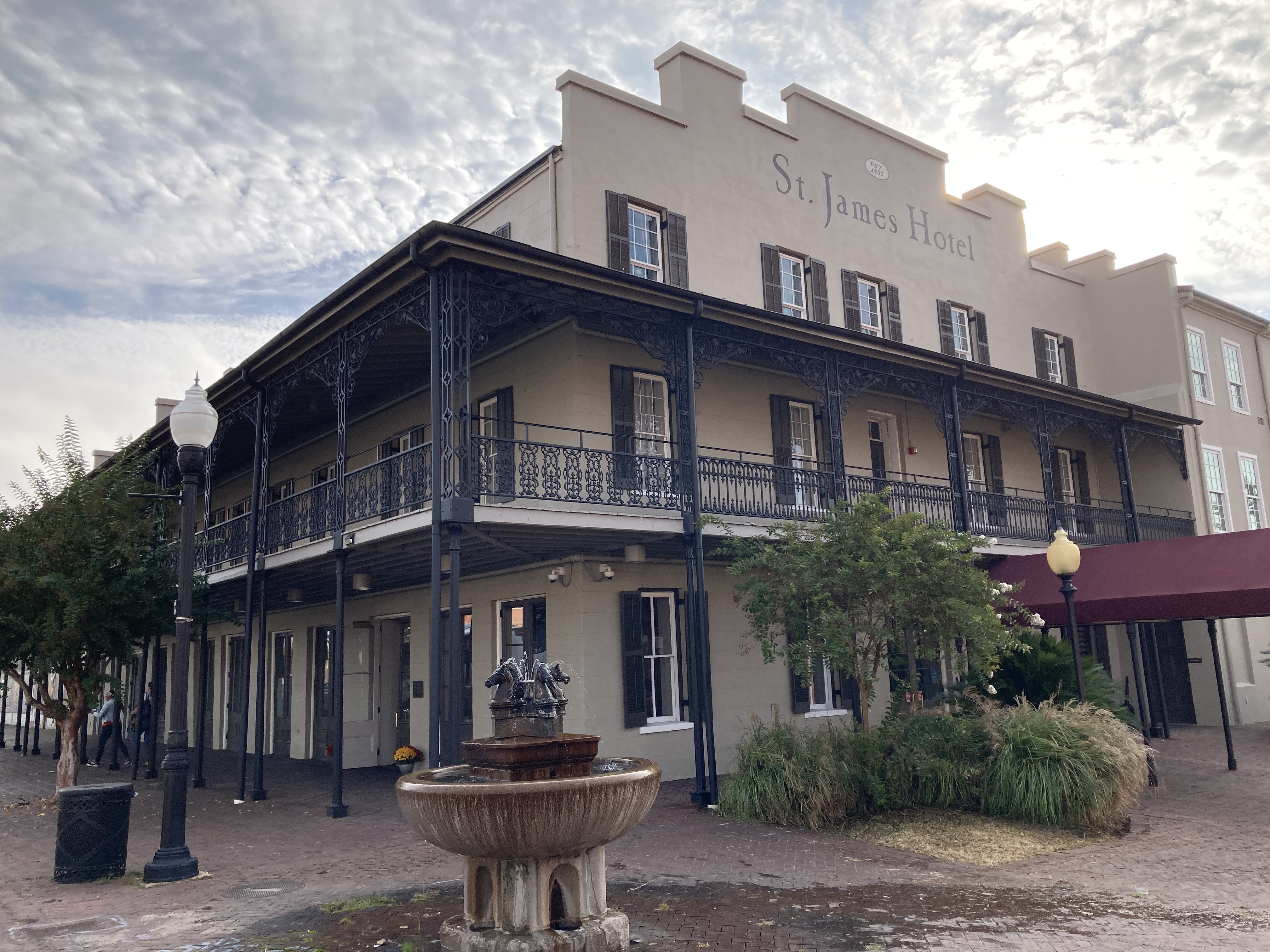
After a short break at our hotel (the St. James hotel, recently renovated by Hilton), we took a short walk to The Revolt Selma, a new restaurant opened by a Black entrepreneur, for a buffet-style steak dinner.
This article is part of a series about our recent travels to the US South. To see the introductory article in the series, click here.

Sunday, October 23, 2022
We started earlier than usual today in order to catch the 8 am service at New Horizons Church, a majority-Black church in a former strip mall in southern Jackson. The facility was beautifully adapted to its use as a church, and we were warmly welcomed. Most of the music was presented by a children’s group, which was very talented.
After the service, we met with the Senior Pastor, Bishop Ronnie Crudup. He described the formation of the church and also went into considerable detail about the political climate in Jackson and more generally in Mississippi. One story that struck me was that the Governor, rather than distribute federal aid from the American Recovery Act, sent at least some of the money back to the federal government saying that it was not needed. This struck me as simply cruel. In any case it is organizations like New Horizons that are developing the community for future leadership.
We then went to a local restaurant for brunch with some local women leaders (and teenage leaders) who are working in the area of voting rights and getting the Black community, and Black women in particular, to participate in the political process and specifically to vote.
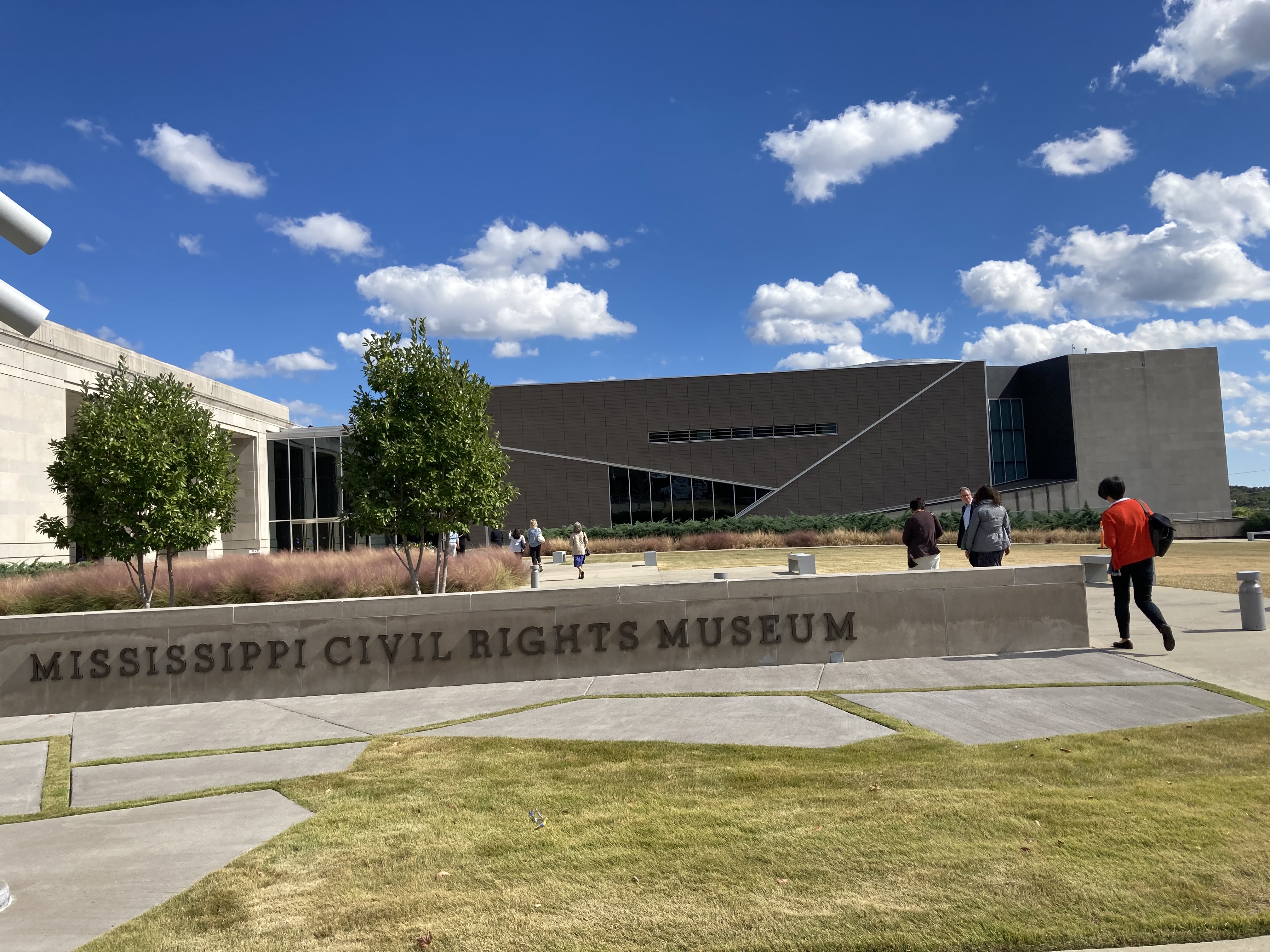
After brunch we took our bus to the Mississippi Civil Rights Museum in downtown Jackson. The museum is, perhaps surprisingly, funded by the State of Mississippi. We started out with a short talk by Hezekiah Watkins, one of the original Freedom Riders. We then had some time — although not enough — to explore the museum, which took us from the days of slavery to the present, with an emphasis on the mid-20th century civil rights movement.
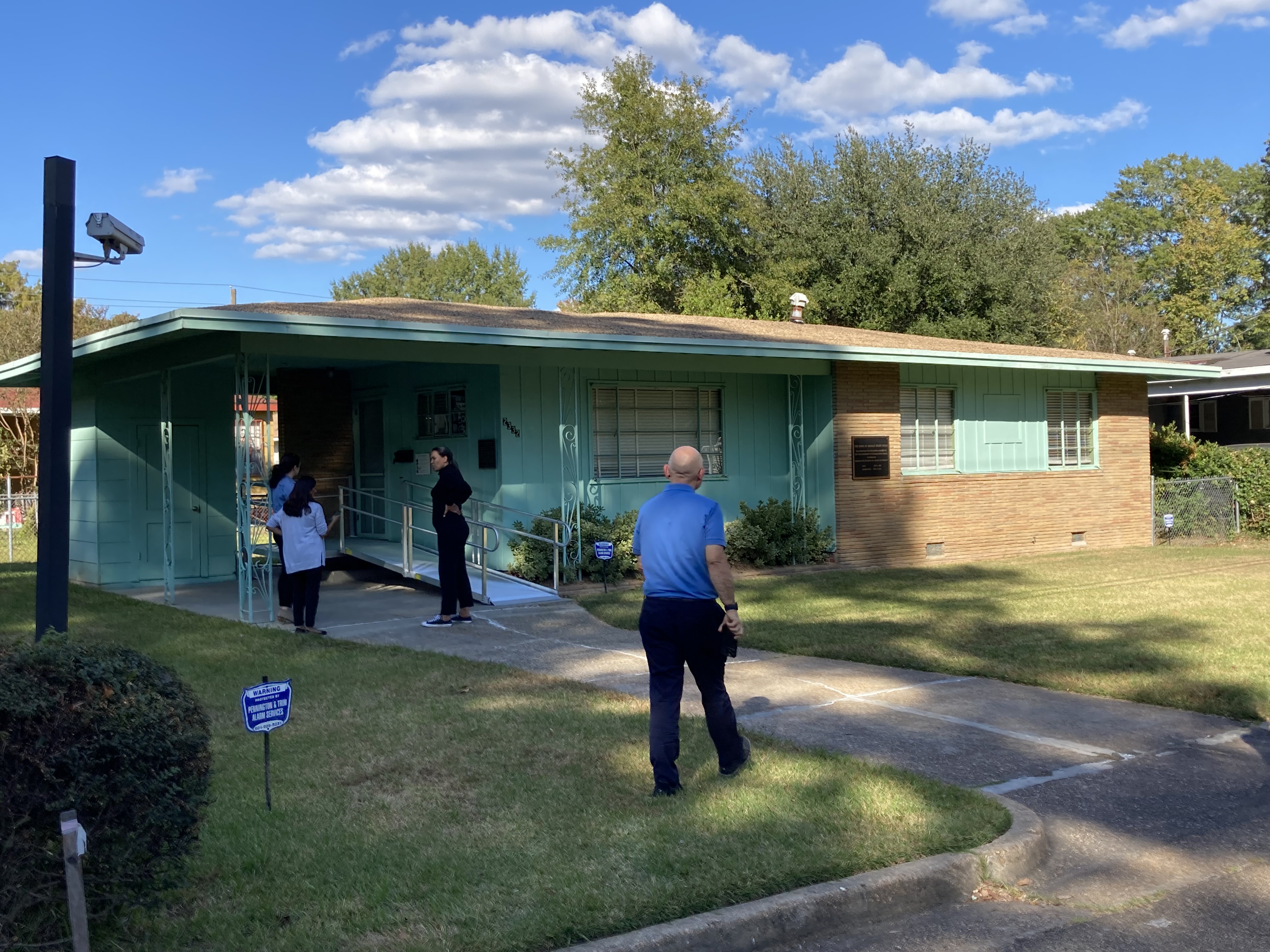
We then took the bus to the Medgar Evers home. Evers, the field secretary for the Mississippi NAACP, was shot and killed there in 1963. The house has recently been designated as a national monument, but unfortunately wasn’t open for tours when we were there.
This article is part of a series about our recent travels to the US South. To see the introductory article in the series, click here.

Saturday, October 22, 2022
Today we are off to Jackson, Mississippi. We are also changing focus from history (enslavement) to contemporary civil rights issues. After breakfast we had a visit from three community members involved in trying to improve the criminal justice system in Louisiana. First we heard from Will Snowden of the Vera Institute. He spoke about their initiative to reduce the population in Orleans Parish jails following Hurricane Katrina from about 7200 to 1000, largely by observing the distinction between jails (typically short-term detainees awaiting trial) and prisons (long-term convicted detainees). This distinction gives long-term detainees the potential to have access to education and training programs to help them develop. Vera Institute is working more broadly to improve equity in the criminal legal system in Louisiana as well.
We then heard from Everett “Buck” Ofray and Louis Gibson, both former long-term detainees who had been convicted of second-degree murder. They described their journey from arrival at Louisiana’s notorious Angola Prison, forced to labor initially without pay and later for only 20 cents an hour. Held without parole, they had to challenge the system to obtain access to education and vocational opportunities. Eventually they worked their way into more and more responsible jobs like maintaining aircraft for the State Police. Changes in law allowed them to eventually be paroled. They described their process of re-integration into society; both are now working to assist other recent detainees. Louis is also working as a paralegal. This was truly an inspirational talk.
We then loaded into our bus for the three hour drive to Jackson, Mississippi for the next phase of our journey. We stopped along the way for a picnic lunch and to discuss what we have learned so far.
This is also homecoming weekend, a big deal in Jackson, so we expect everything to be crowded. We had dinner this evening at the Char Restaurant, again a very enjoyable meal. Tomorrow will be an early and full day, so we are turning in early.
This article is part of a series about our recent travels to the US South. To see the introductory article in the series, click here.

Friday, October 21, 2022
After breakfast at our hotel, we got on the bus and went east to visit one of the bayous. Along the way, we stopped and were introduced to a native American couple who explained the many ways that the oil industry in the area had impacted their lives. In addition to needing to relocate, they were severely affected by the Gulf of Mexico oil well disaster, and continue to endure health threats from toxic emissions from the refineries, many of which have been made legal through lobbying efforts on behalf of the oil companies.
We continued east through St. Bernard Parish, and as we did, we saw many skeletons of dead oak trees. These have apparently died due to increased salination of the underground aquafer. Many homes were seen that were propped up on platforms typically 20 feet above ground. Many of these homes were owned not by locals but by sport fishermen as second homes or as rentals. As we looked out into the waterway, it was fairly obvious which boars belonged the visiting sport fishermen and which were owned by locals. As our hosts explained, the waterway is always in a state of transition. There have been efforts to open new channels from the Mississippi River to the Gulf of Mexico, and other projects that would change the salinity of that portion of the delta. Nobody seems to be sure how long this will last.
Returning to New Orleans, we had lunch at a very pleasant restaurant, Carmo. Our next stop was at a youth development organization called Son of a Saint. Housed in a newly renovated former ice house, Son of a Saint provides mentorship services to boys who have lost their fathers. Engagement with them begins in middle school and extends through their educational career and beyond. They have a very impressive track record with the boys they have mentored.
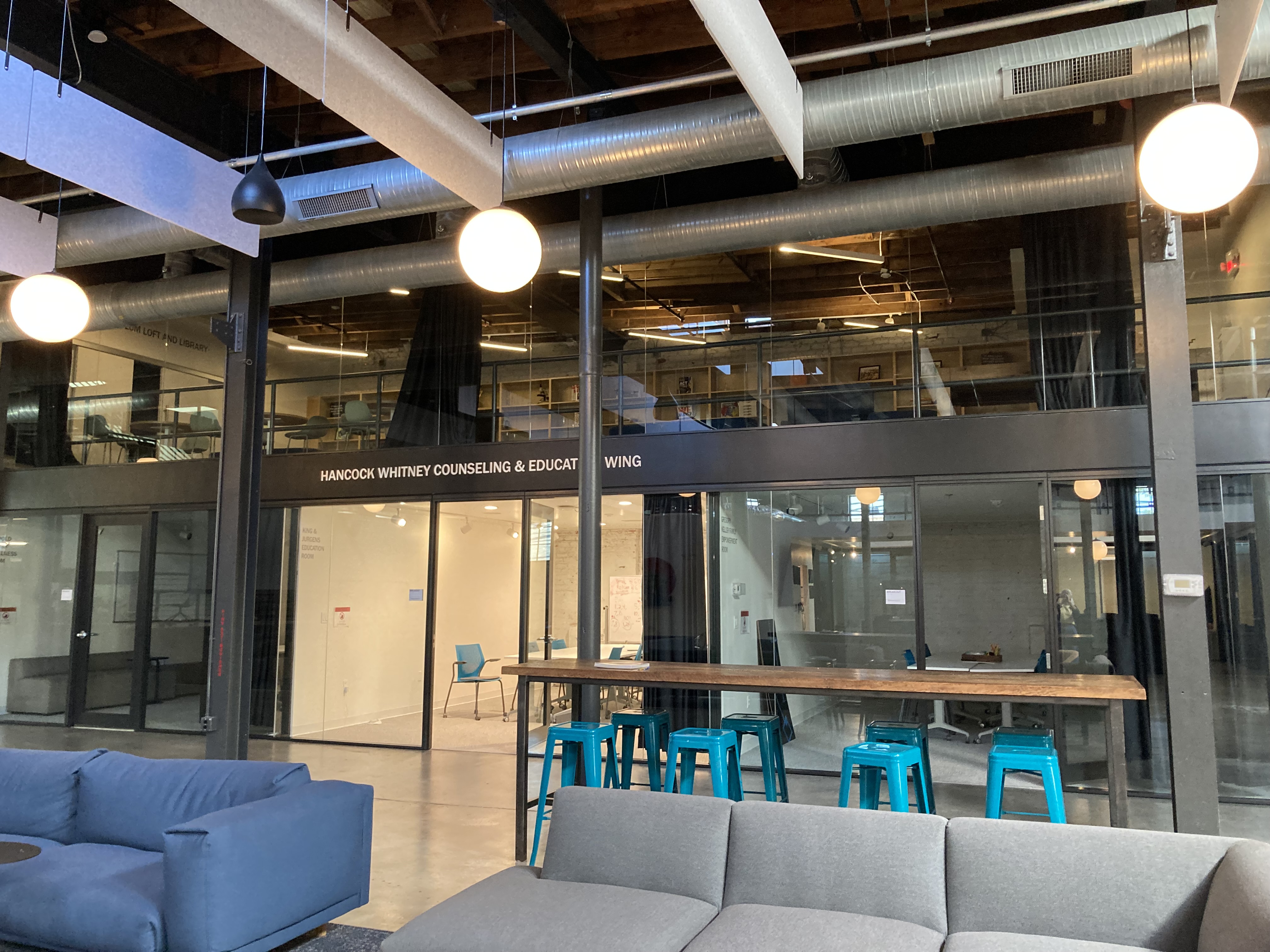
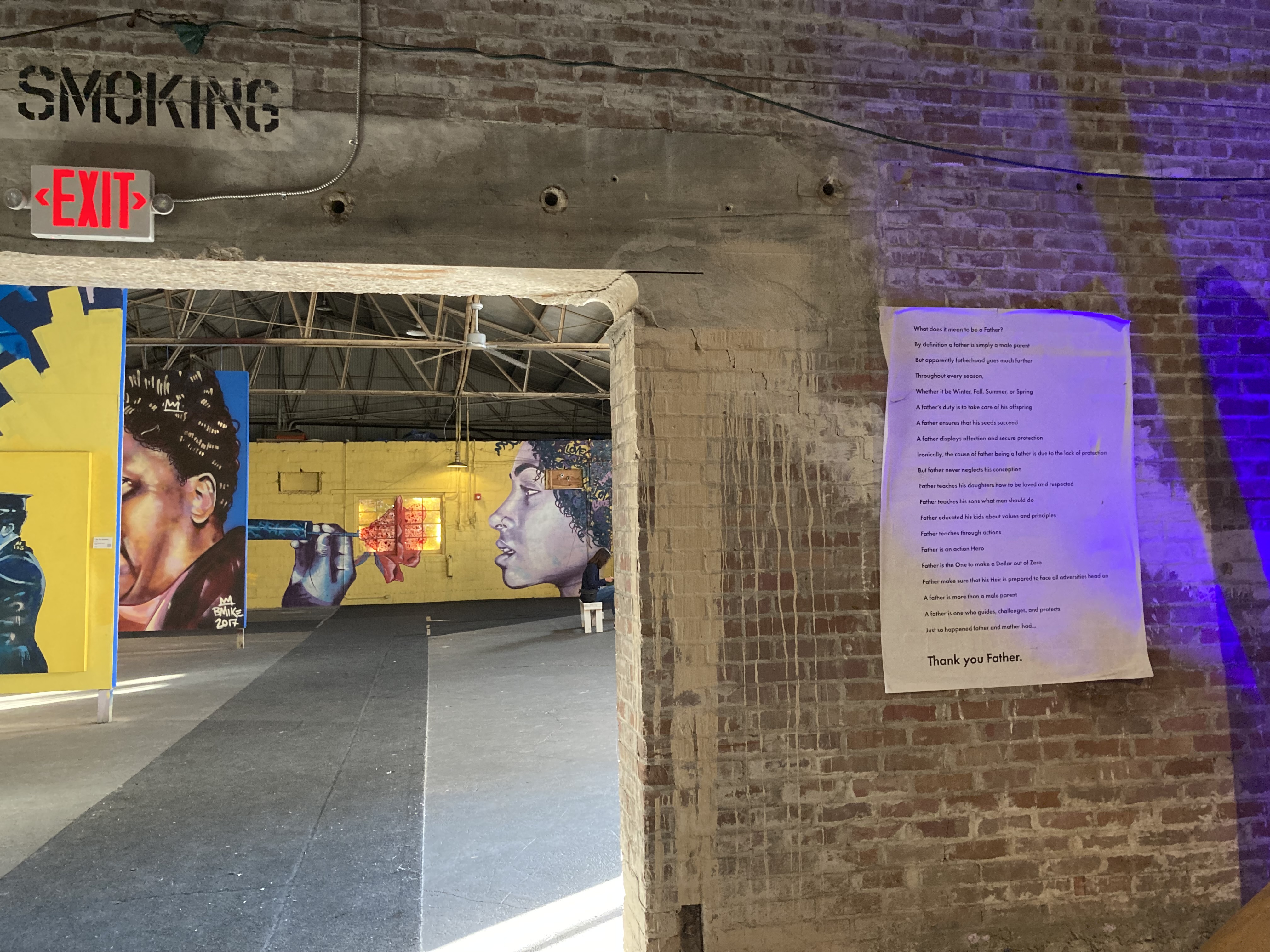
We then traveled to StudioBE, a warehouse art gallery space featuring the art of “BMike”, a local urban artist. As you might expect, BMike’s preferred medium is spray paint, but the amount of expression and detail he is able to impart is truly impressive. But spray paint is not his only medium: there were exhibits in many forms, even simulated video games. Along with the art were words that were in many cases quite profound. This visit definitely broadened my art tastes.
After a short break at the hotel, the group went to dinner at the Windsor Court Hotel, where we had stayed on our visit to New Orleans about 10 years ago. It was a wonderful dinner, definitely too much food but all of it delicious.
This article is part of a series about our recent travels to the US South. To see the introductory article in the series, click here.
 Altmode