
This is part of a series about our vacation to the Galápagos Islands and mainland Ecuador. To see the first article in the series, click here.
August 16, 2010
The day began early; although we had a 9:15 am flight to Miami, we were told to be at the airport three hours early, and shuttles from the Hilton only operate every hour so we caught the 6:00 shuttle. It turns out that we had plenty of time. Fortunately, the Quito airport has free WiFi so we were able to catch up on email and such while we waited for the flight.
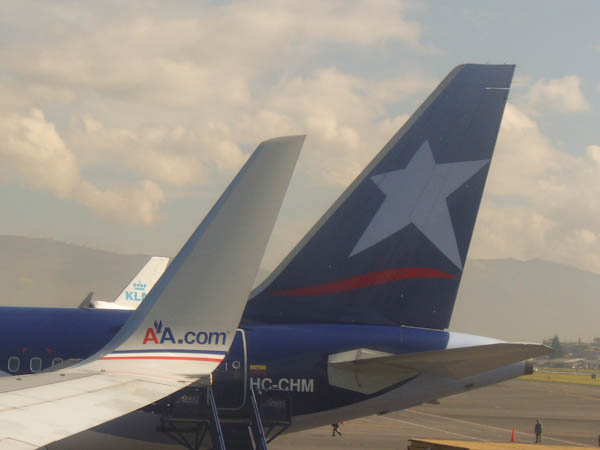 Quito has grown up around its current airport, and as a result it doesn’t have room to expand or lengthen its runway, which (as Antonio told us the other day) is too short for some aircraft. Much as many other cities have done, Quito is building a new airport further outside the city, to be surrounded by a green belt to prevent the same problem from occurring anew. Unlike many such airports, however, the existing Quito airport hasn’t been allowed to get shabby. The facilities are modern and clean, giving no indication that the airport is about to be replaced.
The flights were, happily, uneventful and on time. Our return was also through Miami, and although we are aware of Miami’s reputation for being a difficult place to clear US Customs, we had no such problems.
We would have been happy with a shorter (less than 5 hour) layover in Miami, but taking time for dinner helped fill the time.
We didn’t particularly like the selection of movies offered on either flight, so we watched a movie on our iPad that we had rented through iTunes. We used a three-way splitter on the audio output of the iPod which initially didn’t sound right for Kenna and me. It turns out we both were using Apple earphones than have an extra contact on the connector for the volume control and play/stop button. By pulling out the plug a little bit we got the audio to sound right.
At the risk of using a cliché, even though it was a fantastic trip, it’s always good to be home.
The day began early; although we had a 9:15 am flight to Miami, we were told to be at the airport three hours early, and shuttles from the Hilton only operate every hour so we caught the 6:00 shuttle. It turns out that we had plenty of time. Fortunately, the Quito airport has free WiFi so we were able to catch up on email and such while we waited for the flight.
Quito has grown up around its current airport, and as a result it doesn’t have room to expand or lengthen its runway, which (as Antonio told us the other day) is too short for some aircraft. Much as many other cities have done, Quito is building a new airport further outside the city, to be surrounded by a green belt to prevent the same problem from occurring anew. Unlike many such airports, however, the existing Quito airport hasn’t been allowed to get shabby. The facilities are modern and clean, giving no indication that the airport is about to be replaced.
The flights were, happily, uneventful and on time. Our return was also through Miami, and although we are aware of Miami’s reputation for being a difficult place to clear US Customs, we had no such problems.
We would have been happy with a shorter (less than 5 hour) layover in Miami, but taking time for dinner helped fill the time.
We didn’t particularly like the selection of movies offered on either flight, so we watched a movie on our iPad that we had rented through iTunes. We used a three-way splitter on the audio output of the iPod which initially didn’t sound right for Kenna and me. Turns out we both were using Apple earphones with the extra contact on the connector for the volume control and play/stop button. By pulling out the plug a little bit we got the audio to sound right.
This is part of a series about our vacation to the Galápagos Islands and mainland Ecuador. To see the first article in the series, click here.
August 15, 2010
For the last day of our trip we had a half-day tour of Quito. As we began the tour, our guide, Susy, described some of the changes in the city over the past few decades. The city, particularly the old town at its center, became much too crowded by an influx of indigenous people from the country. In an effort to make the city more liveable, the government moved the large number of street vendors to an indoor location and began cleaning up the town. Much of this change has occurred in the past 10 years.
Quito is a very long, narrow town, extending about 60 km from north to south but only a few km wide due to the constraints of the Andes Mountains. South Quito is largely working class; north Quito is the “new city” where much of the businesses are located, and central Quito, the old town, is the center of government and culture.

Statue of the Virgin of Quito
We began our tour by driving up a hill topped by a large statue of the Virgin Mary, quite reminiscent of the statue of Jesus in Rio de Janeiro. There was a commanding view of the city from the top, as well as the surrounding mountains, a few of which are topped with snow. While we were there, a police helicopter circled and landed; we understand that some sort of drug enforcement operation was underway. Throughout the day, national and metropolitan police as well as private security guards were very much in evidence. Parts of Quito can be somewhat dangerous, especially after dark, and it seems that they’re determined to improve that situation.
Near the statue, we noticed a group of three bins for plastics, paper, and other trash. Throughout the day, we would see that these bins are ubiquitous throughout the city, something that puts Quito ahead of many cities in the United States.
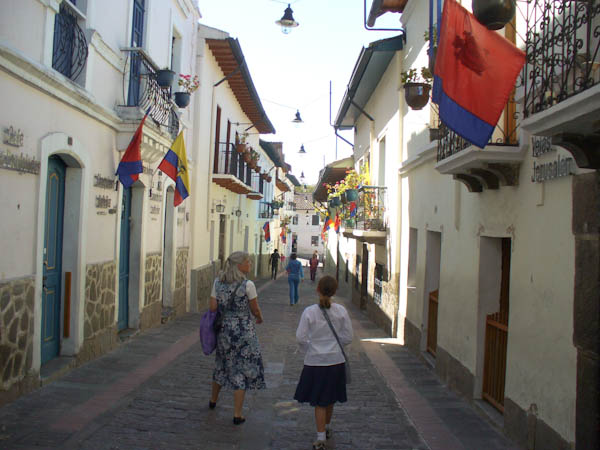
Street in Old Town
Once down from the hill, the van we were riding in dropped us off and most of the rest of the tour was on foot, which gave us a much better feel for the city. It also enabled us to visit many of the narrow streets in the Old City that are closed to vehicular traffic. Susy said that it is an adjustment for many who are used to taking their cars everywhere to park and either walk or take a taxi to their destinations. Quito is not unique in that respect.
We visited a few of Quito’s beautiful churches on our tour. The most notable, the Moorish-styled Compañía Church, was having an organ concert while we visited. While I don’t have any details on the organ, Susy told us that such concerts were extremely rare due to the fragility of the organ. It was a beautiful instrument; we had to choose between listening to the music and Susy’s description of the church which was worth listening to as well. Unfortunately, no photographs are allowed inside this or the other churches we visited.

Changing of the Presidential Guard
Following a short stop for coffee, we arrived at Independence Square for the weekly changing of the Presidential Guard. Antonio suggested yesterday that we see if we could get the tour adjusted to accommodate this, and it was quite a pageant. We arrived just as the Ecuadorean national anthem was played, and noted that a large number of spectators sang along. Susy joined as the audience shouted “Viva!” at the end. Clearly these people are quite proud of their country.
After a short visit to a beautiful hotel in the Old City (and possible venue for dinner), we returned by van to the Hilton where we are staying.
After freshening up, we decided to take a walk suggested by Susy up Amazonas street, one of the main streets in the new (north) town that passes by our hotel. I noticed that Amazonas has a two-way bike path on one side of the road that is separated from the roadway by a small curb. Unfortunately, I didn’t see a single bicycle using the path during our visit.
We stopped for lunch at a restaurant that (we decided) caters to tourists more than we might have wanted, although the food was good. This section of town seems to be set up to accommodate young people who are visiting, perhaps to learn Spanish, from English-speaking countries. We walked through an unusual but drab shopping mall that was built entirely in a helical shape: the floor sloped upward its entire length, about six floors. We walked past quite a number of other shops but none were particularly interesting.

Playground in Parque El Ejido
Across the street from our hotel is a park which has a small market, with many of the same things we saw in Otavalo yesterday. There was also a great array of playground equipment that Celeste had quite a good time trying out.
At dinnertime, we had planned to have a nice dinner out to mark the last day in Ecuador, but we weren’t particularly hungry so ordered some appetizers in the hotel bar for dinner. They were excellent.
Packing for our departure tomorrow consumed the evening. We retired early, as we’ll be up early as well.
Quito is a surprising town in many respects. It’s not immediately obvious that there is a lot of urban renewal in progress because of the attention being paid to preserving the architectural style, particularly in the Old Town. As was my initial impression upon arriving in Ecuador, Quito has a distinctly European feel. As with yesterday’s tour of Otavalo, our day discovering Quito was well spent.
This is part of a series about our vacation to the Galápagos Islands and mainland Ecuador. To see the first article in the series, click here.
August 15, 2010
When we booked this trip, we thought it would be a shame to come all this distance and not see some of the human culture as well as the animals. For our first full day in Quito, we arranged for an all-day “Otavalo cultural experience” tour. Joining us on the trip were three members of another family from the cruise. Our very knowledgeable tour leader was named Antonio.
Otavalo is about 2 hours north of Quito on the Pan-American Highway. We quickly realized how rugged the Andes Mountains are around Quito. The road is well-built and wide enough, but the hills are steep. From Quito’s 9500 foot elevation, we descended down deep ravines and up hills, down to 6700 feet and up to 10200 feet, with many more twists and turns than are visible on most maps.
On the way to Otavalo, Antonio gave us a bit of a history lesson. Since early in 2000, Ecuador has used the US Dollar as its currency, a painful change in terms of loss of savings for virtually everyone. However, it has been a very positive change in stabilizing the economy by ending a period of hyperinflation and improving confidence in the economy.

Equatorial Monument
Our first stop was at the equatorial monument. Since I was watching the GPS, I knew that we had crossed the equator and back once already, due to the switchbacks in the road. The monument we visited is actually about .111 minute (about 678 feet) south of the actual equator indicated in my GPS (I tried both the WGS84 datum and Bogota map datum with similar results). This is probably due to a survey error, although Antonio pointed out that the earth’s wobble may account for a change in position. Antonio doesn’t like the other visitor center closer to the actual equator because there are some exhibits on Coriolis effects that he believes are rigged. He described them, and he’s probably right about that.
We continued to a small town that is noted for small pastries. We tried some, and they melt in your mouth. Seems like they have a lot of shortening.

Otavalo Market
We arrived at the Otavalo market about 10:30 am, and spent an hour shopping and buying a few small things. It is local custom to bargain a bit when buying something, but i almost felt guilty about that because even the asking prices were so reasonable. I ended up getting a couple of souvenir t-shirts for $4.75 each, an embroidered blouse for Celeste for $9.50, and so forth. The busy day at the market is Saturday, and it was a little quiet on Sunday morning although business picked up as we were leaving.

José at his loom in Peguche
From Otavalo we went to the small village of Peguche to visit José Cotacachi, a local artisan weaver. He demonstrated his loom and his assistant showed us the pigment cochineal, which is an insect that when crushed yields a strong red pigment that can be modified by the addition of an acid, a base, or sulfur powder. Kenna found a wonderful shawl there which we purchased, much higher in quality than anything you find in the public market.
We then took some back roads to Cusin, a hacienda where we had a wonderful lunch of Andean food. There were several local specialities whose names I unfortunately don’t remember that were very good.
On the way back, we stopped by another small village, Calderón, where they make small figurines out of pastry which they lacquer to stabilize it. The work they do is much more detailed than one would expect would be possible with pastry dough.
As we returned to Quito, we experienced one of the afternoon showers common in the region. We ended the day with a very favorable impression of Ecuador and its people, who were very friendly and kind to us.
This is part of a series about our vacation to the Galápagos Islands and mainland Ecuador. To see the first article in the series, click here.
August 14, 2010

National Geographic Endeavour
It is a sad day indeed. This morning we must leave first our cabins, then the Endeavour that has been our home over the past week. It seems like a much longer time considering all we have done, but also far too short. We must also say goodbye to many friends we have made. I’m sure this will be hardest on Celeste because there are several girls around her age that have been talking, laughing, and playing cards together in our free time the past several days. I hope that Kenna and I don’t seem too boring to Celeste for the rest of the trip.
We were due to depart the ship at 8:00, but they kept us on board longer (and showed us videos) until they got word that the plane we would board had left Guayaquil, which turned out to be about an hour late. We finally took our last Zodiac ride to the shore, and bus to the airport. There were about 20 minutes available for souvenir shopping, which mostly consisted of (more) calendars and a deck of the popular playing cards with local animal life pictured on each card. Once through security, we were admitted to a VIP lounge to wait in comfort for boarding.
Everyone was on the flight to Guayaquil. The dozen or so of us continuing on to Quito were seated in the front of the plane, which made it easy for us to say good-bye to our departing friends.
We were met in Quito by a Lindblad representative who helped get our bags loaded onto the bus that took us to the Hilton. We spent a couple of hours relaxing and getting organized, and then met others from the ship who are returning via Quito for dinner in the hotel restaurant. After a very good dinner (although not up to Endeavour standards), we said our good-byes as each of the family groups will be going in different directions tomorrow. Our direction will be Otavalo, a town a couple of hours north with a well known indigenous market.
This is part of a series about our vacation to the Galápagos Islands. To see the first article in the series, click here.
August 13, 2010

View from Bartolomé
We relocated overnight a short distance to the small island Bartolomé, near Santiago Island. Bartolomé has a path consisting of boardwalk and stairs that can be used to ascend to the peak at the center of the island. We started early and did a hike up this path before breakfast. The island is quite young, so there is very little in the way of soil and very little rainfall (again being in the rain shadow of Santa Cruz) so what little vegetation exists is well adapted for a dry climate. The peak gives a commanding view of the surrounding islands. There is a solar-powered beacon light at the top; I notice that there are solar panels on all sides because the sun can pass both north and south over the course of a year (although I wondered why the north and south solar panels were positioned at steep elevations so close to the equator).
We returned for breakfast and then took a ride on the ship’s glass-bottom boat near the island. We could see quite a variety of sea life, mostly similar to fish we had seen on snorkeling trips, except that now we were in a position to hear the naturalist at the same time. The highlight of the ride was a quick visit from a sea turtle that swam under the boat.

Beach on Bartolomé
A Zodiac boat then took us to a nearby beach where much of our group was either soaking up the sun or snorkeling. Although we had brought our snorkel gear, we decided not to go to the trouble of getting it on to go snorkeling. A few hearty souls went in the water without wetsuits, but did not stay for long. Celeste and her friends did some sand sculpture, including a very accurate sand depiction of a sea turtle. The sand was copper-colored, very fine, and wonderful to walk on.
After lunch, we spent some time packing and catching up on laundry while the ship relocated to Puerto Egas on the northwest side of Santiago Island. Santiago had been inhabited until about the 1970s by a salt mining operation, and is still recovering from the effects of species introduced long before that, including goats (which have been eradicated) and rats (which haven’t yet).
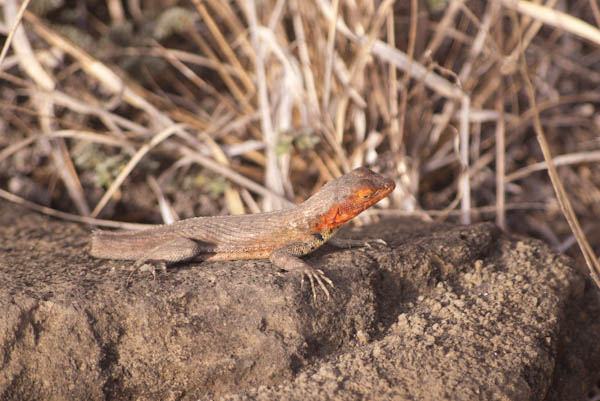
Santiago Lava Lizard (note missing tail)
The group we were touring with was growing too large, so another naturalist, Alexandra, attempted to split off part of the group into another one she would lead. However, Kenna, Celeste, and I were the only ones that saw her, so we got what amounted to a private tour of the trail. In addition to the “usual” sea lions, marine iguanas, and crabs (my, how quickly we get jaded), we saw several of the endemic lava lizards (this island’s lava lizards have a characteristic red streak down their side), a fur seal (technically a double-furred sea lion), and numerous birds including a striated heron and the colorful warblers.
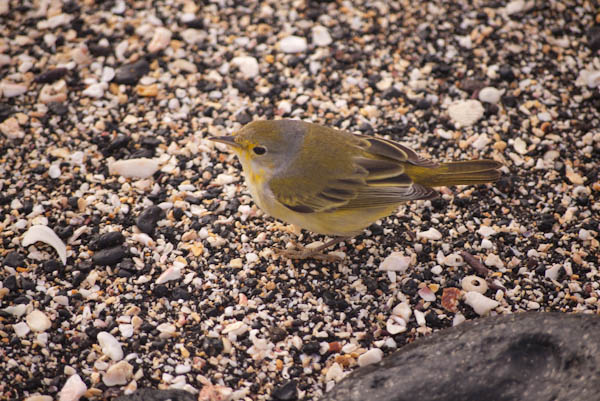
Yellow Warbler
There were many tide pools formed from the lava underfoot, and I was curious why they aren’t filled with sea creatures such as limpets as they are in California. Alexandra told us that that the water temperature varies widely over the span of a year, 30°F or more, due to the confluence of different ocean currents in the Galapagos, so limpets and such would probably not survive very long under those conditions.

Sea Turtle
An appropriate finale to this last hike on the Galápagos was the sighting of not one but two sea turtles in a lava inlet just feet from where we were standing. We got to watch them for a few minutes, and took several pictures before completing the trail and returning to the ship.

Galápagos Fur Seal
The farewell reception this evening was festive but muted because nobody wanted the trip to end. One of the ceremonies was the distribution of Zodiac boat driver’s licenses to the kids (including Celeste) who participated in driving lessons yesterday. The certificates entitle the kids to drive Zodiac boats on future cruises as long as they are in good standing with the Captain and ask nicely.
Dinner was excellent, as usual (getting jaded on this, too, apparently) and we are retiring early because we need to be ready for an early breakfast, with our bags packed, in the morning. Unfortunately, it was cloudy again this evening so no repeat of the spectacular star display from a few days ago.
For more information on this day’s activities, see the Lindblad Expeditions Daily Expedition Report.
This is part of a series about our vacation to the Galápagos Islands. To see the first article in the series, click here.
August 12, 2010

"Dragon" (Land Iguana)
We awoke this morning to a clear day, anchored amidst a number of small islets on the opposite (northwest) side of Santa Cruz Island. Our morning hike took us to a site known as Cerro Dragon or Dragon Hill, named after the endemic land iguanas that live there. We saw quite a number of them, as well as the large holes in the ground in which they live. Apparently feral dogs and cats had severely decimated the population of these iguanas, although this is getting much more under control. Nevertheless, someone from our ship heard, and one of the naturalists saw, a couple of small cats on the trail. This was a serious concern and reported to the authorities for eradication.
I’m happy to see that, unlike the developed portion of Santa Cruz island we saw yesterday, introduced species aren’t nearly as much in evidence, at least to my untrained eye. The naturalist explained that the developed (non-national park) portion of Santa Cruz was fairly small. I have to think that the drier climate here on the leeward side has a lot to do with it as well, because the wind and birds will carry invasive species’ seeds without regard for the boundaries. It’s nice to see that the problem is a little more contained than it seemed yesterday.
After the hike, we went out snorkeling along an islet known as Guy Fawkes Island. The water was a degree or so warmer today, and the sunshine helped visibility quite a bit. For most of the swim, the main attractions were very colorful marine creatures attached to the cliff on the side of the island. Toward the end, a very large ray (probably a manta ray, but I’m not sure) appeared below us, and then (finally!) a sea turtle. A sea lion also showed up to play, although there were so many other snorkelers in the water around her that it was difficult even to see her. Overall, an excellent snorkeling outing. Just before lunch, the kids went out on “Zodiac driving lessons” which all enjoyed.
While we ate lunch, Endeavour moved a short distance to the vicinity of a small islet known as Sombrero Chino or Chinese Hat, named for its elevation profile as seen from the ocean. While some of the nearby islets have a peaked but smooth profile (somewhat like the roof of a thatched hut), Sombrero Chino has a much craggier top.

Celeste and Jim on Kayak
After lunch there was a Darwin lecture for those interested and a Galápagos game for the kids, which Celeste did quite well on. Later, Celeste and I went out kayaking while Kenna went to the beach to watch. We didn’t get to see much wildlife from the kayak (as expected) but got some good exercise and practice paddling around. When we were returning the kayak, one of the other kayaks had come loose and we caught it, but were told to leave it alone; it seems that guests aren’t allowed to help with this sort of thing. On the Zodiac boat returning to the ship, we took a short detour and saw a penguin standing on a cliff in a small inlet. It was our first clear sighting of the Galápagos Penguin.
At the end of the afternoon, many of us (and all of the family) took a Zodiac boat ride around Chinese Hat and neighboring Bainbridge islets. Jan, the naturalist on our boat, explained that the craggier appearance of Chinese Hat was due to a more violent eruption there than on the other islands that look “thatched” due to an accumulation of ash. It is a very new islet as evidenced by the roughness of the lava.

Galápagos Penguins
On our ride, we returned to the site of the penguin sighting, and this time saw both an adult and juvenile Galápagos penguin. This time I had my good camera, fortunately, and got some good pictures of them and of a lava heron perched nearby.

Lava Heron
We returned for dinner and got a preview of the video they offer for sale of our week’s activities. In between pictures of our group there was apparent stock footage (there was a prominent picture of flamingos we are positive wasn’t taken this week), but it looks like a nice thing to have anyway as it does catch some events we remember like the flightless cormorant tugging at the ropes on our Zodiac. Dinner was a barbecue served out on the pool deck and sun deck, and was excellent as usual. Given the clear skies all day, we were looking forward to more star gazing this evening, but unfortunately it clouded over. No stars tonight.
For more information on today’s activities, see the Lindblad Expeditions Daily Expedition Report.
This is part of a series about our vacation to the Galápagos Islands. To see the first article in the series, click here.
August 11, 2010
Endeavour travelled all night in order to go from Fernandina around Isabela and back to the southern coast of Santa Cruz island near the center of the archipelago, a distance of about 110 miles. Two more crossings of the Equator, but no fanfare this time, especially since both were late at night. Today’s itinerary included the Charles Darwin Research Center, the city of Puerto Ayora, and other activities in the highlands north of Puerto Ayora.

Baby Española Tortoises
A large focus of the Charles Darwin Research Center is repopulation of the native giant tortoise populations on several of the neighboring islands. We got to see a number of enclosures within which they maintained separate populations of tortoises from each island, growing them until they are of sufficient size that they are ready for return to their “home” islands. As with baby animals of all sorts, the baby tortoises were extremely cute. Each one has a number pointed onto its shell as well as an implanted RFID chip to identify them and their home island. We also got to see Diego, a famous tortoise from Española Island that had been at the San Diego Zoo. When the tortoise population on Española was near extinction, the remaining male tortoises on the island were not, um, doing their jobs and a call was put out to zoos for help. Diego helped reestablish the tortoise population on that island, and today nearly all of Española’s tortoise population is descended from Diego.

Puerto Ayora Street Scene
Santa Cruz Island, and the town of Puerto Ayora in particular, is a bit of a shock after several days of being on pristine, well-protected islands like Fernandina. The waterfront area of Puerto Ayora was quite touristy, with everything from inexpensive souvenir shops to expensive-looking art galleries. You begin to realize what the inevitable consequences of modern human habitation are: motor vehicles, restaurants, stores, and litter. While there wasn’t as much litter as we had seen in Guayaquil, the total amount of litter we saw the last few days consisted of a single cigarette pack that Kenna picked out of the water on one of our snorkeling trips.

Banana Trees
The introduction of non-native species was also very evident here. As we traveled around the island, we saw banana and coffee trees, and were told that there were many avocado trees and coconut palms as well. Many cattle were seen grazing on elephant grass that was introduced to feed them, but the grass seems to have invaded everywhere. Blackbirds were introduced to rid the cattle of insects, but are now a problem as they have been observed eating the eggs of the native finches. Introduced blackberries block movement of the tortoises and are also extremely hard to control, since the birds eat the seeds and deposit them everywhere. The good news is that the birds that eat blackberries apparently don’t travel from island to island, so this problem hasn’t spread to the pristine islands.
After a short shopping break, we took a bus up the hill a few miles to a restaurant for lunch. Kenna, Celeste, and I had the driver let us out a couple of miles before we got there and walked the rest, giving us a better chance to see the countryside up close as well as a little extra exercise. After a great lunch, we headed out by bus for the Los Gemelos pit craters further up the hill.

Albino Ground Finch
The pit craters were striking by their abruptness, a sudden drop off with almost no warning (and fences only in certain places). They were surrounded by a forest of endemic Scalesia trees that supported a variety of bird species. Notable among the birds we saw was an albino ground finch.
We then proceeded to the property of a local farmer that sits in the middle of a tortoise migratory route. It was an unusual sight to see what looked like a typical field strewn randomly with giant tortoises. We saw somewhere in the vicinity of a dozen to 20 tortoises milling around and eating the vegetation.
On the way back to Puerto Ayora, we stopped off at a lava tube very similar to the walk-through tube in Volcanoes National Park. The Galapagos Islands, we are told, have many notable lava tubes such as this one.
This evening’s activities back on the Endeavour included a presentation from one of the scientists at the Charles Darwin Research Station. After dinner, we had entertainment from a local musical group along with lively dancing. Celeste particularly got into the dancing, but they even managed to recruit me at one point to join in.
For more information on the day’s activities, see the Lindblad Expeditions Daily Expedition Report.
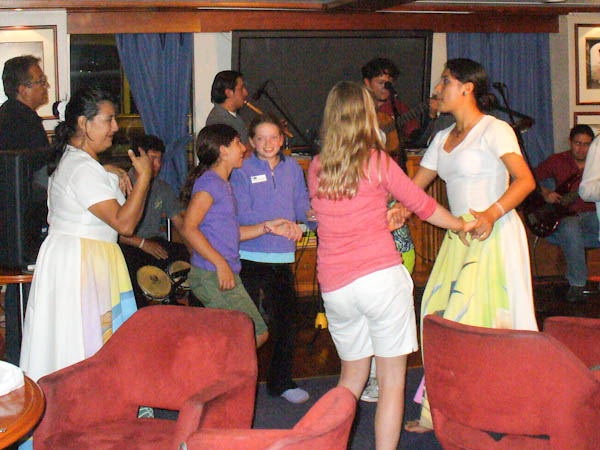
Local Music and Dancing
This is part of a series about our vacation to the Galápagos Islands. To see the first article in the series, click here.
August 10, 2010
Overnight, we had a rather long excursion to the north end of Isabela island, the largest of the Galapagos group. This took us north of the equator for the first trip. I left my GPS turned on and awoke in the night a couple of times to check our position, the first time awakening about 10′ south of the equator and the second time about 5′ north. I had wondered whether we would get anywhere near the 0° 91° W confluence point, but it turns out we passed about 10 miles west of there. Besides that, it was dark which made it difficult to document the confluence properly, as a previous night-time visit to that point revealed.
We were urged to be on the lookout for sea activity in the morning, and sure enough, we encountered a pod of the inappropriately-named common dolphins. Smaller than the bottlenose dolphins we saw yesterday, they are actually quite uncommon. The ship followed the dolphins for a while, and did about three full turns in the process.
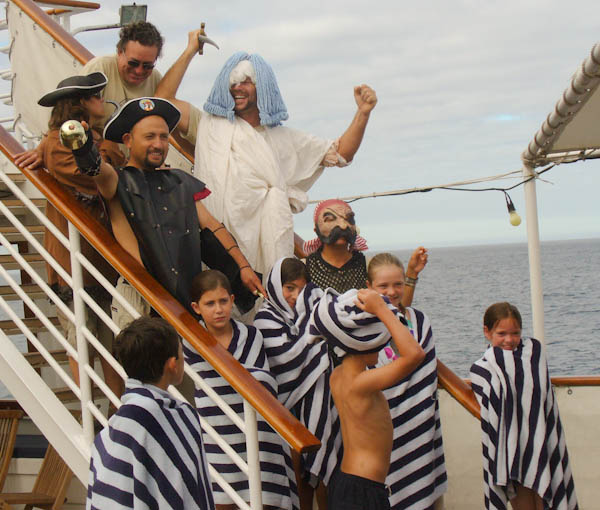
King Neptune and Friends Crossing the Equator
After breakfast we crossed the equator a second time and this time it was commemorated by a small ceremony at the swimming pool for the kids. Some of the crew dressed as pirates, many kids jumped into the swimming pool, and the kids were presented with Equator-crossing certificates signed by the Captain.
We anchored off Punta Vicente Roca on the northwest side of Isabela and everyone took Zodiac boat tours of the coast. There was a lot to see, including fur seals which are technically sea lions but look different from the common ones; these have a thicker coat and look like small brown bears, only with flippers, as they walk on the rocks. There were also a few turtles and sunfish, and glimpses of a couple of Galápagos penguins. There was an opportunity to go snorkeling later in the morning, but we opted to stay on the ship instead and were told that the water was a little murky.
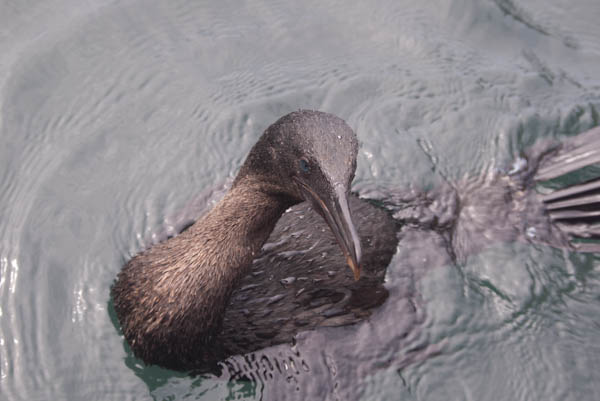
Flightless Cormorant
While we were looking at the scenery, one of the endemic flightless cormorants swam by our Zodiac boat. It seemed to be looking for nesting material, because it kept tugging at some of the ropes on the side of the boat, apparently hoping to pull something free. It was fun to watch, and of course gave us a great look at this unusual bird that has evolved to have only vestiges of wings that are not useful for flight.
Over lunch, the ship moved to Fernandina Island, a geologically recent island just west of Isabela. The area where we walked was mostly lava that had been deposited by an eruption of the volcano in the 1960s, and was very reminiscent of the recent lava flows near the Kilauea volcano on the big island of Hawaii.
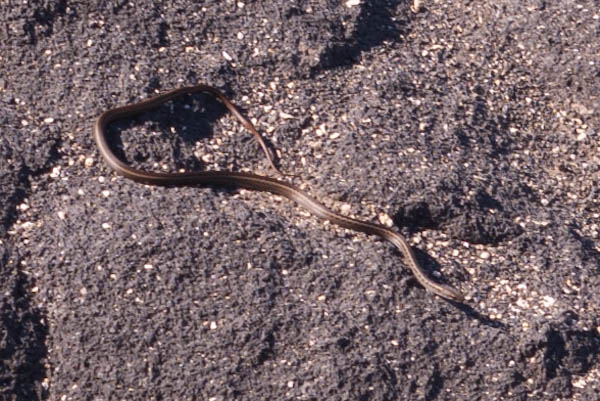
Galápagos snake
Soon after our arrival on Fernandina, someone spotted a small Galápagos snake. They are apparently constrictors (kill their food by squeezing), but this snake’s food must have been very small indeed, as the snake was only a foot or two long and about the diameter of a crayon. In an effort to get a better picture of the snake, I took a step without looking where I was going, and stepped into a crevasse. Fortunately I stepped cleanly into the crevasse, and only scratched my leg rather than doing more serious damage. Looking where you step is important in Galápagos because you might step on something living, and this was a good reminder to me.
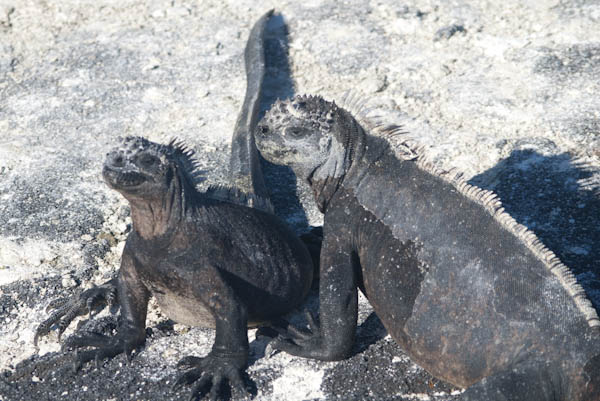
Marine Iguanas
The rest of our tour on Fernandina showed mostly what were now familiar creatures: marine iguanas, sea lions, and the very colorful crabs. One thing I hadn’t noticed before was the iguanas “spitting” salt water. This is done to such an extent that small creatures, such as a lava lizard we saw, sometimes have a distinct whitish cast from the dried salt.
Today is Kenna’s birthday, and since the information form we filled out for the cruise included information on birth dates, the dining room staff prepared a cake and small celebration for those seated at our table. I was able to arrange to have some friends we had met on the trip join us at our table, and it was a very nice way to celebrate the occasion. It was a special movie night for the kids, but Celeste came and joined us for the cake and celebration.
For more information on our day at Isabela and Fernandina Islands, you can also read the Daily Expedition Report from the Lindblad Expeditions website.

Sunset from Endeavour
This is part of a series about our vacation to the Galápagos Islands. To see the first article in the series, click here.
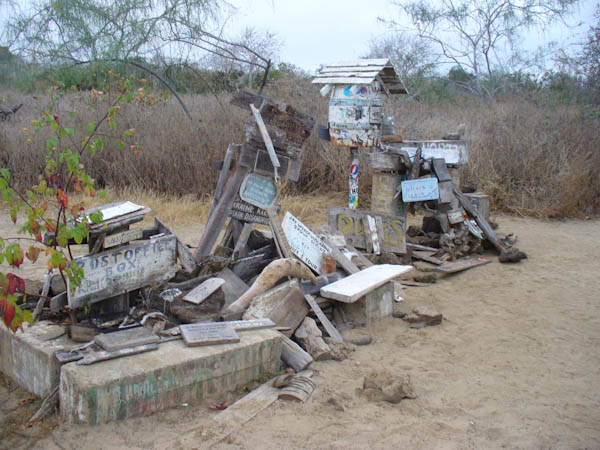
Post Office Cove
August 9, 2010
The day began with an early (6:30 am) Zodiac boat ride to Post Office Cove on Floreana Island. This was one of the more touristy aspects of the trip, a barrel established long ago as a place to leave mail and to pick up mail that you’re able to deliver. According to the tradition, you’re supposed to deliver whatever mail you pick up personally rather than by putting a stamp on it and putting it in a mailbox. Celeste mailed a postcard she had created yesterday in the kids’ program aboard the ship, and picked up a postcard for someone that lives within walking distance of our home, which we will deliver when we get back.
After breakfast, we went for our second snorkeling outing. Overall, this went a lot more smoothly than yesterday, the only hitch being that I managed to bite part of my snorkel mouthpiece off, which caused it to leak a bit more than it should. We took the more moderate option, which was considerably more scenic than yesterday, but we still haven’t seen any sea turtles and the only sea lions we saw were on the coastline nearby. There were only a couple, and if I were them, I’d be intimidated by all the snorkelers in the water together.
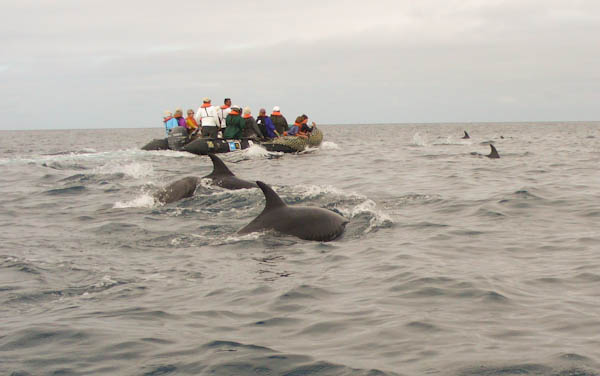
Dolphins near the Zodiacs
After another great lunch, we had a leisurely early afternoon during which Celeste participated in the daily “kids’ corner” activities where they do artwork or other crafts. Around mid-afternoon, we took a Zodiac boat to a different part of Floreana island. Initially, we wondered where the boat driver was taking us (not toward the island) but soon we found ourselves in the midst of a pod of bottlenose dolphins. They were jumping so close to the Zodiac that Celeste said that she felt that she could reach out and pet them.
We arrived a bit early to Floreana and had a half hour or so to explore the beach area where we landed. The sand was extremely fine, and Celeste and some of her friends had a great time burying heir feet and letting the surf wash over them. The sand was an interesting color of brown — more on that in a minute.
Our hike took us past a brackish pond where some flamingos are often found. Unfortunately, no flamingos today. The pond grows algae on which brine shrimp feed, the brine shrimp being the primary food of the flamingos, which gives them their distinctive pink color.
We continued along the path through an isthmus that separated an ancient volcanic cone from the main part of the island. We came down the hill to another beach with very different sand: still very fine but much yellowed in color. Our guide explained that the color of this sand came from coral and coralline algae just offshore that break up to form the sand. Behind this beach was a sandy area with a number of shrubs that are nesting places for a number of sea turtles. None of the turtles were in evidence, but their footprints definitely were. A lone frigate bird patrolled overhead, searching for newly-hatched baby turtles on the way to the ocean that it could make a meal of.

Adult Crab on Floreana
The beach was beautiful, but you wouldn’t want to swim there. Our guide pointed out a large number of sting rays in the shallow water, a very unpleasant surprise for anyone who might venture in. The shore had other attractions in the form of very colorful crabs (and drab, well camouflaged baby crabs) sitting on the rocks.

Peridot Crystals in Sand
Upon returning to the original beach, our guide told us more about the distinctive sand color there. Picking up some of the coarser grains of sand, she showed us that the greenish tint came from tiny crystals of the mineral peridot. Kenna was particularly charmed by this, having always had an affinity to peridot in part because it is her birthstone.
We returned to the ship, got cleaned up, and visited with some of the other guests before the daily “recap” meeting and dinner. We had dinner with three of the ship staff, including the doctor, who told us some fascinating stories about the history of the Endeavour and other ships in Galápagos service. After dinner there was a bedtime story about the history of Floreana emphasizing some early disappearances of people from the island.
For more information on our day at Floreana, you can also read the Daily Expedition Report from the Lindblad Expeditions website.
Postscript (August 22): This evening we walked over and delivered the postcard we picked up on Floreana to a surprised recipient a half-mile or so away from our home. He told us that a cousin of his had been to the Galápagos recently. It was apparently this cousin who had sent the card. The Floreana post office barrel works!
This is part of a series about our vacation to the Galápagos Islands. To see the first article in the series, click here.
August 8, 2010
After our first night on the ship (Celeste and I slept great; Kenna less so) we had breakfast and had a hike on the western end of Española Island. Española is in the southern part of the island group, and has its own unique species, most notably the Waved Albatross.

Sea Lion with 2 Day Old Pup
Right after getting off the Zodiac boat our guide noticed a sea lion placenta on the ground, and a few feet away was an approximately 2 day-old sea lion nursing from its mother. Near the shore there were also large numbers of marine iguanas; we had to watch our footing carefully in some areas to avoid them.

Waved Albatrosses
Walking inland a bit, we came into a nesting area of the Waved Albatross, a beautiful sea bird that lands virtually no place but here. We continued to a cliff on the south shore of the island and were able to see them skimming the water along with frigate birds and swallow-tailed gulls. The path was boulder-strewn but easily passable. Again returning to the shore, we re-entered the land of sea lions and marine iguanas and had to step carefully in many places to avoid both the animals and their poop.
After returning to the ship, we had more briefings on snorkel and kayak procedures and then were fitted for wet suits and snorkel gear. The wetsuits were a bit worn but we were able to find suits that fit well. After lunch, we had a little downtime and Celeste had a chance to meet some of the other girls her age on the ship. We then headed out snorkeling. Since we had all been snorkeling in deep water in Hawaii last year, we opted for the deep-water option that held the best likelihood of seeing more wildlife.
When I think of the equator, I usually think of hot weather. It was surprisingly cool today, in the upper 70s. Part of what’s causing that is that the ocean is unusually cool due to a cooling of the ocean known as La Niña. We definitely noticed the cool ocean while snorkeling. The thermometer on my watch indicated a water temperature of 67 degrees F. A bit of a shock when we first got into the water, but the wet suit did its job and we were quite comfortable soon.
The snorkeling outing was what I would describe as a practice outing. There were mostly small fish (anchovies, I think) but not a great deal to see. The cloudy weather also contributed to limited visibility. We all did fairly well, except for some minor equipment problems (mask leaks for Celeste and Kenna, and my snorkel leaked water and had to be cleared regularly). We had thought about going kayaking later in the afternoon, but opted to enjoy the comfortable library on the ship to do some needle work, read, and work on this journal.
After dinner, Kenna and I ventured out to see the night sky. It was a clear evening, and the stars were unbelievable. The bow of the ship was dark, making the Milky Way clearly visible, and although many of the constellations were unfamiliar this far south, the sheer number of stars was really amazing. We promised ourselves that we would return with Celeste and with Pocket Universe on either the iPad or iPhone to so some more detailed stargazing.
For more information on this day, you can also read the Daily Expedition Report from the Lindblad Expeditions website.
 Altmode