
This article is part of a series about our recent vacation in Alaska. To see the introductory article in the series, click here
The day started, as many have, cloudy with a threat of rain. We wanted to revisit the store at the Denali Visitor Center, so we opted to have breakfast there as well. The choices were limited, and delivery time for those who ordered a hot breakfast was very slow.
This was one of the longer drives of the trip. This part of the Parks Highway was very scenic, but we were plagued by slow-moving mega-RVs that were sometimes difficult to pass and most of which (particularly two with Arkansas plates) did not pull over when a line formed behind them. We stopped from time to time to look at things, even though it meant that we had to pass some of the same RVs a second time.
One of these stops was at a rather bizarre cross between a hardware store and a flea market called Wal-Mike’s in Trapper Creek. They sold Alaska license plates with just about anything you wanted on them. There were also a lot of references to Sarah Palin, things like old campaign signs that were for sale, but we decided not to ask about her. Picnic lunch was at a visitor center at the turnoff for the Talkeetna spur road. Although the visitor center was closed this time, the picnic tables were fine until it started to rain. We had off-and-on rain much of the day.
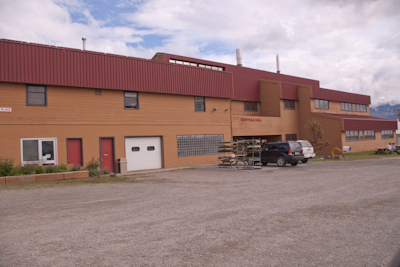
Matanuska Experiment Farm
After a quick drive through Wasilla (mostly harmless) we stopped at the University of Alaska’s Matanuska Experiment Farm just southeast of town. We explained that we were tourists and got a wonderful introduction and walking tour of the facility, led by the superintendent. The work they’re doing includes efforts to try to understand losses in the moose population, use of local grasses for hay to feed livestock, tests of various potato yields in local conditions, and extraction of synthetic oil from wood pulp. Unfortunately this facility and others like it are losing a lot of their funding because agricultural research doesn’t have the popularity of many other Federal programs.
Our lodging for the night is the Knik River Lodge, south of Palmer and about an hour’s drive from Anchorage. Despite its relative proximity to Anchorage, you would think we are out in the middle of nowhere: it’s very quiet and secluded. The rooms are individual cabins on a hillside overlooking the Knik River Valley. Dinner was very delicious and served in a large circular tent (a yurt). We were happy to reconnect with a group from the Netherlands that we had encountered in Kennecott earlier in the trip.
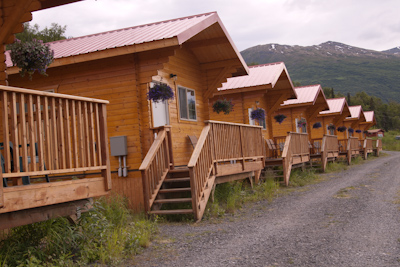
Knik River Lodge cabins
This article is part of a series about our recent vacation in Alaska. To see the introductory article in the series, click here.
We had booked an all-day (actually 14-hour) bus tour down most of the main road of Denali National Park. To minimize congestion and for preservation of the park, private vehicles are for the most part not permitted on the park road. Instead, there is a bus system for transporting visitors. In addition to the scheduled buses, there are tours operated by concessions under contract to the National Park Service. Our tour took us basically the entire length of Park Road, a distance of 92 miles each way.
Our bus driver/tour guide, Kevin, did an excellent job of describing the history of the park and of spotting and stopping the bus for many wildlife sightings. Among the animals we saw were moose, caribou, Dall sheep, grizzly bears, and golden eagles. But one of the most prized sightings was not of a living thing: the sky cleared just enough, at the right time, for us to see Mt. McKinley! We have talked with quite a few Alaska residents who haven’t had that opportunity yet.
At the midpoint of our trip, we stopped by Kantishna Roadhouse for lunch and some activities. We chose the dog sledding demonstration, where I learned that the predominant sled dogs aren’t huskies any more, but rather mixed breeds chosen for their temperament and physical characteristics. Irish setters, for example, lend their excitement to the team very favorably.
Returning to the start brought more animal sightings, particularly grizzly bears. After a light dinner at the hotel, we turned in early. 14 hours on dirt roads takes a lot out of a person.This article is part of a series about our recent vacation in Alaska. To see the introductory article in the series, click here.

Park on the Chena River in Fairbanks
Today’s drive is relatively short, so we took some time exploring downtown Fairbanks and attending to some grocery shopping and errands. While much of downtown Fairbanks isn’t all that attractive, the riverfront has been made into a very nice park with exhibits from Alaska’s 25th anniversary of statehood in 1984.
Proceeding down the Parks Highway toward Denali, we passed through the town of Nenana, which seemed like a good place for the day’s picnic lunch. The visitor center there was a real treat. We stopped because of the public picnic tables, but after a while the volunteer there came out to offer us coffee. When we went to talk with her and learn about the area, we found out about the Nenana Ice Classic, an annual contest to predict the date of the annual ice breakup on the Nenana River. She also had a wealth of information about the Denali area and onward.

Nenana Ice Classic "Tripod" for detecting ice breakup
Arrival at Denali greeted us like so many national parks, with a hyper-commercial business district just outside the entrance. Hotels, restaurants, souvenir shops, tour operators, and the like were well represented. The district definitely earns its nickname, Glitter Gulch. We found the way to our hotel, the Grande Denali Lodge, up a steep dirt road with switchbacks. The hotel seems very nice, again the type frequented by tour buses, and our rooms have a wonderful view (of the east end of the park and Glitter Gulch).
It was still mid-afternoon so we went to the park Visitor Center, viewed exhibits, and took a short hike. Yelp helped us find a reasonable place for dinner and then we retired. Tomorrow we need to be ready to be picked up at 6:00 am for our tour of Denali Park, so it’s going to be an early morning.
This article is part of a series about our recent vacation in Alaska. To see the introductory article in the series, click here.
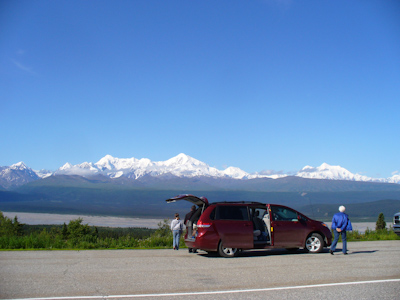 We awoke to a bright and sunny day. The Lodge at Black Rapids was situated on a west-facing hillside, and the morning sun gave an wonderful view of some of the Alaska Range. We had an excellent breakfast, and soon after departing for Fairbanks caught a glimpse of a cow moose with her calf by the side of the road. The road was flatter as we continued north out of the Alaska Range.
Continuing west past Delta Junction, we got a much better look at another cow moose and calf by the side of the road, calmly eating grass as if there wasn’t a road right next to them with cars speeding by. The road was excellent, with somewhat more traffic than we had become accustomed. It was also quite a bit hillier than I expected from the relief map I was looking at at the Lodge. The road cuts directly through Eielson AFB, paralleling the main runway, and several F-15 fighters landed just as we passed through. Quite a show!

Santa Claus House, North Pole, Alaska
With our “tourist trap shields up”, we stopped at Santa’s House in North Pole, Alaska. The entire town plays to the Christmas theme, with candy-cane streetlights and decorations displayed year-round. Santa’s House was unexpectedly nice: souvenirs, yes, but not junky ones; helpful staff, and Santa is most pleasant (yes, jolly!) and really enjoys talking to people. We were able to have our lunch at the picnic tables there before continuing to Fairbanks.
We are staying at Pike’s Waterfront Lodge on the west side of Fairbanks, near the airport. It is a generally comfortable upscale motel, the type frequented by tour groups. After checking in, we went to the Museum of the North on the University of Alaska at Fairbanks campus. The museum put a lot of Alaska history in perspective for us. It was organized in several sections each highlighting a different region of the state. I was particularly moved by the exhibit on the interment of the Japanese-American and Aleut people during the Second World War.
Although today is a few days past the Summer Solstice, Fairbanks is the most northerly point on our trip, so today is the longest day. Sunrise was at 3:02am; sunset is at 12:44 am (tomorrow!).
This article is part of a series about our recent vacation in Alaska. To see the introductory article in the series, click here.

Horsetail Falls, on the Richardson Highway
Today is mostly a driving day, about 220 miles up the Richardson Highway a little past the settlement of Paxson. The first half of the drive was road we had covered on the way to Valdez, but we took a little more time stopping at waterfalls, the Worthington Glacier, and similar scenic spots. We returned to the Wrangell-St. Elias National Park visitor center for our picnic lunch (and to buy a few souvenirs) and then got into some new territory when we passed Glennallen. The scenery from Glennallen to Paxson was unremarkable; mostly like the black spruce we had seen on the Parks Highway on Day 2.
The Richardson Highway parallels the Alaska Pipeline along much of this route, and we had a few opportunities to see it. It goes both above and below ground level, depending on the condition of the soil it’s passing through. In many areas, it has some very unusual heat radiators that extend above the pipeline to help maintain the ground at its natural temperature: melting the permafrost would probably cause the pipeline to sink.
Just past Paxson we started to enter the mountains of the Alaska Range, and the scenery quickly improved. There were again many scenic lakes and a few more glaciers. Very abruptly we came to our accommodations for the night, the Lodge at Black Rapids. Save for a couple of very low-key signs, we would have thought that we had arrived at a large house, rather than a bed-and-breakfast style inn. The Lodge is really in the middle of nowhere — it’s about 40 miles to the nearest restaurant, so it’s the only choice for meals. But our dinner was excellent: halibut, beautifully prepared. The Lodge is off the grid, currently operating off a generator but planning to use windmills at some point in the future. The view from the Lodge was spectacular.
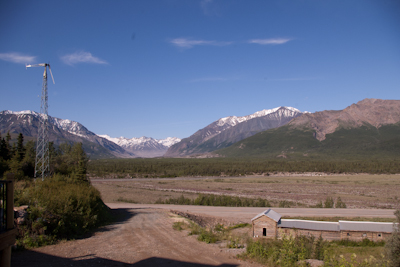
View from the Lodge at Black Rapids
This article is part of a series about our recent vacation in Alaska. To see the introductory article in the series, click here.
This morning, after breakfast at the hotel (more pipeline and/or fishing workers), we took an all-day glacier and wildlife cruise to the Mears Glacier. The Mears Glacier is located west of Valdez, emptying into Prince William Sound, and an excellent opportunity to see a glacier calving into the ocean. The weather forecast was for rain, but no sign of it yet.The trip to the glacier addressed our need to see wildlife in a big way. Almost immediately, we saw an immature bald eagle; later, we saw more bald eagles, a black bear, mountain goats, many sea otters, harbor seals, and some Sitka black tail deer. The boat, the Valdez Spirit, was modern and comfortable.
About halfway to the Mears Glacier, we passed the Columbia Glacier, which deposited zillions of little icebergs into the water. A bald eagle perched on one of them. Later, we encountered many sea otters, many with pups, in the water and on a few of the icebergs.The Mears Glacier is a very impressive wall of blue-white. There were icebergs in the water here too, but not nearly as many as near the Columbia Glacier. The boat stopped about a quarter-mile from the glacier and shut off its engine so that we could hear the glacier. As we drifted out, they restarted and moved in a couple of times. After seeing and hearing several smaller calves, a sizable chunk of the glacier broke off right in front of us. Very impressive:
On the way back, we took a somewhat different route that took us past a Steller’s sea lion “haul out area” (essentially a sea lion lounge), then stopped to view a group of humpback whales, then stopped again to view several orcas. Overall, we could not have asked to see more!
We went to a considerably more modest place for dinner, Old Town Burgers, which despite the name turns out to have excellent fish and chips (both salmon and halibut) and grilled salmon sandwiches, all prepared fresh. We were very happy to enjoy the local specialities. While walking back to the hotel, some noisy birds were flying overhead. We looked up: more bald eagles!
This article is part of a series about our recent vacation in Alaska. To see the introductory article in the series, click here.
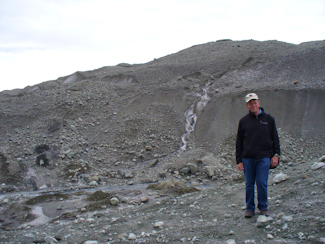
Standing on the Root Glacier
We awoke to a beautiful morning. Our flight out wasn’t until the afternoon, so we had breakfast, checked out of the hotel, and took the Root Glacier Trail to the tip of the Root Glacier, about 2 miles away. The trail started out as a tractor road but eventually narrowed to a well-maintained trail. The scenery was excellent, although we didn’t see any wildlife, perhaps due to the frequent hiker traffic. We crossed a couple of streams (with footbridges, fortunately) and then descended to the glacier and stepped over onto it. We were on the “dirty” portion of the glacier, which was a good thing because we didn’t have crampons and the grit provided at least modest traction. We were careful not to venture out too far, especially since one of the other guests at the Lodge had sprained his ankle very badly the day before.

Last view of the Kennicott and Root Glaciers
The return flight, on the same airplane but now with a pilot named Kelly, was smooth and with considerably more visibility than the trip to McCarthy, even though it was not as clear as it had been earlier in the day. We spent less time flightseeing on this flight, but there was still a great deal to see.
The drive to Valdez down the Richardson Highway, as many of the locals had said, was very scenic. As we approached the Chugach Mountains, we saw a dark shape beside the road, which turned out to be a moose — the first significant wild animal we have seen. The Chugach Mountains were also very impressive, as was the trip through the Thompson Pass, apparently one of the snowiest places in Alaska. There were many attractive waterfalls along the way, but we were anxious to get to Valdez and decided to stop on the return trip instead.
Valdez, the southern terminus of the Alaska Pipeline, was somewhat as expected. Many workers, both from the pipeline and the fishing industry, were in evidence, and the town (and the Best Western, where we stayed) had a mix of tourists and people who were there to work.
The restaurant we chose for dinner, supposedly one of the better ones in town, wasn’t particularly good. We will hope for a better restaurant tomorrow.
This article is part of a series about our recent vacation in Alaska. To see the introductory article in the series, click here.
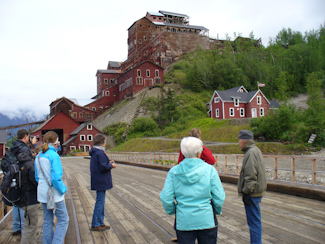
Kennecott Mill
It rained quite a bit last night, so I was glad not to be taking a hike first thing in the morning. Instead, following breakfast, we took a 2 1/2 hour tour of the Kennecott Mill, which described the crushing and separation of the copper ore from surrounding limestone. The mill building is 14 stories tall, built on the side of a hill, and is said to be the largest wood-frame building in the United States. The local copper mining and milling operation was a marvel of management, a huge investment but enormously profitable in its 27 years of operation. A chemical extraction plant was also built that used ammonia to dissolve the copper to separate it from the limestone. The concentrated ore was shipped to Tacoma, Washington for smelting and refinement.
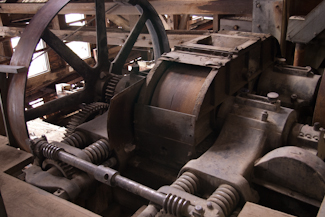
Machinery in Kennecott Mill
After the tour, we spent some time in the local craft shop, then had an excellent pizza lunch from a pizza shop housed in a bus. We then took the local shuttle bus to McCarthy, the other village in the area, about 4 miles to the south. While somewhat touristy due to the park, McCarthy has more of the feel of a local working community and a less developed feel than Kennecott.
McCarthy has a fine museum with many pictures and artifacts of the area during its heyday. In remote areas like this, departing residents often leave their things behind rather than have to transport them out, so the museum had a great source of things to put on display.
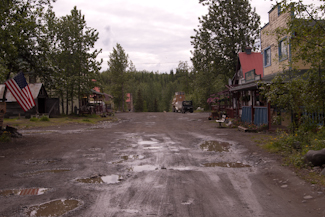
"Downtown" McCarthy, Alaska
McCarthy has more of the things that a minimal community needs to have: a general store, a fire department, a couple of places to eat, and of course a saloon. Having just had lunch while waiting for the shuttle bus, we weren’t ready for the recommended French fries at “The Potato”, but did enjoy an ice cream cone at the general store a little later. We wandered down to the river, skipped rocks, and finally walked the half mile to the footbridge connecting McCarthy with the highway to Chitina where we caught the shuttle back to Kennecott.
We’re starting to learn a bit about land ownership and private enterprise in Alaska. While the only public bridge connecting Kennecott and McCarthy with the outside world is the footbridge, I asked how the vehicles got there and learned that there in fact is a privately-owned vehicle bridge. The bridge is locked, and tolls are high: reportedly $1000 a year for a key or $250 for a single trip. Obviously the expense of building a bridge is high, so the high price may be warranted. This is also made more practical by the lack of real estate taxes (and the lack of public services). Many see the high price as a benefit, because it has effectively kept tour buses out of the area. This is reminiscent of the private toll roads that used to exist in the lower 48 many years ago.
This article is part of a series about our recent vacation in Alaska. To see the introductory article in the series, click here.
Our third day began on a relaxed note with breakfast at the Wilderness Lodge and a short hike around the grounds. We haven’t seen much in the way of wildlife, and are beginning to wish for a moose, bear, eagle, or something like that, but nothing yet.

Main Street, Chitina
We continued south on the Richardson Highway, stopping to admire a couple of the many lakes along the way. We turned east on the Edgerton Highway toward Chitina (pronounced chit-na). About five miles before town, we stopped at Chitina Airport, where we were scheduled for an afternoon flight to McCarthy, inside Wrangell-St. Elias National Park. There was a runway here and some parked cars, but no buildings except for a storage building. We were told by some people that the staff from Wrangell Mountain Air, our carrier, would arrive later.
Continuing into Chitina, we stopped at the end of the paved road. It’s also possible to drive (almost) to McCarthy, but it is a long gravel road that causes many flat tires. By “almost” I mean that the road ends across the river from McCarthy, with only a footbridge to get to town. We had our picnic lunch in Chitina, which wasn’t quite as pleasant as yesterday because it was quite windy. We also walked around the town a bit. The local “pay” phones don’t have a coin slot because local calls are free, but the local Wi-Fi service costs $8.95 a day so we didn’t try it out.
We returned to the airport and chatted with some of the dozen or so fellow travelers, speculating about what sort of plane would arrive to take the 20 or so of us to McCarthy. What did arrive was not a single plane but four, from Wrangell Mountain Air. The five in our party got our own plane, a Cessna piloted by a friendly and knowledgeable pilot named Ben. After loading the luggage into the back, we got in; I got the “co-pilot’s” seat, with a caution that the controls are live and that I shouldn’t step on the rudder pedals by mistake.

Arrival at McCarthy Airport
Before we knew it, we were airborne. The flight to McCarthy took about 30 minutes, and Ben was an excellent tour guide in addition to being an excellent pilot, pointing out many sights below and answering our questions. The weather for the flight was generally rainy, but we managed to stay below the clouds. We took a pass over the Kennicott and Root glaciers, and got great views of them, before landing at McCarthy Airport.
Soon after we arrived, a shuttle van arrived to take us to the Kennicott Glacier Lodge. We didn’t get to see the small village of McCarthy, but went north on a bumpy road (much bumpier than the flight) to Kennecott. Kennecott is the site of a copper mill that operated from about 1910 to 1938, now designated as a National Historic Site.
The Kennicott Glacier Lodge is a charming building with a long porch looking out over the glacier. It was originally built in the 1910s, then rebuilt in a similar style after a 1983 fire. The rooms were small but comfortable, with shared bath facilities, and artifacts (invoices and other paperwork from the Kennecott Copper Company, old magazine ads, and small implements) all over the walls.
Observant readers may notice that I have used two spellings: Kennecott and Kennicott. The glacier and valley (and the lodge, which is named after the glacier) are Kennicott, but the copper company and the town are Kennecott. The reasons for the spelling differences aren’t clear to me.
After arrival, we stopped at the National Park visitor’s center and took a tour through town, visiting several buildings, such as the power plant and the manager’s office, that were open to the public.
Dinners at the Lodge are prix fixe, served family-style, and somewhat pricy by normal standards but one has to remember that everything needs to be brought in a long distance. Tonight’s dinner was turkey with all the trimmings (except stuffing) and was excellent. After dinner one of the local guide firms gave a presentation on the tours available from them, ranging from the tour of the copper mill building to technical glacier climbs and mountaineering.
This article is part of a series about our recent vacation in Alaska. To see the introductory article in the series, click here.
We ventured back into downtown Anchorage for breakfast. We tried a restaurant that was well rated on Yelp only to find that it had a long wait, so we opted instead for a more modest but still excellent coffee shop. From our window seats, we could see preparations going on for some event on the streets. After breakfast, we asked one of the workers, who was very friendly and helpful. It turned out that they were setting up Anchorage’s Solstice Festival, which started about noon. Unfortunately, we had to be on our way before that.
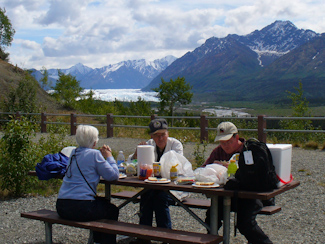
Picnic overlooking Matanuska Glacier
Our first day of travel was primarily east on the Glenn Highway to Glennallen, then south on the Richardson Highway a short distance to Copper Center. The road out of Anchorage was, unexpectedly, a six-lane freeway. We like to do picnic lunches on road trips like this, so on our way out of Anchorage, we stopped at a Wal-Mart for a cooler, food, and plates and such. Wal-Mart isn’t where we typically shop, but it was efficient.
The freeway ended where the Wasilla traffic split off. We stopped briefly at a visitor center in Palmer, the agricultural center of the region. The very long summer days permit the growth of record-sized vegetables, and we got some information on where those might be seen for later in the trip.
We continued east on the Glenn Highway to a state park area overlooking the Matanuska Glacier. It was a clean and quiet area with a couple of picnic tables with an excellent view of the glacier. After lunch, it got much busier when a tour bus and other visitors showed up, and we took a short hike on the 1-mile nature trail.
Continuing to the town of Glennallen, the roadside scenery became less attractive as it was dominated by black spruce trees, many of which were dead or dying. We learned that these trees are growing on a relatively thin layer of soil atop permafrost, which did not support them well, leading to “drunken trees” that look like they’re about to topple. Soon the Wrangell Mountains became visible in the distance, and provided new scenery.
Just after turning south on the Richardson Highway, we came to the headquarters and visitor center for Wrangell-St. Elias National Park. Prior to this trip, I was largely unaware of Wrangell-St. Elias, despite the fact that it is the nation’s largest national park, five times the size of Yellowstone. Large portions of the park are glaciated and wilderness, and it extends into Canada, becoming Kluane National Park there. We watched a short video and got some sightseeing tips from the rangers before continuing to our hotel. We are visiting the Park tomorrow.

View of Mt. Drum from Copper Center
We are staying overnight just outside the town of Copper Center at the Copper River Princess Wilderness Lodge. We got an idea of the extent of the wilderness here as we drove in, when we saw a couple out walking, talking on their respective cell phones. The Lodge is beautifully decorated in a wilderness theme, and was relatively new, having been built in 2002. It is operated by Princess Cruises, and a number of the other guests were visiting as part of a cruise package. In many respects it reminds me of one of the Disney hotels in terms of the style of decoration and the attention to detail. The Lodge has large windows and spectacular views of the Wrangell Mountains to the east.
 Altmode