
July 11, 2013

Hraunfossar
We enjoyed a good breakfast buffet at our hotel, then departed for Reykjavík. Along the way, we planned to stop at a couple of additional waterfalls. The first two were adjacent waterfalls, Hraunfossar and Barnafoss. Barnafoss is narrow and with a lot of water going over it, while Hraunfoss primarily channels water through the lava on the face of the cliff, reminding me of Burney Falls in California.
We stopped for lunch in Borgarnes, a town set on a small peninsula on the west coast. Edduveröld, a restaurant that had been recommended by the local tourist information office, was excellent and not touristy at all. We enjoyed hearing the other patrons speak Icelandic, rather than a variety of other languages, for a change.
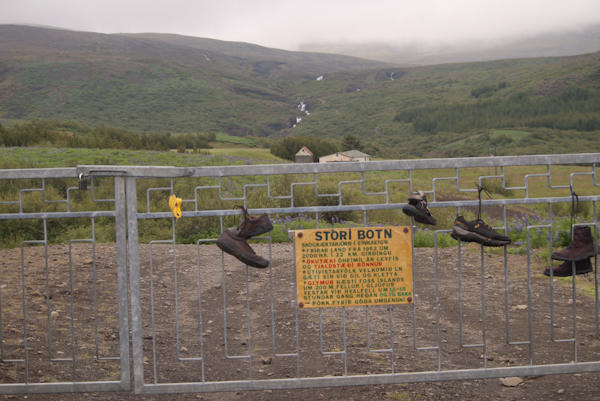
Glymur trailhead
After lunch, we set off down the next fjord toward Reykjavík, intending to hike to Glymur, which is the highest waterfall in Iceland. We had heard it is a bit of a hike and came prepared for that. Figuring that we could comfortably allocate 1 hour and still make the 6 pm deadline to turn in the rental car, we were discouraged by the sign said it was a 2 1/2 or 3 hour hike. So we gave up and continued to Reykjavík.
After checking into our hotel, we toured several of the local souvenir shops, but didn’t find much of interest. Since our lunch had been fairly big, we opted for a local favorite: the Bæjarins Beztu hot dog stand. Their hot dogs are said to be Iceland’s national food. The hot dog was very good – it came topped with sweet mustard, a mayonnaise-like cream, and on top of something crunchy (perhaps fried onions). We followed this with traditional Icelandic desserts: twisted donuts and pancakes (which are actually more like crèpes) at the Café Paris nearby.
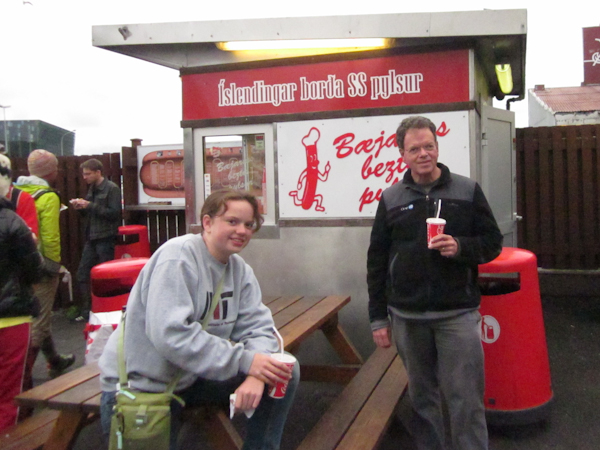
Celeste and Jim after finishing their hot dogs
This article is part of a series about our recent vacation in Iceland. To see the introductory article in the series, click here.
July 10, 2013
Today is primarily a driving day; we have quite a bit of distance to cover to get to the Snæfellsnes Peninsula north of Reykjavik. We set out promptly from Akureyri; the skies had clouded a bit but it was still good weather by Iceland standards.
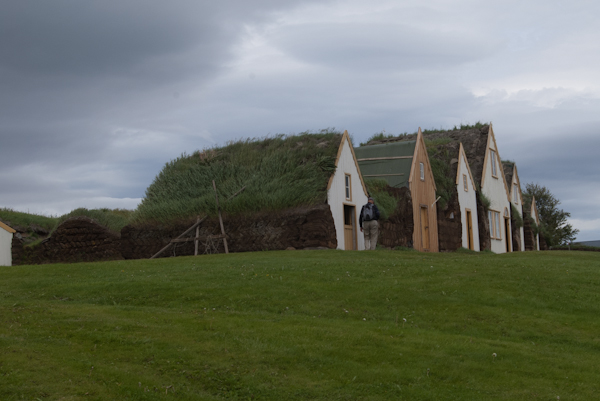
Turf-roofed buildings at Glaumbær
Along the way, we stopped at Glaumbær, a folk museum showing some of the early turf-roofed houses and community lifestyle in the 1800s. The houses were surprisingly cozy, and had many facilities for cooking, food storage, and the like. This is probably to be expected with an extended and harsh winter.
The rest of the drive had more traffic than we had seen in East Iceland, but it was definitely still light. The weather degraded, with rain much of the way later in the day. We arrived at our hotel late in the afternoon. The Hótel Búðir, located on the south side of the Snæfellsnes Peninsula, is a beautiful hotel constructed on lava fields “in the middle of nowhere”. We have a room high up with an excellent view of the ocean.

Snæfellsnes Glacier
We will have limited time to explore tomorrow, so we went for a drive out to the end of the peninsula. The first (southern) part of this drive was rainy and foggy and we almost turned around. But the northern side of the peninsula was shielded from the rain and was quite nice. We had dinner (delicious fish soup and dessert) at the Gamla Rif café. We had an excellent view of the Snæfellsnes Glacier, and the skies obliged by clearing so we could see it.

The attractive and ubiquitous sheep
This article is part of a series about our recent vacation in Iceland. To see the introductory article in the series, click here.
July 9, 2013
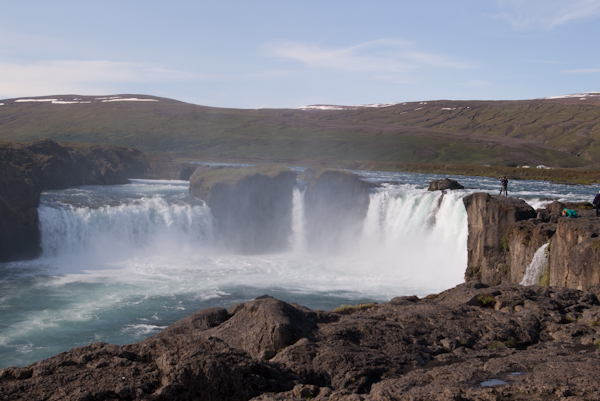
Goðafoss
We rose to a beautiful day. Leaving Húsavík, we traveled south and encountered yet another waterfall, Goðafoss. Goðafoss, or God’s Falls, is said to be the site where in AD 1000, the leader at the time, having declared the land to be Christian at the Alþing, threw all his pagan stuff in the falls. Very convenient to the road, Goðafoss is yet another falls with a very substantial amount of water flowing over it. It makes you wonder where an island like Iceland gets all that water.

On the Icelandic horses
From Goðafoss, we continued north to Pólar Hestar, a stables where we were booked for a 2-hour tour on those beautiful Icelandic horses. Our guide took the three of us initially at a walking pace, then at a trot, across some beautiful farmland. The trot was something none of us was used to; in the few times we have been riding in the US, all we get to do is walk. Along the way, Celeste fell off her horse; she got the wind knocked out of her and was a little bruised, but was able to continue. Our guide asked if we were interested in going faster (at a gallop), but we weren’t ready for that and took a shorter route to finish at the allotted time. But riding one of those magnificent horses was a wonderful experience, and the scenery was perfect.
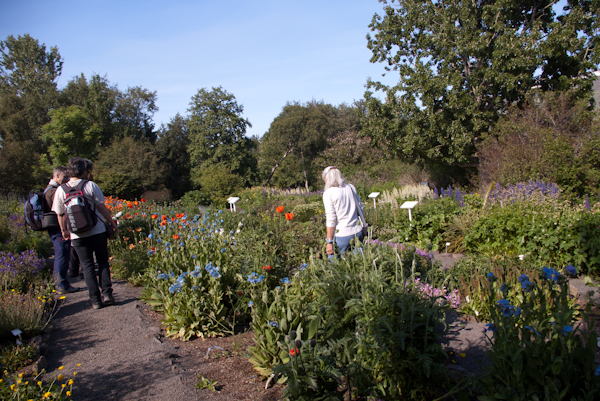
Botanical garden in Akureyri
From there, we continued to Akureyri, our stop for the night. It was early afternoon, so we checked in, grabbed lunch, and set out for the Akureyri church (designed by the same architect as Hallgrímskirkja church in Reykjavík), then to the botanical garden. Did I mention what a beautiful day it is? It seemed like much of Akureyri was out today, taking advantage of a sunny day in the high 60s.
Just downhill from the botanical garden is the Brynja ice cream shop, reputed to be among the best in Iceland. So of course we had to try it. As expected, there was a line out the door; what better weather to get ice cream? What surprised me is that it’s soft ice cream, not the sort we usually regard as premium ice cream. I tried the chocolate, which was good, but honestly I could have used a bit more chocolate in it. Kenna had vanilla and Celeste had strawberry. We all liked our ice cream but it wasn’t the best we had ever tasted.
We walked back to our hotel, and checked out the business district, visiting several souvenir stores. There were a lot of nice things, but much of it seemed too warm to get much use in California. The prices are rather high as well. This will probably not be a souvenir-heavy trip.
After relaxing at the hotel for a bit, we decided to go to Greifinn, a restaurant a little north of the city center, which gave us a reason to explore more of Akureyri. It was a nice “family” restaurant, happily devoid of the tour buses that have resulted in instant crowds many places we have gone. Much of the conversation around us was in Icelandic, which made us happy to be off the Tourist Track for a little while. The food was good, but not remarkable.
Returning to our hotel, we realized that Akureyri had traffic lights — something we hadn’t seen (although we never really missed them) since leaving Reykavik about a week earlier. Akureyri, the main city in North Iceland, was a bit of culture shock in several respects: traffic lights, vehicle noise (particularly motorcycles), and people talking loudly on the street as we went to sleep. I suspect we’ll need to get used to that again when we return to Reykjavík.
This article is part of a series about our recent vacation in Iceland. To see the introductory article in the series, click here.
July 8, 2013
Today was the mid-trip day where we stayed in the same hotel, the Húsavik Cape Hotel, for two nights, so we got laundry done (the hotel sent it out for us). The itinerary for today featured a trip to an ice cave near Lake Mývatn. We were advised to dress warmly.

Entrance to the ice cave
Mývatn translates as “midge lake”, and midges — annoying insects not unlike mosquitoes — were there in clouds. Accordingly, we waited inside at the information center in the town of Reykjahlíð for as long as possible to avoid the bugs. Anton, our guide from Saga Travel, met us in a 4 wheel-drive van with extra large tires, whose function would be evident shortly. We were fitted for studded boots, and set out for the cave. We soon went off the paved road onto a secondary road that got worse and worse. It became an incredibly bumpy ride; we were thrown all over the place, held in place only by our seat belts. After about 45 minutes of this we stopped, gathered our things (and endured more midge attacks), and did a 20 minute hike across a lava field to the entrance of the cave. We climbed down a ladder and changed into our studded boots.

Ice stalagmites
The cave opening is protected by a locked door to protect the delicate environment inside. We slid through a small opening to access the main chamber, which had many stalactites and stalagmites formed very slowly from dripping water; the cave stays at exactly the freezing point. The cave floor was solid ice, about 10 meters thick. There were a number of unusual and beautiful ice formations. One of these called “the chandelier” particularly impressed me: it was a section where there were hundreds of tiny droplet icicles hanging from the ceiling. I didn’t think that surface tension would allow water to do that.

The Chandelier
After our return hike and another bumpy ride back, we went to the nearby Nature Baths for lunch followed by our first experience with Iceland’s many public paths. Like the famous Blue Lagoon near Reykjavík, these baths draw from the output of a geothermal power plant. Locker room facilities were very nice. The water is an eerie bluish-white at about 97 degrees, and it has a very slippery feel. We spent about a half hour in the bath, then continued south along Lake Mývatn.
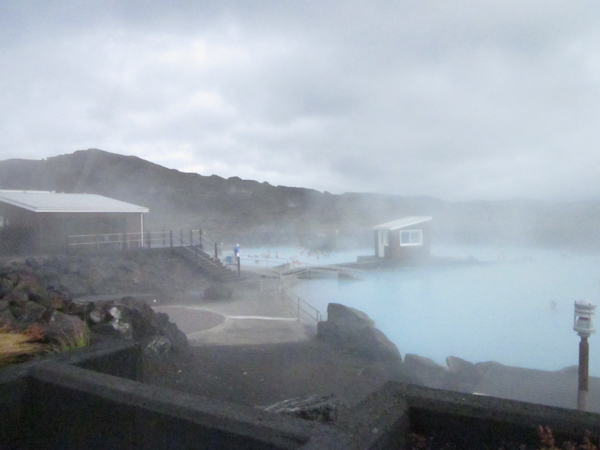
Mývatn Nature Baths
We stopped at a nearby park called Dimmuborgir, and took a short hike to some lava tubes that were fun to climb around. Then, ready for dinner, we went to the nearby Vogafjós Cafe, which was recommended by Anton. It’s a local cooperative of several farms and serves mostly locally-produced food. It had both excellent food and authentic farm surroundings.
This article is part of a series about our recent vacation in Iceland. To see the introductory article in the series, click here.
July 7, 2013

Dettifoss
Today was mostly a driving day along the northeast coast to the town of Húsavík in northern Iceland. Along the way, we stopped at Dettifoss, a waterfall known for the amount of water passing through, and its canyon that is sometimes described as “Iceland’s Grand Canyon”.
On the way there, we passed through a lot of desolate country, probably best described as resembling Nevada but of course much cooler. Some areas are devoid of vegetation, some have sparse vegetation, and some have a fair amount of grass and are used for sheep grazing. The one constant was the wind: for the last couple of days the wind has been consistently strong.

Dettifoss and canyon
After driving about 20 miles of dirt road, we turned off for Dettifoss and, with little warning, encountered a canyon with a substantial river running through. The sudden encounter of the canyon does remind one of the Grand Canyon, although Dettifoss is in a much smaller canyon. We walked around and took quite a few pictures, trying to keep the mist out of our cameras.
We continued up the dirt road a similar distance to another small canyon, Ásbyrgi, which was apparently formed from a catastrophic flood caused by a volcano a few thousand years ago. We did a bit of hiking in the best weather of the trip so far. We decided to defer lunch because of tour bus crowds (and the restaurant didn’t look that great, anyway).

Our whale watch boat
We continued to Húsavík via Route 85, the north coastal road. Along the way we reached the northernmost point of the trip, just beyond 66.2° north latitude, beating out Fairbanks, Alaska for the northernmost place any of us has been.
Húsavík is a pleasant fishing town with a significant tourist trade, primarily whale watching tours. After checking into our hotel and getting a late lunch, we joined a whale watching tour that we had been booked on. This was a smaller boat than whale tours we had been on previously, and there was basically no place to go but on deck. Accordingly, we were issued waterproof suits basically identical to those we wore for the Zodiac boat ride a few days ago. Fortunately we didn’t get as wet.

Blue Whale (back)
Initially, we saw a few different humpback whales, which we have seen many times previously. But our leader saw a much larger spout in the distance, so we went that direction and saw something new (for us) and relatively rare: a blue whale, the largest animal ever to live on Earth. We couldn’t see much other than (briefly) the whale’s back, but it was clear that this was a much larger whale than any we had seen before.
After the whale watch, we went to Naustið, a local fish restaurant recommended by our hotel, for a light dinner. I had their fish stew, which was spicy but very good. Kenna and Celeste shared rhubarb pie, which was even better.
This article is part of a series about our recent vacation in Iceland. To see the introductory article in the series, click here.
July 6, 2013
Typical East Iceland farm – with waterfall, of course
Today was a driving day, the first since leaving Reykjavík that we didn’t have a planned activity. Following a good buffet-style breakfast at our hotel, we traveled north on the Ring Road. We stopped briefly in the coast city of Höfn, then continued to Djúpivogur for a quick lunch. We had heard of a cafe with good cakes and coffee there, but instead found a casual restaurant with good fish and chips and sandwiches. We did find the cafe after lunch, but a tour bus was parked outside and the place was jammed.
Throughout East Iceland, we have been impressed with the relentless strong wind. It was very evident at our hotel this morning, and made driving a bit more challenging today. Do the locals get this all the time? One of the staff at our hotel this morning said it has blown so hard that the concrete came off the roads. Was she serious?
After lunch we encountered our first official fjord. The road is narrow and has a precipitous drop-off, so it requires careful driving (but still not as difficult as the Sonoma Coast in California). We also drove on a short section of the Ring Road that is still unpaved. Eventually we turned more inland, through a long tunnel toward Egilsstaðir, the commerce hub for the local area.
We had a quick snack before continuing to our accommodation for tonight, the Hotel Hallormsstaður. The hotel is located on the eastern shore of Lake Lagarfljót, a long narrow lake that is said to contain the Lagarfljótsormur, also known as the Iceland Worm Monster, roughly the Icelandic equivalent of the Loch Ness Monster. In any case, we didn’t see the creature.
Icelandic horses outside our cabin
The hotel is located in the largest forest in Iceland, a notable place because Iceland has relatively few trees. Our room is a small cabin set apart from the hotel, very cute but a little small for the three of us. Right in front is a horse rental operation with absolutely majestic Icelandic horses. I’m not particularly an admirer of horses, but these are something very special (as are most of the Icelandic horses I have seen).
We returned to Egilsstaðir for dinner at the Cafe Nielsen, since we were getting tired of hotel dinner buffets. All three of us had excellent dishes, and shared a bowl of their lobster bisque that came highly recommended in reviews we read. While the bisque was very good, I’m not sure it quite lived up to the reviews.
As I’m typing this, it is still very windy outside, and that can be heard here in the cabin. We hope this doesn’t keep us awake.
This article is part of a series about our recent vacation in Iceland. To see the introductory article in the series, click here.
July 5, 2013
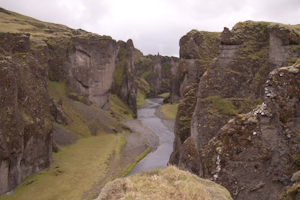
Fjaðrárgljúfur canyon
Following breakfast at our hotel, we backtracked a short distance on the Ring Road to the Fjaðrárgljúfur canyon, which had been recommended by the Iceland Unlimited people as one of the hidden treasures of Iceland. We went a few km up a narrow gravel road and came to a parking lot with a number of cars and vans. We walked up the trail a short distance, and found a beautiful narrow canyon that had been cut by a stream over the centuries. We took a few pictures and continued on.
We stopped in Kirkjubæjarklaustur for groceries (a picnic lunch) and it was time to fill the car’s gas tank for the first time. As with many of the local stations, this one was self-service, so we tried Kenna’s new chip-equipped Visa card. However, US credit cards aren’t issued PINs, so we weren’t able to use the card. We went inside, used the same credit card to buy a debit card with 10,000 Icelandic Krona (ISK) on it, and used that in the pump. We’ll keep trying to see if the chip in the new credit card is usable anywhere.

Svartifoss
We continued on to another waterfall, Svartifoss, for which we have heard multiple recommendations. Svartifoss is notable for the attractive basalt behind the falls, but it requires about a 1.4 km hike from the parking lot. We ate the lunch we purchased earlier (in the car, due to the weather) and quickly made the hike, in order to keep us on time for the tour we had booked later in the afternoon. It was, as promised, an extremely attractive waterfall, and well worth the trek.
This is probably a good time to talk about the Ring Road (Hringvegur) that circles Iceland. The Ring Road, Route 1, was completed only relatively recently, in 1974. Even now, most of the Ring Road is a single lane in each direction. Many bridges in more rural areas, like the portion we drove today, have single lane bridges, which is not generally a problem because traffic is very light. I haven’t run into a conflict yet, but I’m a bit concerned that I don’t fully understand the etiquette (protocol) for handling a simultaneous arrival with a car in the other direction.
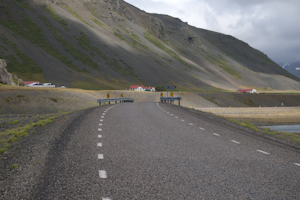
One-way bridge on Ring Road
Iceland undergoes geological change at a rate much faster than I have seen anywhere else. Volcanoes erupt every several years, in some cases causing flash floods of melted glacier water and icebergs. That was evident at one point where there was on display some twisted girders from a bridge that had been destroyed several years ago and had to be replaced. As a result, they have standardized their bridge span lengths so that spare parts can be ready when this happens in the future.
Much of the countryside we passed through today was desolate, although from time to time there would be a grassy farm area. It reminded me of portions of the Mojave Desert, although the area gets a great deal of rain (it rained considerably today, in fact). Portions were black lava, devoid of vegetation (reminiscent of parts of the Big Island of Hawaii), and portions had scant vegetation. We were going through one of the areas of scant vegetation, and came up over a hill, when…
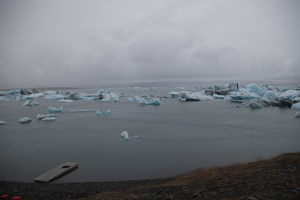
Jökulsárlón
ICEBERGS AHEAD!
In the middle of all this we came upon Jökulsárlón, a glacial lagoon filled with water and icebergs, that was our tour for the afternoon: a Zodiac Boat ride to the glacier.
It had gotten rather rainy, but we were issued “waterproof” suits to wear over our clothes as well as life vests. There were 10 of us, plus the guide, on our boat. We took 15 minutes or so to get close to the glacier’s face, then proceeded at a more leisurely pace back to our starting point, looking at many floating icebergs on the way.
The guide told us that the lagoon is quite recent: it started forming only about 100 years ago, and only connected to the ocean about 23 years ago. Since that time, the lagoon has become partially salty, accelerating the melting of the glacier face. He also mentioned that he hadn’t seen the glacier actually “calve” an iceberg, which surprised us because we had seen that happen on our trip to Alaska two years ago.
The rain increased during our boat ride, and despite the “waterproof” suits our clothes got quite wet. So we made our way directly to our night’s accommodations, the Hali Country Hotel. After changing into dry clothes, we had dinner at the hotel (which was fine, although there were not many other choices available anyway). After dinner, we toured their small museum honoring an Icelandic writer, Þórbergur Þórðarson, who grew up in that local area.
This article is part of a series about our recent vacation in Iceland. To see the introductory article in the series, click here.
July 4, 2013
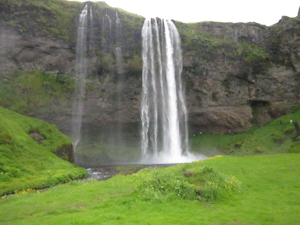
Seljalandsfoss
Today our planned activity was a glacier walk scheduled for noon. After a classic European-style breakfast, we stopped by two waterfalls, Seljalandsfoss and Skógafoss. Seljalandsfoss has enough space under it that there is a trail allowing one to walk behind the waterfall. It is a popular tourist stop; several tour buses were there but fortunately it was not too crowded. Skógafoss was a very high but more conventional waterfall with a trail and many steps allowing us to hike up to the top.
At 11:30 we arrived for our glacier walk. We were each fitted for a climbing belt (to be used in case we needed to be rescued), crampons, and a helmet. Five of us were on the tour: the three in our family, plus a couple from Minnesota. We were accompanied by our tour leader, Thomas, and his assistant.

On the glacier
The walk was fun and very informative. We learned a lot about how much the glacier has receded and how quickly it changes. Black conical formations on the glacier actually start as holes that fill up with dirt, which then protects the ice underneath from melting while all of the surrounding ice does melt, leaving a conical shape made of ice but covered in dirt. The glacier is very close to the Eyjafjallajökull volcano that disrupted air traffic with Europe in 2010. As a result, there is both glacial dirt (scraped from the canyon the glacier occupies) and ash on the glacier.
Thomas also gave us a sampling of the legends about this and other nearby glaciers and volcanoes. It was fun sorting out where the facts end and the legend begins. Overall, the glacier walk was a great experience, marred only by the intermittent rain.
Following a quick lunch at the cafe at the base of the glacier, we resumed our drive, over somewhat desolate terrain from old lava fields. We stopped briefly near Vík at a bird sanctuary, but it was interesting mostly from a geological point of view as it was raining and the birds seem to have taken cover.
We arrived a little earlier at our lodging this evening, the Hotel Laki just outside of Kirkjubæjarklaustur. This is a friendly family-run hotel, perhaps less luxurious than the previous nights’ lodgings but every bit as comfortable. We enjoyed sitting in their lounge before having a buffet-style dinner.
This article is part of a series about our recent vacation in Iceland. To see the introductory article in the series, click here.
July 3, 2013
Today is our first day “on the road”. We got up early to check out of the apartment, grab a quick breakfast from Subway, pick up the rental car, and get to Þingvellir National Park around 9 am for snorkeling at Silfra.
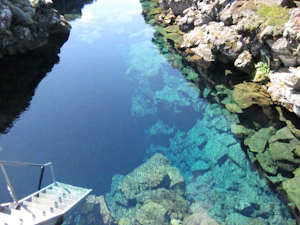
Entrance to Silfra
Snorkeling in Iceland? Isn’t it rather cold, do I hear you say? Yes, in fact, it is; Silfra ranges between 2 and 4 degrees Celsius all year. For this reason, we wore drysuits, provided by the diving company, dive.is. After an initial briefing, we got into our drysuits, a cap for our heads, and neoprene gloves for our hands.
Silfra is a deep crevasse between the North American and Eurasian tectonic plates. Unfortunately, a scuba group went through just before us, so there was more natural stuff floating in the water than I was led to expect. But the visibility is still unbelievable, and the blueness of the deep water is striking. Our drysuits and the layers underneath kept us plenty warm; only my hands were cold (and not all that cold, at that). The water was drinkably clean; a big difference from ocean snorkeling.
After the snorkeling, we explored around Þingvellir a bit. Þingvellir is the site of Lögberg (Law Rock), where the very first parliament, the Alþing, convened over 1000 years ago. The exact location of the rock isn’t certain, but since we know that they met next to a cliff so the speakers could easily be heard, we have a pretty good idea where it was.
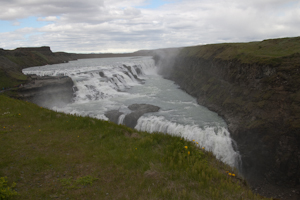
Top section of Gullfoss
From Þingvellir, we moved on to two attractions that complete the “Golden Circle”: Gullfoss and Geysir. I’m not sure where they got the term “golden circle” because there isn’t really a circle. Gullfoss, or “gold falls”, is notable for the volume of water passing over it. Not as much as Niagara Falls, but a very impressive amount nonetheless. It’s possible to get very close to Gullfoss, which adds to the experience.
Geysir is, as the name implies, a geyser, and is apparently the original geyser from which the name comes. There is actually a field of several geysers, which is a good thing because Geysir is largely dormant lately while one of the others, Strokkur, erupts regularly if briefly.
Our lodging for the night is the Hotel Rangá, a luxury resort near Hella. The hotel includes many amenities, including many hot tubs, a lounge with a billiards table and jigsaw puzzle, and a gourmet restaurant. We had a small, excellent dinner there.
This article is part of a series about our recent vacation in Iceland. To see the introductory article in the series, click here.
July 2, 2013
We woke to a beautiful day in Reykjavík. After wandering around the neighborhood and finding a good café for breakfast, we set out to continue our exploration of town.

Þór (Thor) or Christ statuette, National Museum
We first walked by the Alþingi (pronounced “althingie”), Iceland’s parliament. It’s a very clean, modern building connected to a much more traditional-looking building that fits in well into the surroundings. It has a very modest sign on the front; we almost missed it. Then we walked to City Hall, located at one end of the downtown lake. Inside City Hall there is a large relief model of Iceland, as well as a temporary exhibit on books. We then walked to the National Museum, a modern and well-displayed collection showing artifacts from circa 800 to 2000. They have incorporated multimedia nicely through interactive displays that complement the story told by the many items they have on display.
From the museum we took a bit of a walk to The Pearl, a restaurant located on top of the City’s geothermal water tanks. There was a well-maintained and well-used mixed-use (bike/walking) path the entire way; biking seems to be a popular mode of transit in Reykjavík.

The Pearl atop water tanks
The Pearl (Perlan) is situated in a mirrored glass dome atop six water tanks. There are actually two restaurants here: a cafeteria, with a moderately priced menu, and a high-end revolving restaurant on the top level that is open for dinner. We opted for the former. There is a great view of Reykjavík from the deck outside.
After lunch, we went to the Saga Museum, which is located in an unused one of the six water tanks. The museum had a good audio guide and dioramas of many events early in Iceland’s history, but was limited in its scope.
Dinner was at a fish-and-chips restaurant in the harbor area where we had excellent Icelandic cod. We are turning in early; we hit the road first thing tomorrow morning.
This article is part of a series about our recent vacation in Iceland. To see the introductory article in the series, click here.
 Altmode