
Friday, June 19, 2015
Last night we made the final decision to include a short trip to Berlin in our itinerary, so we’ll have a limited amount of time in Paris. We got a fairly good start today in an effort to get checked in at the hotel, return the rental car, and still have a significant amount of time to do some sightseeing.
The trip back to Paris was routine. We stopped by the hotel first to check in and leave our luggage so we could go sightseeing right after dropping off the rental car. There was the usual heavy traffic around Paris (I was driving this time) as we made the trip on city streets, first to fill the tank, and then to Gare du Nord station. But we made it, unscathed.
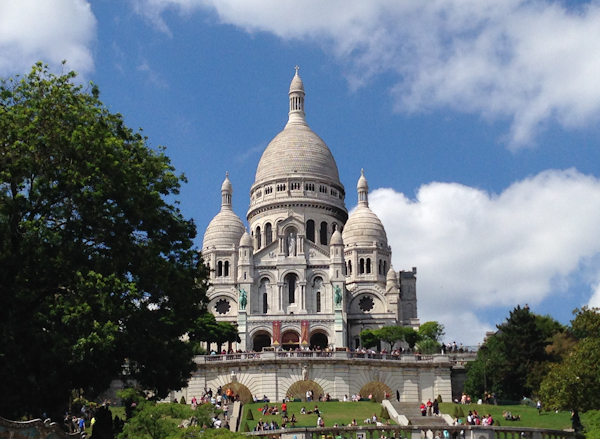
Sacre Coeur
After a quick lunch, we made our way to Sacré-Coeur, which none of us had visited previously. The way from the Métro station to the church was mega-touristy: souvenir shops and stands everywhere, lots of scams (“find the ball!”) and street vendors hawking selfie sticks, water, little models of the Eiffel Tower, you name it. When we got there, the church was very nice, but newer than we had realized. The view from Montmartre was wonderful though.
We went through the gauntlet of street vendors, scams, and such back to the Métro station, to go to L’Arc de Triomphe. It was very crowded and we pushed onto a train and others pushed in behind us. I quickly realized that my wallet wasn’t in my pocket; it was dangling from the lanyard to which I had clipped it. I looked and the Euros were gone, but everything else looked intact.
There was an urchin (boy) right behind me wearing a shoulder bag who was the obvious thief. I’ll call him Gauvroche, after the urchin in Les Misérables (I also understand that the French word for urchin is gauvroche). I grabbed Gauvroche by the wrist and pulled him around in front of me, largely to let him (and others nearby on the train) know that I knew he had done it. But of course he denied anything, and I realized that he had been careful not to take anything that was identifiable as mine. So I let him go, and some of the other passengers told him to get off at the next station, which he did. The other passengers nearby were friendly and sympathetic, and asked to make sure I was all right.
What I ended up with was a €150 lesson in pick pocketing. It could have been so much worse, especially in terms of inconvenience, if he had made off with my credit cards, driver’s license, ATM card, etc. I got off easy, but it still took most of the rest of the day to settle down. The lanyard probably gave him something to grab and told him which pocket to target, but without it my wallet would probably have been dropped or handed off to an accomplice, so who knows what would have happened there.
We walked under l’Étoile (huge line to go up in L’Arc de Triomphe, and that wasn’t a priority anyway) and headed for the Eiffel Tower. Again we were in a tourist zone with all sorts of street vendors, but fortunately they were less aggressive than at Sacre Coeur. At the Eiffel Tower there was, as usual, a significant line, and we determined that my Swiss Army Knife that I was carrying didn’t pass security, so we decided to do the Tower tomorrow.

Orsay Museum from the Seine
Next stop was to take a cruise on the Seine. We walked down a couple of bridges to the tour company recommended by a friend, and just missed one of their departures, so went for dinner and came back. The tour boat had a capacity of 1000 and was maybe about 60% full, largely with people from many tour buses. The ride, about 75 minutes long, was pleasant, but it was almost as much fun watching people take pictures and brandish selfie sticks. The recorded narration was in first in French, followed by English, German, Spanish, Mandarin, and Japanese; this limited the amount of information available in each language.
We returned to our hotel at dusk via the Métro, and it was evident what a marginal neighborhood our hotel was in. We hurried the few blocks back from the station. The hotel (Suite Novotel) itself is very nice, but apparently the neighborhood accounts for its low cost.
This article is part of a series about our recent vacation in Europe. To see the introductory article in the series, click here.
Thursday, June 18, 2015
Last night it rained, the first significant rain we have had on the trip. The weather has been amazingly good, although we were also hoping for some rain as a counterpoint to California’s drought. Getting rain in the night and having it let up in time to load luggage in the car is about as good as it gets.
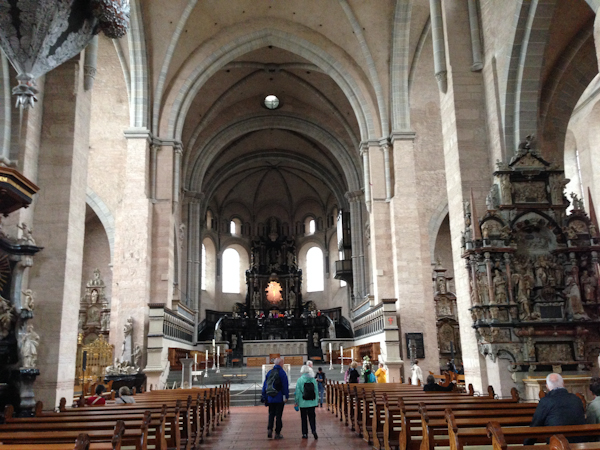
Interior of the cathedral at Trier
Leaving Bacharach, we were surprised to see both our car’s GPS and Google Maps lead us not back to the Rhine, but up a winding road in the hills. It turned out to have a few hairpin turns but wasn’t actually that bad. Following some lingering showers en route, our first stop was at Trier, the site of another prominent cathedral and basilica. It also had a prominent city gate known as the Black Gate that dates from Roman times.
From Trier, we drove to Luxembourg, the first visit to that country by Kenna and Celeste and the first since high school for me. As expected, Luxembourg City had all the trappings of a business center: lots of modern buildings, a convention center, and business people in suits. We walked around a bit, got some lunch, and continued back into France to Metz.
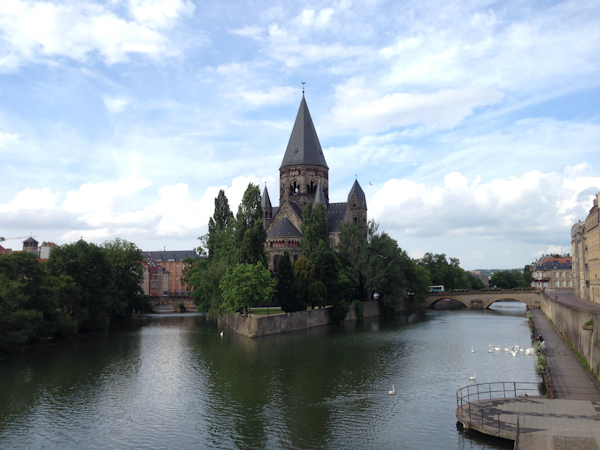
The Moselle River at Metz
Kenna and I had visited Metz, the capital of the Lorraine region, in the late 90s and loved it. It is situated along the picturesque Moselle River, has an attractive city center, and few tourists. Oh yes, there’s a great cathedral there, too.
For once, we arrived early enough to explore the city before dinner. We walked through much of the downtown, visited the cathedral, and checked out quite a few potential options for dinner. We settled on La Cloche, a typical small restaurant near the cathedral with a local menu and a very friendly owner. Kenna and Celeste had pasta dishes and I had a Lorraine plate consisting of local sausage and ham, potatoes, and salad. It was a very enjoyable dinner.
This article is part of a series about our recent vacation in Europe. To see the introductory article in the series, click here.
Wednesday, June 17, 2015
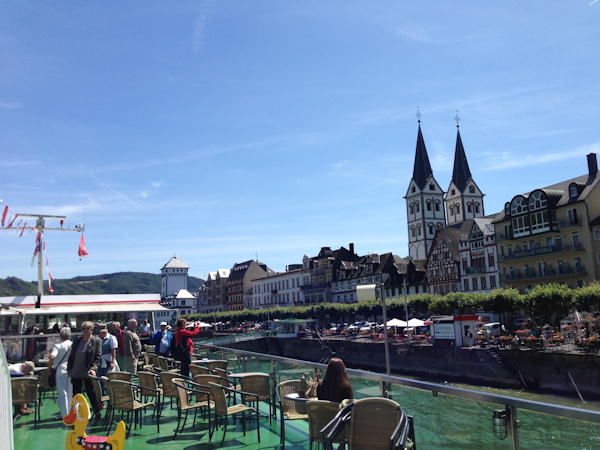
Cruising down the Rhine
We have been looking forward to a day without the car, so we walked the mile or so into Bacharach from our hotel. There we boarded a river tour boat for a cruise to Boppard, about 1 1/2 hours north, passing through one of the most scenic stretches of the Rhine. The weather couldn’t have been better. We passed several of the long-haul river cruise ships, with their staterooms and huge picture windows, as we went. Most of the people got off our boat about halfway at St. Goar; it appeared that many of these were part of groups from tour buses.
When we got to Boppard, we made our way quickly to the train station to head back south. We bought our tickets, helped a Scottish couple who were having trouble buying theirs — and got on the wrong train, one heading north. Ugh. So we got off at the first train station, Spay, a pleasant village where there isn’t anything to do but watch the river flow by. We bought a return ticket to Boppard, waited most of an hour for the next train, and continued to St. Goar. Not the best use of an hour and a few euros in train fare, but not a disaster either.
St. Goar is another touristy village, dominated by the Burg (castle) Rheinfels. We walked up to the castle from the town, paid admission, and took a convoluted tour of the various fortifications and facilities of this medieval castle. Lots of stairs! Celeste particularly enjoyed exploring all the hidden rooms. Bring your flashlight if you go there, or use the flashlight on your phone as we did.
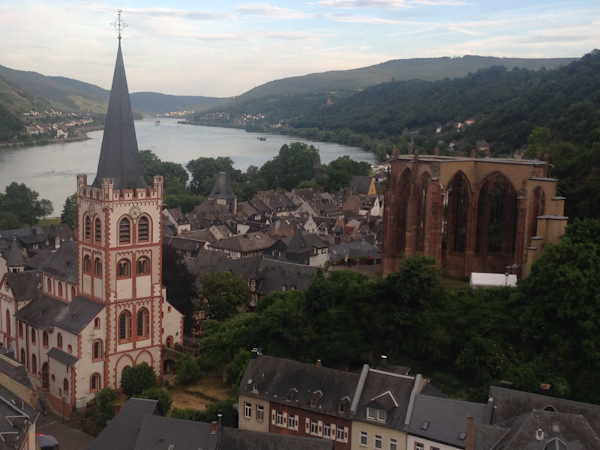
View from city wall of Bacharach and up the Rhine
We made our way back to Bacharach on the train (the right one, this time) and explored the town. We decided on a brewpub that was very pleasant except that the German atmosphere was shattered by a nearby table of loud Texans. Not surprising in a tourist town.
After dinner we walked one of the old City walls and a trail that took us up to the local castle that is now used as a youth hostel. We climbed up a lookout over the Rhine and city before returning to the hotel after a very full day.
This article is part of a series about our recent vacation in Europe. To see the introductory article in the series, click here.
Tuesday, June 16, 2015
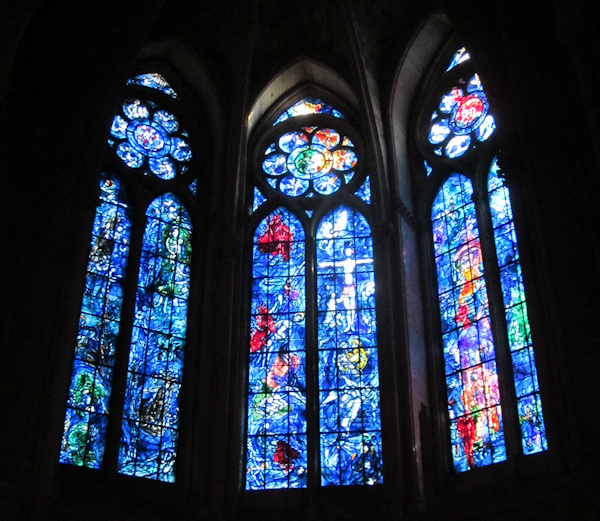
Marc Chagall windows in Reims Cathedral
We began our day by driving into Reims and visiting the cathedral there. Reims is notable as the place where French Kings were crowned for several hundred years until the end of the monarchy. Extensively damaged in World War I, it was rebuilt but fortunately fared better in World War II. It includes several sections of more contemporary stained glass windows including a notable set created by Marc Chagall.
Schorbach is a small village in Lorraine that some of Kenna’s ancestors come from. She and I had been there before and we wanted to show it to Celeste. Just a few miles from the German border, Schorbach is notable for its 12th century ossuaire (bone house) into which the bones of the deceased were moved when the cemetery filled up. There is also a prominent church with a cemetery showing the large number of townspeople sharing the names of Kenna’s ancestors. Although the ossuaire and church were heavily damaged in World War II, the rest of the village was completely destroyed.

Ossuaire (bone house) in Schorbach, France
We briefly drove through Bitche, the nearest small city, which has a very prominent fortress on a hill. From what I have read, it hadn’t been breached until the 20th century, and from its construction it’s obvious why.
Driving north from Schorbach, we quickly entered Germany. On the way to the Rhine Valley, we encountered an exit we had planned to take that was closed, as was the next exit. Then there was a traffic jam. Eventually we discovered that the cause was an overturned truck that had to be brought upright by a crane. Of course, Kenna had to drive this traffic jam as well.
When we arrived in Bacharach, we drove to our hotel, which was about 1.5 km out of town. After checking in, we walked to a nearby restaurant from which we got an authentic, but very heavy, German dinner.
This article is part of a series about our recent vacation in Europe. To see the introductory article in the series, click here.
Monday, June 15, 2015
It’s time, alas, to leave our comfortable lodgings in Bayeux and head to our next destinations east of Paris. Along the way, we planned a stop a Monet’s home and gardens at Giverny.
After driving the freeway most of the way back to Paris, we got another sample of France’s back roads. Arriving at Giverny, we found a large tourist village with many tour buses, including several school groups (which makes sense).

Monet’s Garden, Giverny
The gardens are amazing. Monet created the garden to use as a subject for his paintings, and that tradition continues to great effect. There were extensive and lush gardens near the house, and further away (through a pedestrian underpass) was the water lily pond with Japanese-style bridges and, again, more lush flowers, trees, and other foliage. This is not the sort of garden you would want to maintain during California’s current water shortage!
We also walked through Monet’s house and saw how the furnishings, pictures on the wall, and even the colors of the furnishings were all planned to provide inspiration to Monet’s work.
After leaving Giverny, our route passed close to Paris. We took the péripherique (ring road) around the city, and found ourselves in gridlock rush hour traffic. We spent a lot of time at a dead stop, particularly annoying in the long tunnels along the route. Kenna was driving at the time, and her left leg was really tired from pushing the clutch. I don’t know if this traffic is typical, but it’s really bad. The connection to the A4, the main freeway going east, requires exiting onto city streets and going through a traffic light or two, and probably accounted for a lot of the congestion.

Kenna and Celeste at entrance to Disneyland Paris
We were, of course, running late by the time we cleared the Paris traffic and were getting hungry. That, combined with a little curiosity, led us to Disneyland Paris for dinner, where we ate at the Planet Hollywood restaurant at Disney village. The meal was as expected, but it was fun to see the entrance to Disneyland and how it is presented in French.
We continued to Reims, where we found a convenient hotel close to the freeway. The room is quite small for the three of us, but it is clean and comfortable enough.
This article is part of a series about our recent vacation in Europe. To see the introductory article in the series, click here.
Sunday, June 14, 2015
After breakfast, we set out for the D-Day beaches that are the focus of many visitors to Bayeux. A short drive took us to Arromanches, the site of a harbor set up as part of Operation Overlord, one of the engineering marvels of the effort. We walked around the town and climbed up to the cliff overlooking the beach, which was the British landing site Gold beach.

American Cemetery, Colleville-sur-mer
We then drove over to Omaha Beach in the American sector. The American cemetery in Colleville-sur-mer is free, and has an excellent museum describing the history of D-Day. After exiting you can walk to the War Memorial and the cemetery itself, which were just as moving as one would expect.
We stopped for lunch, first at a convenient but slow restaurant that seemed to take its location for granted. After waiting to be served in a reasonable time, we left and used Yelp to find a nearby family-run restaurant that had excellent galettes: whole wheat pancakes with ham, cheese, and perhaps egg filling them. A very enjoyable lunch.
Returning to Bayeux, we headed for the cathedral. We were offered a guided tour, and after asking for English we were guided by a bilingual woman who was just learning the tour in English, and her mentor. We had a delightful time hearing about the cathedral from her, and helping her discover the words for things she was unsure of. In the process we heard that there would be an organ and choral concert at 6 pm, and resolved to return for that.
Our next stop (after the obligatory ice cream break) was the Tapestry of Bayeux, a 70-meter long embroidery giving the history of the Norman conquest. The story is quite a bit different from what we heard on the English side of the channel, particularly as it told of Harold promising the throne to William in return for rescuing him from another group that had held him hostage. The invasion was characterized as William just collecting on that promise that Harold had broken. The tapestry was used to tell the story of the invasion to generations of people who (mostly) couldn’t read or write. Well-planned audio guides narrated the story for us as we walked, slowly, the length of the tapestry.
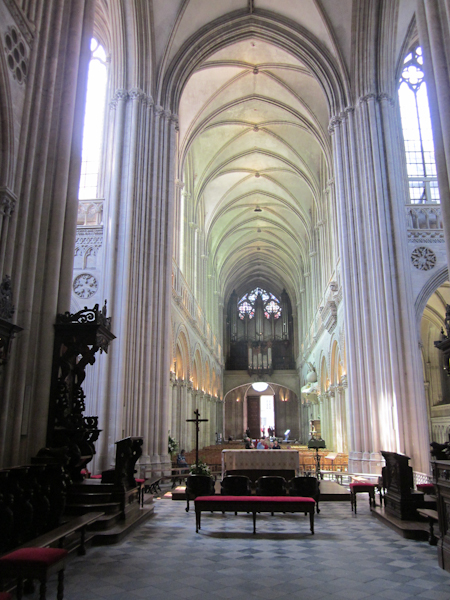
Interior of Bayeux Cathedral
We then returned to the cathedral for the concert. A 9-member choral group sang the first half, and was joined by the cathedral’s impressive organ for the second half, which included a heavy solo piece in B minor (ré minor) that showed off the organ’s capabilities well. The quality of the performance, acoustics, and general surroundings made this an enjoyable concert, although maybe a little less for Celeste.
Being a Sunday, a lot of things are closed in France, including the restaurant that we had planned on for dinner. So we returned to the Reine Mathilde where we had dinner on our first evening in Bayeux for another enjoyable meal.
This article is part of a series about our recent vacation in Europe. To see the introductory article in the series, click here.
Saturday, June 13, 2015
Nearing the midpoint of our trip, it’s time to do laundry. We found a laundromat downtown and took care of that chore.

L’Aure passing through Bayeux
While the laundry was washing, we got a better look at Bayeux. It’s a bigger city than it first appeared last night, but still a very pleasant size. It’s also more tourist-focused than was immediately apparent, largely due to proximity to the D-Day beaches. Still, the tourist focus is well managed, low-key, and doesn’t completely ruin the character of the town as so often happens. The city center is dominated by a huge, attractive cathedral, which we will definitely explore. We walked down the primary shopping street and found a wide variety of small shops, then discovered a “farmers market” a block or so off the street which had a wonderful selection of produce, meats, cheeses, seafood, and some prepared food (particularly paella) as well as clothing and other things. It was the sort of market that you picture when you think of France.
One of the advantages of having a flexible itinerary as we have is the ability to extend the stay at places that are really nice. I inquired and we arranged to stay three rather than the planned two nights in Bayeux, both because the hotel is so nice and because there is so much to do and see.
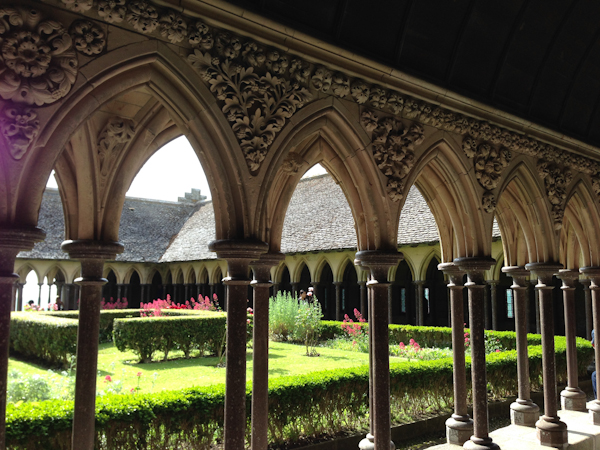
Cloister and garden at the Mont Saint Michel abbey
After a quick lunch, we headed off to Mont Saint Michel, about a 1 1/2 hour drive. The car came with a navigation system, and we decided to use it; it sent us down some farm roads and we began to wonder if we were lost, but we were fine. In the process, we got to see the rural life of Normandy. The only hassle with the navigation system was when it tried to route us down a bicycle path as we approached Mont Saint Michel. Later we concluded it was a recently decommissioned street.
Mont Saint Michel is a medieval monastery built on an island (with a land bridge at low tide) just off the coast. Today it is connected by a bridge used mostly by shuttle buses; they’re removing a causeway that had caused the bay to silt up. We parked and took one of the shuttles to the island.
The abbey is in the center, at the top of a steep hill. We walked past many tourist shops and up many steps to get there. The tour takes visitors through much of the abbey, which like many others was built (and rebuilt) over several centuries in a mixture of Roman and Gothic architectural styles. Different rooms held chapels, rooms for the monks to do their work, and a cloister adjoining a small garden. It was a marvel of engineering as well, with impossibly tall stone walls towering over us. We were very fortunate to have small crowds (probably because we were there very late in the day) and clear weather to look out.

Mont Saint Michel
The return trip was uneventful but we returned rather late. There were still a few restaurants open, and we got some pizza before retiring back to our room.
This article is part of a series about our recent vacation in Europe. To see the introductory article in the series, click here.
Friday, June 12, 2015
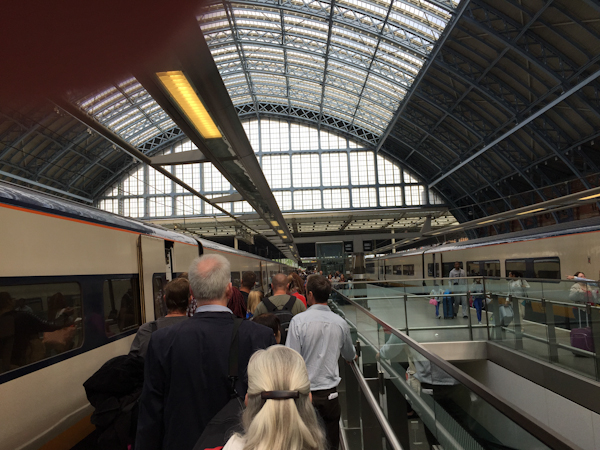
Leaving St. Pancras International
We got a good start today and headed for the Tube. I was a little dubious about trying to get on the Tube with our luggage during rush hour, but after letting one crowded train pass we got on just fine. Arriving at St. Pancras International Station, a gleaming new facility that contrasts with the original building, we needed to collect the tickets that we had ordered online. I went to a ticket counter that said “international”, and tried to get tickets from the machine, but it wanted a collection reference number I didn’t have. So I waited in line for an agent, who told me I was at the wrong place. Ugh. Down the hall we went, and got checked in quickly. Of course, we also had the usual international formalities: security and passport control. We made it through about 5 minutes before the train was called.
The trip was uneventful. We hadn’t booked the trip very far in advance, so I had to sit separately from Kenna and Celeste. I turned on my GPS, and it recorded a maximum speed of 190 miles per hour across the French countryside. Still, we ended up being 20 minutes late into Paris Gare du Nord, even though we didn’t notice any delays enroute.

Entrance to Domaine de Bayeux
After a quick lunch at a snack bar in the station, we picked up our rental car at Hertz and started our drive to Normandy. Traffic leaving Paris was slow as one might expect on a Friday afternoon. We made our way to Bayeux, our base for the next couple of days, and found the hotel quickly. Our room at the Domaine de Bayeux is amazing! It’s a roomy, recently renovated suite with a loft up a circular stair that delighted Celeste.
Even though we got in late, the restaurants are open later. We had dinner at the Reine Mathilde restaurant which was very pleasant and a nice introduction to French cuisine.
This article is part of a series about our recent vacation in Europe. To see the introductory article in the series, click here.
Thursday, June 11, 2015
On this, our last day of sightseeing in London, we got an earlier start. We went straight to the Tower of London, and started with the Crown Jewels, which are less crowded early in the day. I decided that I’m far too practical to be a monarch; all that elaborate and expensive stuff (e.g., the Royal Orbs), to be used for ceremonial purposes once in a lifetime seems like a colossal waste. But I guess the point is to impress other countries, and apparently it works.

The White Tower
We then took the 45-minute tour of the Tower, led by the Ravenmaster, Chris Skaife. He gave an excellent and humorous introduction to the history of the Tower, and we learned that we can even follow him (and the Ravens) on Twitter at @ravenmaster1.
Following the tour, we walked through the White Tower, the building in the center of the fortress, which houses an extensive collection of suits of armor. Apparently there has been an exhibit there for a hundreds of years, to impress visitors with British strength.

GPS reading on the Greenwich Meridian
After lunch, we took the light rail out to Greenwich to the observatory. I had visited Royal Greenwich Observatory with my family while I was in high school. It was much as I remembered it, except that there seemed to be a lot more tourists, including school groups from various countries. It’s a good thing that tourists have so much interest in an attraction such as this.
Having used my GPS to check the location of the equator a few years ago, I of course brought it to check and see if it agreed with the indicated Greenwich Meridian at the observatory. As it happens, it was off by a little bit (about .001 degree, or 290 feet). The audio guide anticipated my question and explained that GPS units use an approximation for the ellipticity of the earth. That makes sense, but I’d like to understand the details sometime.

John Harrison’s masterpiece: the H4
A highlight of the visit to the observatory was the display of John Harrison’s original clocks, H1 through H4, that Kenna and I had read about in the book Longitude. They were crucial to improving navigational safety and accuracy in the 17th century. The clocks are works of art as much as of engineering. They took many years to complete, and H4, the final model, was revolutionary in introducing refinements like bimetallic strips for temperature compensation.
While at the observatory, we also went to a short planetarium show. Although the show was good (the standard “tonight’s sky” sort of thing), comfortable seats in a dark room meant we had trouble staying awake.
We went back to town to walk around the Cutty Sark, see a bit of Greenwich, and look for a good dinner place. Being our last dinner in England, we wanted local food. One of the guidebooks suggested the Trafalgar Tavern, which was as it said: quite good, but a little overpriced.
We considered taking a boat back to London, but it was getting late so we took the more conventional route of light rail and tube back to our hotel to pack for our onward trip.
This article is part of a series about our recent vacation in Europe. To see the introductory article in the series, click here.
Wednesday, June 10, 2015

Westminster Abbey
Our second day in London started a little late as we lingered in the breakfast room while making onward train, hotel, and rental car reservations for France. We made our way back to Parliament Square and back to Westminster Abbey. I decided that it wasn’t worth the £20 fee for me to visit again, so Kenna and Celeste went in while I explored outside and worked on the blog using my phone.
Next we walked over to the Cabinet War Rooms, the underground command post from which Churchill and his staff directed the British forces in World War II. The rooms are well preserved and the audio guides that were provided described things thoroughly. There is also a museum describing Winston Churchill’s life before, during, and after the War.
After a late lunch at a disappointing American-style restaurant, we went over to the British Museum. We of course started with a visit to the Rosetta Stone, then ventured upstairs to explore one of Celeste’s interests, medieval Europe. Kenna pointed out an exhibit about clocks which interested me, but then, all of a sudden, they started closing doors and ushering everyone out. It took us a couple of minutes to reunite with Celeste, who was in a different gallery at the time the doors closed. It turns out that we had misunderstood the signs and the galleries closed at 5:30 instead of 6 pm.
From there we decided to walk toward Oxford Circus and thence to Piccadilly Circus along Regent Street. Along the way we found a very good bookstore, which was one of our priorities. For dinner, Yelp directed us toward an interesting-looking restaurant in Soho, which turned out to be full, and many nearby restaurants had people spilling onto the streets (as well as there being virtually no kids or teenagers in sight). We wandered around Piccadilly Circus in search of a restaurant that wasn’t too expensive or repetitive, bypassing TGI Fridays and Planet Hollywood because of our experience at lunch. We finally settled on a Pizza Express, local pizza chain that had good thin-crust pizzas.

Buckingham Palace at twilight
We still hadn’t been near Buckingham Palace, so we decided to walk down to St. James’s Park and discovered a performance going on in the Horse Guards Parade ground. I asked what was going on, and one of the police officers said it was preparation for the Queen’s Birthday celebration this Saturday, and suggested a place to get a better look. We didn’t get very close, but it was fun to see the smartly-uniformed guards marching and playing music. As we left, there were several loud cannon blasts; we were glad we knew what it was so we wouldn’t be wondering about explosions somewhere. We continued to Buckingham Palace, which we viewed in the twilight, and on to Victoria Station for the short tube ride back to the hotel.
This article is part of a series about our recent vacation in Europe. To see the introductory article in the series, click here.
 Altmode